


War Fade Fuels Melt-Up
The dominant driver of markets this week was not just geopolitics, but the change in trajectory of those headlines. What began as a high-risk escalation between the U.S. and Iran quickly transitioned into a narrative of containment, and ultimately, de-escalation. That shift—particularly through the lens of oil—triggered one of the strongest two-week rallies in recent years.
At the start of the week, markets were on edge. President Donald Trump’s announcement of a blockade of Iranian ports, coupled with failed ceasefire negotiations over the weekend, sent oil prices surging above $100 per barrel and equity futures sharply lower. Yet, that early weakness was short-lived. As reports surfaced of potential renewed negotiations—including a possible in-person meeting between U.S. and Iranian officials—equities reversed course aggressively.
By Tuesday, the tone had shifted decisively. Oil prices collapsed nearly 8% in a single session, settling near $91 per barrel, as the market grew confident that supply disruptions would be temporary. This decline in energy prices acted as a release valve for inflation fears and interest rate expectations, unleashing broad-based equity buying. Growth stocks led the charge, with NVIDIA (NVDA), Amazon (AMZN), and Meta Platforms (META) all posting strong gains amid renewed risk appetite.
The momentum accelerated midweek. The S&P 500 broke to new all-time highs, driven largely by mega-cap leadership. Microsoft (MSFT) surged alongside software names like ServiceNow (NOW) and Datadog (DDOG), as investors rotated back into high-growth segments. Even as some semiconductor names lagged following cautious guidance from ASML (ASML), the broader trend remained intact.
The decisive catalyst came Friday. Iran’s announcement that the Strait of Hormuz would reopen to commercial traffic during the ceasefire triggered a sharp collapse in oil prices—down more than 10% to roughly $81 per barrel mid-day. This single development ignited a surge across cyclical sectors. Airlines like United Airlines (UAL) jumped nearly 9% mid-day, while cruise operators such as Royal Caribbean (RCL) posted double-digit gains.
The result was a powerful risk-on move that extended a two-week rally, with major indices not only recovering losses tied to the Iran conflict but pushing into record territory. Importantly, the market’s ability to look past peak geopolitical risk—and instead price in resolution—was the defining feature of the week.
Investment Implication: Markets are increasingly trading on the direction of geopolitical risk rather than the absolute level, meaning inflection points in oil and conflict narratives can drive outsized moves across equities, rates, and inflation expectations.
Earnings Strength Meets Selective Scrutiny
As the geopolitical backdrop improved, first-quarter earnings season began to take center stage—and early results confirmed a key theme: fundamentals remain strong, but the bar for upside is high.
According to FactSet (FDS) data, S&P 500 earnings are expected to grow 12.6% year-over-year, marking a sixth consecutive quarter of double-digit growth, with the potential to reach 19% as the season progresses. This backdrop provided a fundamental anchor for the rally, even as macro uncertainty persisted.
The financial sector offered one of the clearest signals of underlying strength. Goldman Sachs (GS) delivered better-than-expected results, driven by strong investment banking and record equities trading revenues, though the stock sold off on “sell-the-news” dynamics after a strong pre-earnings run. Morgan Stanley (MS) also impressed, posting strong trading and wealth management results, while Citigroup (C) stood out with upside net interest income guidance.
However, not all banks participated. Wells Fargo (WFC) declined sharply after missing revenue expectations, highlighting a growing dispersion within financials.
Technology and AI-related names continued to dominate the narrative. Taiwan Semiconductor Manufacturing Company (TSM) reported a 58% jump in profits, reinforcing the strength of AI-driven demand, even as it guided slightly lower on near-term revenues. Meanwhile, Broadcom (AVGO) rallied after expanding its partnership with Meta to support AI infrastructure, signaling continued capital spending momentum.
In consumer and industrial segments, results were mixed but instructive. PepsiCo delivered a strong quarter with a return to volume growth in North America, while Abbott Laboratories (ABT) declined despite beating estimates due to weak forward guidance. Similarly, Netflix (NFLX) dropped nearly 10% after disappointing Q2 guidance, underscoring the market’s intolerance for forward-looking weakness.
Corporate activity also added to the narrative. Reports of a potential merger between United Airlines and American Airlines (AAL) drove both stocks higher, while Charles Schwab (SCHW) fell sharply after announcing a disruptive crypto platform, highlighting how strategic pivots can impact sentiment.
The market is placing a premium on companies with clear, durable growth visibility while penalizing any indication of margin compression or weakening demand. The emphasis now shifts to forward guidance, as investors look beyond the Q1 energy-driven volatility and focus on how management teams are adapting to these conditions going forward.
Investment Implication: Earnings season is confirming a more selective market where valuations alone aren’t enough—stocks are reacting to forward guidance, capital allocation, and exposure to durable themes like AI. A key focus remains hyperscaler spending: investors want to see clear returns on that investment, or a shift toward discipline. Notably, many AI infrastructure names saw negative reactions during the Q4 2025 earnings season, underscoring this concern.
Data Holds the Line
While geopolitics and earnings dominated headlines, the economic backdrop played a critical supporting role—particularly in shaping interest rate expectations.
Inflation data provided one of the most important signals of the week. March Producer Price Index (PPI) came in well below expectations, with headline PPI at 0.5% versus 1.2% expected and core PPI at just 0.1%. This suggested that, outside of energy-driven spikes—particularly gasoline prices, which surged 15.7%—underlying inflation pressures remain contained.
This dynamic allowed markets to partially “look through” the oil shock, reinforcing the idea that inflation tied to geopolitical disruptions may be transitory rather than structural.
At the same time, labor market data remained firm. Weekly initial jobless claims declined to 207,000, continuing to signal a resilient employment environment. This strength is critical, as it supports consumer spending and reduces the risk of a demand-driven slowdown.
However, not all data points were constructive. Housing remained a clear weak spot, with existing home sales declining 3.6% month-over-month to a 3.98 million annual rate. The report cited higher mortgage rates, elevated prices, and limited inventory as ongoing constraints. Similarly, the NAHB Housing Market Index fell to 34, reflecting continued builder pessimism.
Industrial data also showed softness, with March industrial production declining 0.5%. While this was offset by upward revisions to prior months, it still points to uneven momentum in the manufacturing sector.
On the positive side, regional manufacturing surveys surprised to the upside. The Philadelphia Fed Index surged to 26.7, well above expectations, indicating pockets of strength despite broader industrial headwinds.
Taken together, the data paints a picture of an economy that is slowing in interest-rate-sensitive sectors but remains resilient overall—particularly in labor and services.
Investment Implication: The economic backdrop is keeping rate expectations in focus, particularly around whether the Federal Reserve delivers one or two cuts this year. With inflation data showing signs of containment—especially outside of energy—markets have room to price in an additional cut if that trend persists. At the same time, resilience in the labor market helps support this outlook by limiting downside risks to growth while giving the Fed flexibility in its policy path.
Chart of the Week
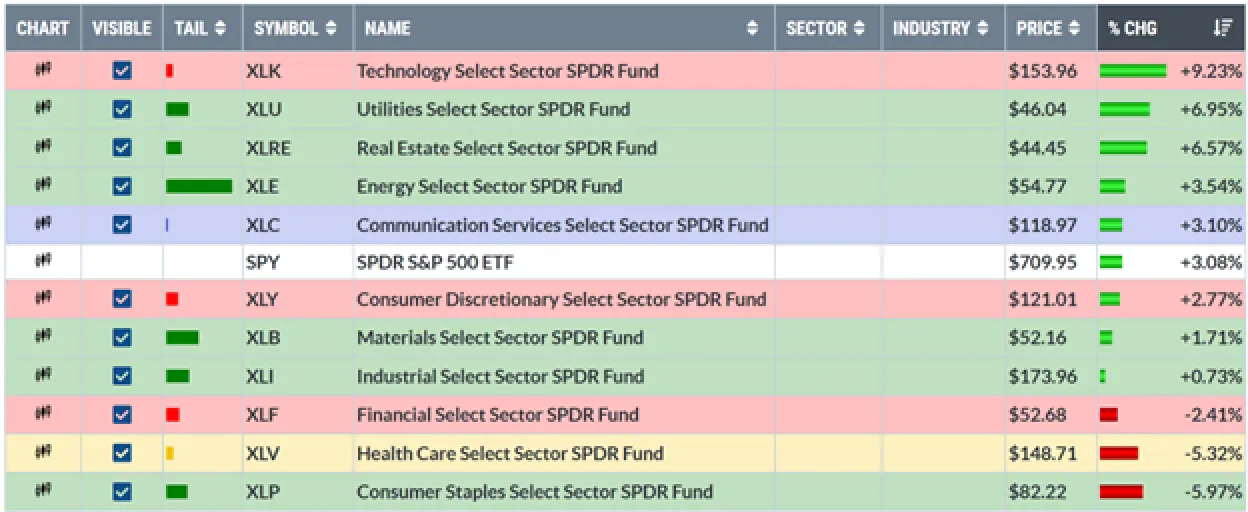
This week, we examine sector performance during the market’s recovery over the past 10 trading days. Leadership has clearly come from technology, as investors appear less concerned that elevated energy prices will materially compress margins in the sector compared to more cost-sensitive areas like consumer discretionary. At the same time, the ongoing buildout of AI infrastructure continues to provide a durable, long-term growth narrative that is attracting capital.
Relative to the S&P 500, leadership has been concentrated in Technology, Utilities, Real Estate, Energy, and Communication Services. Consumer Discretionary has modestly lagged, while Materials, Industrials, Financials, Health Care, and Consumer Staples have either underperformed or posted outright declines over the same 10-day period.
Bottom Line
This week’s market action was defined by a powerful interplay between geopolitics, earnings, and macro data. The de-escalation of the Iran conflict and resulting collapse in oil prices unlocked a surge in risk appetite, while early earnings results confirmed that corporate fundamentals remain intact but increasingly differentiated. Meanwhile, economic data continues to thread the needle between resilience and moderation.
The key shift is that markets are no longer reacting to absolute risks, but to changes in those risks. That transition—from escalation to stabilization—is what powered equities to new highs and will likely remain the dominant force shaping price action in the weeks ahead as investors turn towards earnings results from geopolitics.



Comments
Log in or sign up to join the conversation.