


Earnings Raise the Bar
FactSet released its recent earnings season summary on Friday. Second-quarter earnings season has been exceptionally strong at the index level. As of July 24, 27% of S&P 500 companies had reported results, with 86% delivering positive earnings surprises and 80% exceeding revenue estimates, according to FactSet. FactSet stated the blended year-over-year earnings growth rate (estimates are blended with actual results as they come) reached 37.9%, up sharply from the 23.2% growth rate expected at the end of June. If that figure holds, it would represent the strongest quarterly earnings growth since the third quarter of 2021. The S&P 500’s forward price-to-earnings ratio, however, stood at 20.1 according to FactSet, above its five-year average of 19.9 and 10-year average of 19.0, leaving less room for disappointing guidance or questionable capital allocation.
Alphabet (GOOGL) provided the clearest example of the market’s higher hurdle. Revenue increased 24% from a year ago to $119.8 billion, exceeding the $116.9 billion expected by analysts. Google Cloud revenue surged 82% to $24.8 billion, demonstrating that artificial-intelligence demand is translating into substantial business growth. Those results were overshadowed by Alphabet’s decision to raise its 2026 capital-spending forecast to between $195 billion and $205 billion, an increase of $15 billion from its previous range. Capital expenditures reached nearly $45 billion during the quarter, contributing to negative free cash flow of $5.9 billion. Alphabet shares fell 6.9% Thursday as investors questioned how quickly the company could convert its accelerating AI spending into sustainable cash returns.
Tesla (TSLA) faced an even harsher reaction. Revenue increased 26% to $28.2 billion, supported by 480,126 vehicle deliveries and 13.5 gigawatt-hours of energy-storage deployments. Adjusted earnings of $0.33 per share, however, fell short of the approximately $0.51 expected by analysts. Tesla also reported negative free cash flow of $1.1 billion as quarterly capital expenditures climbed to $5.8 billion. Management maintained its expectation that 2026 capital spending will exceed $25 billion as the company invests in artificial intelligence, robotaxis, battery capacity, robotics, and next-generation manufacturing. Tesla shares declined 14.5% Thursday and continued lower Friday.
Other earnings reports produced sharply different outcomes. 3M (MMM) reported adjusted earnings of $2.40 per share, up 11%, and raised its full-year adjusted earnings forecast from $8.50–$8.70 to $8.80–$8.95. Its shares gained 7.3% Tuesday. Lockheed Martin (LMT) rose 10.5% after raising its sales and profit outlook, while United Rentals (URI) and Thermo Fisher (TMO) also rallied after well-received results. Intel (INTC) initially jumped after forecasting third-quarter revenue of $15.8 billion to $16.8 billion, well above the $15.1 billion analyst estimate, but investors later focused on the company’s decision to raise 2026 capital spending from $18 billion to $20 billion.
Investment Implication: While evidence of the AI buildout is showing revenue results for the Mag-7, investors continue to punish any news of increased capital spending.
Oil Reignites Inflation Fears
Oil became the week’s second major market catalyst. WTI crude settled at $82.59 per barrel Monday, rose to $84.99 Tuesday and $86.85 Wednesday, and then surged another 6% Thursday to $92.09. Brent crude briefly reached $102 per barrel, compared with approximately $72 at the beginning of July. WTI pulled back below $90 Friday as reports suggested that Pakistan, Iran, and China were exploring a possible path toward renewed negotiations with the United States, but prices remained considerably above their early-month levels.
The rally reflected growing concern about Middle East supply disruptions. U.S.-Iran tensions escalated during the week, while Houthi attacks and threats against commercial shipping raised fears about traffic through the Red Sea, the Bab el-Mandeb Strait, and the Strait of Hormuz. Oil’s rise above $100 prompted investors to reconsider the inflation outlook just as recent consumer and producer price data had offered some relief. Reuters reported that oil was approximately 40% higher than a year earlier by Thursday, creating a renewed cost shock for transportation, manufacturing, chemicals, consumer products, and other energy-intensive industries.
The pressure was already appearing in corporate earnings discussions. 3M estimated that higher oil-related costs could reduce 2026 profit by $150 million to $175 million, although the company expects price increases to offset that impact. For businesses with less pricing power, rising energy and freight costs may be harder to pass through without affecting demand or margins. Consumers also face higher gasoline and utility costs, which can divert spending away from discretionary purchases.
Investment Implication: Persistently elevated oil prices would likely widen the earnings gap between companies capable of passing through higher costs and those facing margin compression or weaker consumer demand.
Rates and the Dollar Tighten the Screws
The oil shock quickly spread into the bond and currency markets. The 10-year Treasury yield reached 4.71%, its highest level since January 2025, as investors priced in the possibility that higher energy costs could force the Federal Reserve to tighten policy further. Fed funds futures were pricing approximately two additional quarter-point rate increases by year-end, while the implied probability of a rate increase at the next Federal Reserve meeting rose to 35.8% from 12.8% one week earlier.
Higher yields created a direct valuation headwind for stocks. When Treasury rates rise, investors apply a higher discount rate to future corporate cash flows, reducing the present value of long-duration growth companies whose expected profits are weighted toward future years. Higher borrowing costs can also restrain corporate investment, housing activity, vehicle purchases, and other credit-sensitive areas. The effect was visible during the week in homebuilders, Carvana (CVNA), DoorDash (DASH), software companies, and mega-cap technology stocks. Conversely, real estate stocks rebounded Friday when Treasury yields eased, with Digital Realty (DLR) gaining more than 13% following its earnings report.
The U.S. dollar added another layer of pressure. The Dollar Index gained nearly 0.7% for the week to approximately 101.4, its strongest weekly advance in five weeks. The dollar reached 163.98 against the Japanese yen Thursday, its strongest level since November 1986. Higher U.S. yields and the relative insulation of the American economy from imported-energy shocks supported demand for the currency.
A stronger dollar can reduce the translated value of overseas revenue for U.S. multinational companies and make American exports more expensive in foreign markets. It can also pressure commodities and emerging-market assets, particularly where borrowers have dollar-denominated liabilities. Combined with higher bond yields, the dollar’s advance represented a meaningful tightening of financial conditions even without an immediate change in the federal funds rate.
Investment Implication: Rising yields and a stronger dollar increase valuation pressure on long-duration growth stocks while creating additional earnings and financing challenges for rate-sensitive companies and businesses with substantial international exposure.
Chart of the Week
While the S&P 500 has essentially been in a running correction since May (sideways), more and more stocks continue to improve their trend and participation in the bull market with 67.6% of the S&P 500 components trading above their respective 200-day moving average.
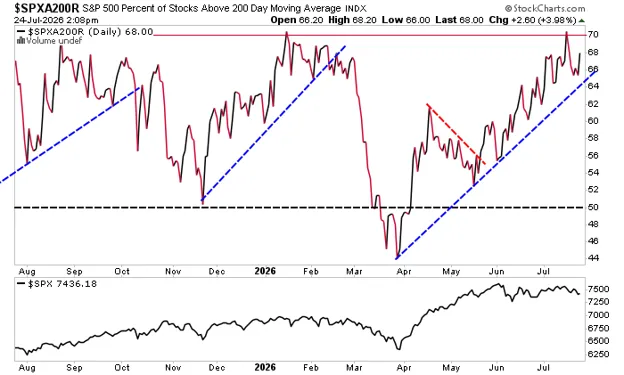
Source: StockCharts, Ryan Puplava, CMT® CTS™ CES™
While semiconductors sucked a lot of the air out of other areas in Q2, their correction has seen money rotate to other areas. I showed the strength in the Financial sector a couple of weeks ago. Another area of strength has been in Health Care. The S&P 500 sector has been trading near 52-week highs, has outperformed the S&P 500 since May, with overall health of the sector improving with 66% of its components trading above their respective 200-day exponential moving average.
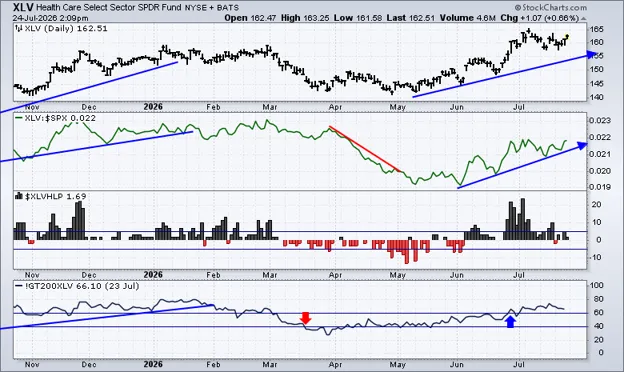
Source: StockCharts, Ryan Puplava, CMT® CTS™ CES™
Bottom Line
The week’s market action reflected a collision between strong corporate earnings and a less supportive macroeconomic backdrop. Earnings growth remained impressive, but Alphabet and Tesla showed that investors are no longer willing to overlook cash burn or rapidly expanding capital budgets simply because spending is associated with artificial intelligence. Meanwhile, the surge in oil prices revived inflation risks, pushed Treasury yields toward critical levels, and strengthened the dollar.
Thursday’s 1.2% decline in the S&P 500 and 2.2% drop in the Nasdaq demonstrated how quickly these pressures can converge. Friday’s easing in oil and bond yields helped stabilize the broader market, but it did not resolve the central tension. Corporate earnings remain strong, while the cost of capital, energy, and investment is rising. The next phase of earnings season will test whether revenue and profit growth can continue to outpace those mounting financial pressures as we continue to hear from the top bellwether companies in the next couple of weeks.



Comments
Log in or sign up to join the conversation.