

Thiruchendur Murugan, also revered as Senthilandavar, is the victorious form of Lord Murugan enshrined on the shore of the Bay of Bengal in Tamil Nadu, where the young war god is believed to have defeated the demon Soorapadman. Thiruchendur is the second of the six sacred abodes of Murugan, the Arupadaiveedu, and it is the only one of them built beside the sea rather than on a hill.
Every year, thousands of devotees gather here for Kanda Sashti, when the Soorasamharam is re-enacted on the beach. Many also visit the Naazhi Kinaru, a holy well said to have been created by Murugan's own Vel. In this guide, we explore the story, symbolism and significance of Thiruchendur Murugan, the Lord of the Seashore, here on Idol Bronze.
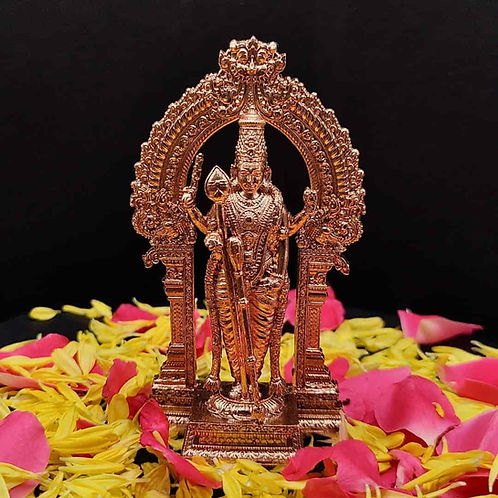
Who Is Thiruchendur Murugan?
Senthilandavar, the Lord of Thiruchendur
Murugan is known by many names: Skanda, Kartikeya, Subramanya, Shanmukha, Kumara and Velan. At Thiruchendur, devotees call him Senthilandavar, Senthilkumar or Senthilandavan. The town's puranic name is Jayanthipuram, and the shrine is praised in ancient Tamil works such as Tirumurugatrupadai, Purananuru and Silappadikaram.
Murugan with Valli and Deivayanai
Murugan is worshipped along with his two consorts. Valli, the hunter-chieftain's daughter, and Deivayanai, the daughter of Indra, stand beside him in the temple and in most idols made for worship. Together they represent the balance of earthly devotion and divine grace.
One of the Six Abodes of Murugan
The Arupadaiveedu are Thiruparankundram, Thiruchendur, Palani, Swamimalai, Thiruthani and Pazhamudircholai. Thiruchendur stands apart because it marks the site of Murugan's greatest victory and lies on the coast, where the waves meet the temple walls.
Iconography and Symbolism of Thiruchendur Murugan
The Vel, the Spear of Wisdom
The Vel is the spear Murugan received from his mother, Parvati. It symbolises sharp knowledge that cuts through ignorance, ego and illusion. At Thiruchendur, the Vel is central to the legend, since it destroyed Soorapadman and, according to tradition, created the Naazhi Kinaru.
The Peacock and the Rooster
The peacock is Murugan's mount and the rooster adorns his banner. Both are said to have come from Soorapadman himself after his final transformation. This is why they symbolise a defeated ego that has been redeemed and brought into the service of the divine.
The Worshipping Posture
The sanctum image at Thiruchendur is modelled to show Murugan in a posture of worship. According to tradition, after his victory he chose this place to worship his father, Lord Shiva. It is a rare and moving reminder that even the victorious commander bows in humility.
The Legend Behind Thiruchendur: The Rise of Soorapadman
The Demon Brothers and Their Boon
Soorapadman and his brothers, Simhamukhan and Tarakasuran, gained great power through penance and a boon that made them nearly invincible. Ruling from their island fortress of Veeramahendrapuram, they oppressed the Devas and held them captive.
The Birth of Murugan
The Devas appealed to Shiva, who released six sparks from his third eye. They were cradled by the six Krittikas at the Saravana Poigai, and Parvati later joined the six children into the six-faced Shanmukha. He was born for the single purpose of restoring dharma.
The Gift of the Vel
Parvati gave her son the divine Vel, and Murugan was made commander of the celestial army. With Veerabahu and the other heroes at his side, he set out to end the reign of the asuras.
The March to Thiruchendur and the Mission of Veerabahu
Camp at Jayanthipuram
Murugan and his army made camp at Thiruchendur, then called Jayanthipuram, on the shore across from the island stronghold of the asuras. This is the site where the war would be prepared and, later, where the victorious Lord would worship Shiva.
Veerabahu, the Envoy
Before the battle, Murugan sent Veerabahu as a messenger to Soorapadman, urging him to free the Devas and choose peace. The demon refused with arrogance, and the war became unavoidable.
The Well Born from the Vel
Tradition says that during the campaign, Murugan thrust his Vel into the ground to bring forth water for his thirsty warriors. This spring became the sacred Naazhi Kinaru, which we explore in the temple section below.
Soorasamharam: The Battle and the Victory
The Fall of Simhamukhan and Tarakasuran
The war raged for days. Murugan's forces first defeated the asura army, and then Tarakasuran and Simhamukhan fell one after the other, leaving Soorapadman alone against the Lord.
The Many Forms of Soorapadman
Soorapadman used his powers of illusion, changing shape again and again. Finally, he hid in the sea as an enormous mango tree, a symbol of the ego that clings to its last disguise.
The Vel Splits the Tree
Murugan hurled the Vel, which split the tree in two. One half became a peacock and the other a rooster. Murugan accepted both, the peacock as his vahana and the rooster on his flag. The Devas were freed, and the great victory of Soorasamharam was complete.
Kanda Sashti: The Six-Day Festival at Thiruchendur
The Six Days of Vratam
Kanda Sashti is observed in the month of Aippasi (October–November), beginning on the day after Deepavali and continuing for six days up to Sashti. Devotees keep fasts, recite the Kanda Sashti Kavacham and pray for courage, protection and relief from troubles.
The Soorasamharam on the Beach
On the sixth day, thousands of pilgrims fill the seashore to witness the re-enactment of the battle, when the Lord's victory over Soorapadman is celebrated with great fervour. It is one of the most powerful sights in the Tamil devotional calendar.
The Divine Wedding
The festival is followed by Thirukalyanam, the divine wedding of the Lord, turning the mood from battle to joy and completing the celebration.
The Thiruchendur Murugan Temple and the Sacred Naazhi Kinaru
A Temple by the Sea
The Subramaniya Swamy Temple at Thiruchendur is one of the largest temple complexes in South India, with an eleven-tiered rajagopuram. Tradition holds that the present temple was built about 300 years ago by Thesigamoorthy Swamigal of the Thiruvaduthurai Adheenam, who is said to have paid his workmen with packets of holy ash, or vibhuti.
The Naazhi Kinaru
The Naazhi Kinaru, also called Skanda Pushkarani, is a sacred well on the beach a short distance from the temple. According to tradition, Murugan created it with his Vel to quench the thirst of his warriors during the battle with Soorapadman. The well is a square structure with a small inner well that is said to hold crystal-clear sweet water, while the water in the larger well is saltish. It lies close to the sea, so devotees regard this contrast as a divine miracle.
A Shrine Celebrated Across the Centuries
From Tirumurugatrupadai to the Kanda Puranam and the verses of Tiruppugazh, Thiruchendur has been praised in devotional literature for centuries. Adi Shankara's Subramanya Bhujangam is also associated with this shrine.
Spiritual Significance of Thiruchendur Murugan
Victory over Ego and Illusion
The mango tree, the peacock and the rooster together teach that the ego can be transformed rather than merely destroyed. Thiruchendur is seen as the place where the soul begins its battle against illusion, or Maya.
Courage and Protection
Devotees pray to Senthilandavar for strength in adversity, freedom from fear and protection from negative forces. Kanda Sashti fasting is especially cherished for this reason.
A Guru Sthalam
Thiruchendur is regarded as a Guru sthalam, so devotees also come here for wisdom, clarity and good guidance in life.
The Blessing of Humility
The image of the Lord worshipping Shiva after victory reminds devotees that true strength is joined with humility and devotion.
Why Is Thiruchendur Murugan Different from Other Murugan Forms?
Thiruchendur celebrates victory. It is the seashore shrine of Soorasamharam, where Murugan appears as the triumphant commander who worships his father after battle.
Palani shows Murugan as Dandayudhapani, the renunciant who stands with a staff on a hilltop.
Thiruparankundram commemorates his wedding with Deivayanai.
Swamimalai portrays him as the teacher who explained the meaning of Om to his father.
Thiruthani is associated with his union with Valli and the calm that follows the war.
Pazhamudircholai is set amid hill forests, where he is worshipped with both consorts.
The setting itself is unique. Thiruchendur is the only one of the six abodes on the sea shore, with the ocean, the Naazhi Kinaru and the battle legend woven into one sacred place.
Conclusion
Thiruchendur Murugan is the Lord who conquers evil and then bows in humility. His story of Kanda Sashti and Soorasamharam, the Vel that pierced the mango tree, and the sweet water of the Naazhi Kinaru beside the salty sea carry lessons in courage, transformation and faith. For devotees across Tamil Nadu and beyond, he remains a comforting presence who removes fear and blesses those who approach him with a sincere heart.
Comments
Log in or sign up to join the conversation.