


Long-suffering readers will know I like to talk in memes. And you’ll know this one surely: a wife lies awake at night wondering whether her husband is thinking about another woman. Beside her, he stares silently into the darkness.
In fact, he’s wondering whether the global economy is trapped in a cycle of recurring supply shocks that keep inflation permanently above target, upending decades-long norms in financial markets. (What a time to be alive in the Smith household…)
This is perhaps the biggest question in the world of economics right now. Each supply shock comes with good reasons to be ignored by central banks. But after five years of above-target inflation, Federal Reserve officials are starting to question whether, when added together, these shocks warrant higher rates. The European Central Bank has already made that call.
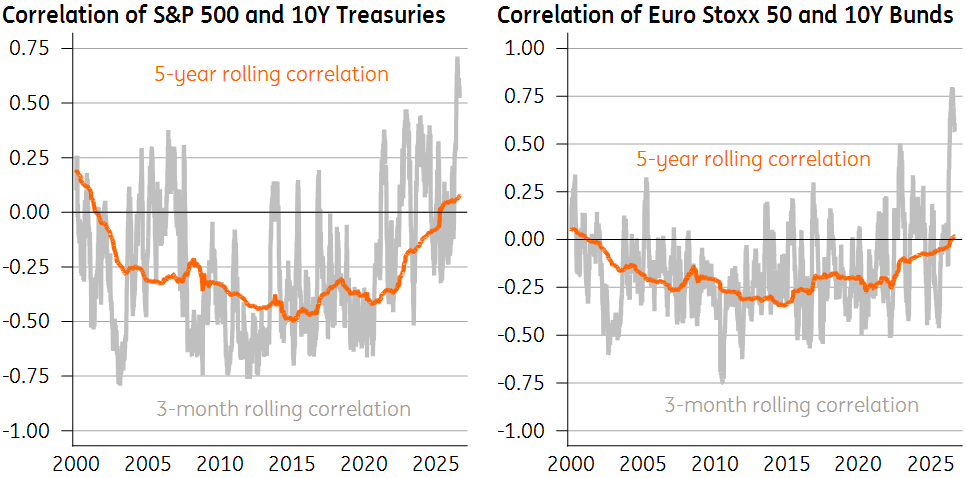
That thinking is hugely problematic for investors. If supply shocks really are becoming more frequent – and we get more periods where inflation rises at the expense of economic growth – then we’ll see more periods where bond and stock prices fall together. As my colleague Michiel Tukker's chart shows, the five-year rolling correlation has recently turned positive for the first time in over two decades. The traditional role of bonds as a hedge is being eroded.
The correlation with bonds and stock prices is increasingly positive
Given the world we live in, it’s hard to argue that these shocks are going to become less frequent. Yet for the time being at least – and notwithstanding the uncertainty in the Middle East – I’m yet to be convinced the next storm is brewing.
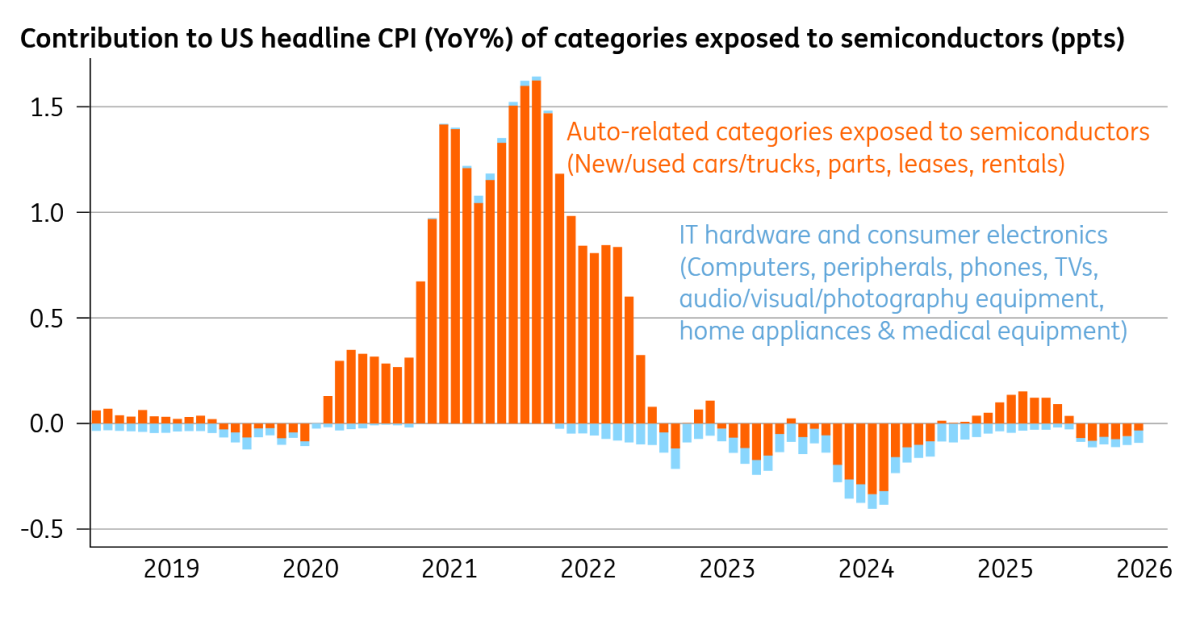
Take semiconductors. The shortage is beginning to push up the price of some consumer electricals. US software and accessories are up almost 20% in price so far this year. Yet added together, I reckon the goods most exposed to ‘chipflation’ make up a mere 1.3% of the US inflation basket. What’s more, the statisticians will offset some of those price rises to account for technological advances.
Admittedly, the risk could multiply if car prices start to surge. They’re stuffed full of chips these days – and the pandemic showed how disruption to car production can spill into used prices and subsequently that of insurance, leasing and rentals.
More likely though, as James Knightley explained to me in a webinar this week, the overall inflationary impact of the semiconductor squeeze is likely to be minimal.
Categories exposed to semiconductors are a drag on US inflation
The same is true when it comes to AI’s hunger for electricity. The grid is a key constraint to the rollout. But like those electronic goods, the weight of electricity in the CPI basket is relatively small, too. And all those data centres tend to be fairly localised – and as Coco Zhang explains, are increasingly sourcing their own power. It’s not clear that this is a big inflationary threat nationally.
Then there’s Europe’s weather woes. Higher temperatures mean more air conditioning, adding yet more pressure to natural gas prices. They’ve spurred dangerous fires. And the corresponding lack of rain has also drastically lowered Europe’s water levels.
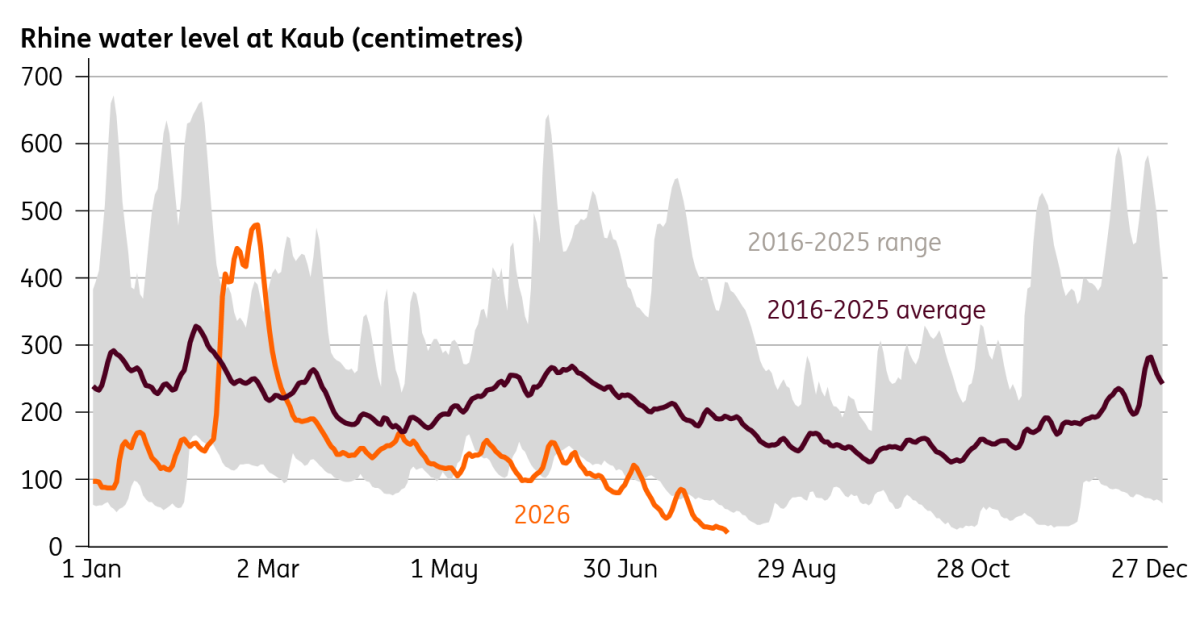
The depth of the Rhine at the German chokepoint of Kaub hit just 20cm this week – a full 170cm below the prior 10-year average. Ships are having to run at a fraction of their typical cargo capacity. And Carsten wrote this week that this could shave 0.3ppt off German growth this year. It’s an issue for supply chains – and even electricity grids. Valentin Tataru writes about Romania’s struggles with the Danube River and nuclear power.
Rhine water levels are dangerously low
In the end though, all of this is a short-lived crisis for the summer. It’s unlikely to have a lasting impact on inflation – even if it is an unwelcome reminder that these climate impacts are becoming more potent.
Just think of El Niño, which is currently pushing up oceanic temperatures in parts of the Pacific.
The Bank of England recently singled this out as a potential upside risk to inflation. Not so much because of the impact on food inflation, which our team expects to be contained (and has been falling recently, despite the Middle East situation). But because of the wider impact on the Panama Canal. Authorities are already having to apply shipping restrictions in response to lower water levels and the risk is that gets worse.
Still, nothing here strikes me as a major source of upside risk for inflation over the coming 12 months or so. And when taken together with the fading hit from tariffs and lower rental growth, James K thinks the Fed can still get away with holding interest rates this year – though clearly next week’s price data will be key (more on that below).
There’s a bigger point here though: History tells us that supply shocks only become truly dangerous for central bankers when they collide with a jobs market capable of propagating them.
Workers need enough bargaining power to recover lost purchasing power through higher wages. Firms need enough pricing power to pass rising costs on to consumers. That is how temporary price increases become persistent inflation. And none of this is especially true today.
Jobs markets have cooled markedly from their post-pandemic extremes – as today’s US payrolls shocker demonstrates. The re-acceleration in America's labour market, which underpinned the Fed's recent hawkish pivot, really doesn't seem to have lasted. And it echoes why there's little sign of wage growth emerging on either side of the Atlantic. The conditions that allowed the inflation shocks of 2021-22 to become deeply embedded are largely absent.
Supply shocks may be getting more common. Price changes may well become more volatile. But without the fuel of a tight jobs market, the inflation fire can only spread so far. That’s why, from the Fed to the Bank of England, we expect interest rates to undershoot what markets are currently expecting.
James Smith
Why Fed Chair Kevin Warsh could make markets more volatile
Warsh's scepticism towards forward guidance could result in greater market volatility, says ING's FX Strategist Francesco Pesole, although Warsh cannot stop other Fed members from making their own views known. Pesole shared his views in a recent webinar with Developed Markets Economist James Smith.
THINK Ahead in developed markets
United States (James Knightley)
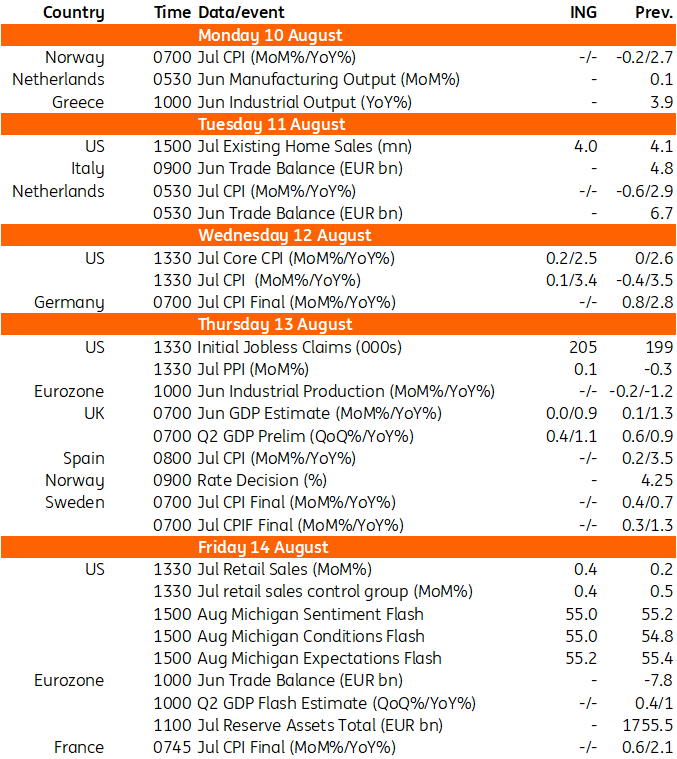
July CPI (Wed): July US consumer price inflation will be the main release to watch. June’s report was very benign, with softness spread across a number of categories, while falling gasoline prices pulled the headline price change down by 0.4% month-on-month. July has seen more volatility in motor fuel costs, but on balance they are a touch lower than in June and, as such, we are hopeful of another relatively benign outcome of 0.1% MoM. Core inflation is going to be a little more elevated, but with weak wage growth, tariff refunds giving US corporates a cash flow boost, and housing costs cooling, we are hopeful of a 0.2% outcome. The consensus amongst economists is split fairly evenly between a 0.2% print and a 0.3% print for core inflation. Market reaction may be fairly limited given we have another jobs report and inflation report ahead of the 16 September FOMC meeting.
July Retail Sales (Fri): Retail sales will also be closely followed given consumer spending accounts for 70% of all US economic activity with retail sales responsible for around 43% of that spending. Auto sales volumes were flat, while gasoline station sales should be pulled lower by price falls, with the rest of the components showing modest growth. The 250th anniversary of US independence and the FIFA World Cup may have lifted activity in the first half of the month, particularly for groceries and eating/drinking out.
UK (James Smith)
2Q GDP (Thu): Solid second quarter growth is more a reflection of the faster momentum through the latter stages of the first quarter. Monthly GDP numbers have been running less hot through April/May, and we expect that to continue into June. Survey indicators look less strong than the headline GDP figures, and we continue to think some of the strength through the first half is down to issues with the seasonal adjustment of the data.
Key events in developed markets



Comments
Log in or sign up to join the conversation.