

Key Takeaways
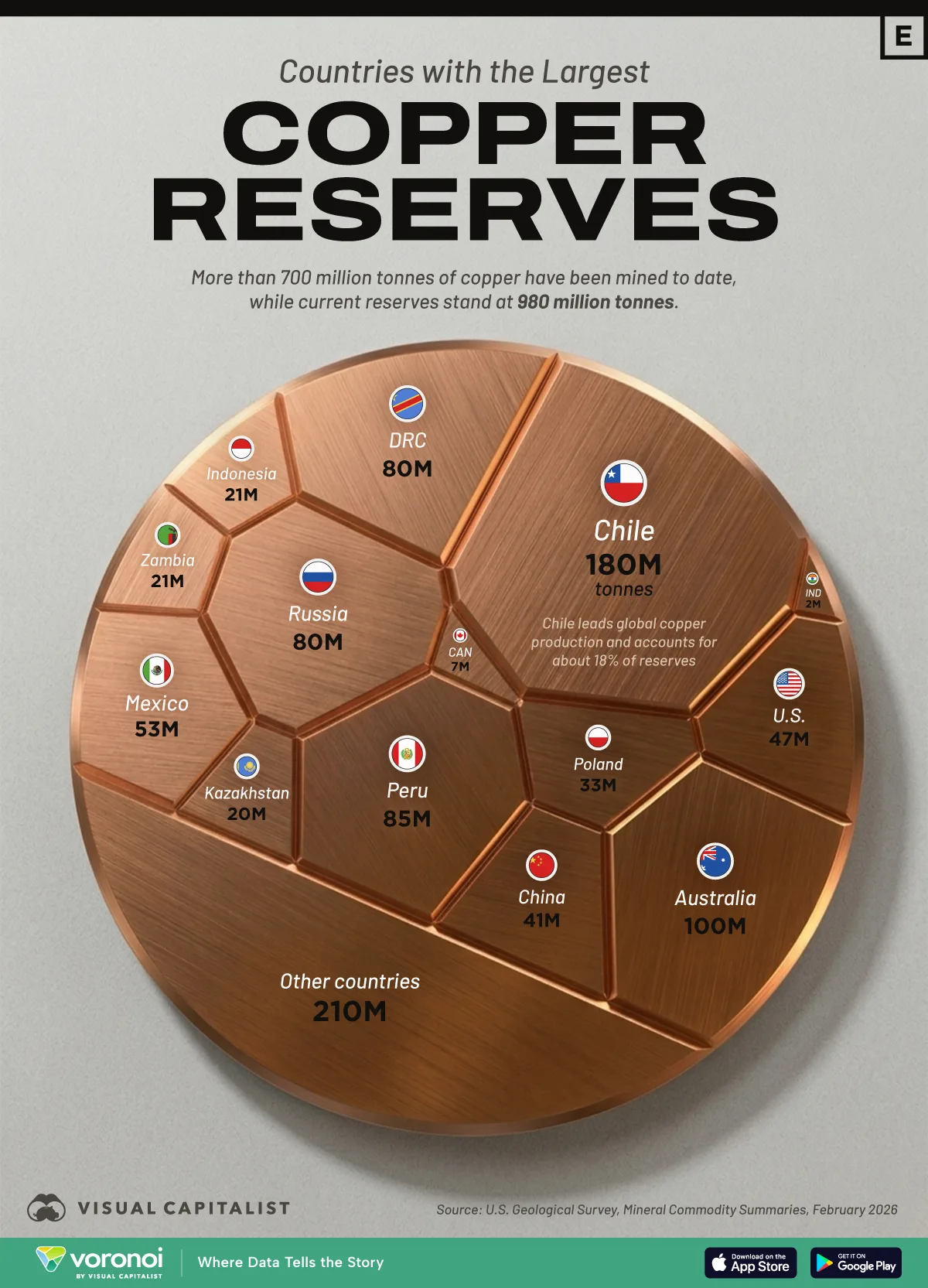
Chile alone holds 180M tonnes of copper—nearly double the next largest country.
Just five countries account for over half of global copper reserves.
Known reserves (980M tonnes) exceed all copper ever mined to date.
Copper is one of the world’s most critical metals, powering everything from construction to electric vehicles and renewable energy systems. As demand rises, where this resource is located is becoming increasingly important.
This visualization shows global copper reserves by country using data from the U.S. Geological Survey (2026), highlighting which nations hold the largest known deposits and how concentrated supply really is.
Demand for copper is expected to surge in the coming decades, driven by electrification, AI infrastructure, and the expansion of power grids. This makes the geographic distribution of reserves more strategically important than ever.
Chile Dominates Global Copper Reserves
Chile dominates global copper reserves with 180 million tonnes—nearly double Australia, the next largest holder, giving it unmatched influence over global copper supply at a time when demand is rapidly rising.
Rank | Country | Reserves (Mt) |
|---|---|---|
1 | 🇨🇱 Chile | 180 |
2 | 🇦🇺 Australia | 100 |
3 | 🇵🇪 Peru | 85 |
4 | 🇨🇩 Congo (DRC) | 80 |
5 | 🇷🇺 Russia | 80 |
6 | 🇲🇽 Mexico | 53 |
7 | 🇺🇸 United States | 47 |
8 | 🇨🇳 China | 41 |
9 | 🇵🇱 Poland | 33 |
10 | 🇮🇩 Indonesia | 21 |
11 | 🇿🇲 Zambia | 21 |
12 | 🇰🇿 Kazakhstan | 20 |
13 | 🇨🇦 Canada | 7 |
14 | 🇮🇳 India | 2 |
-- | 🌍 Other countries | 210 |
-- | 🌐 World total (rounded) | 980 |
Chile’s reserves account for about 18% of the global total, reinforcing its position as the world’s top producer.
These vast deposits, particularly in the Atacama Desert, have made Chile central to global copper supply chains. Australia and Peru also have significant reserves, but are in a distinct second tier behind Chile.
Reserves Are Concentrated in a Few Regions
Copper reserves are highly concentrated: the top five countries—Chile, Australia, Peru, the DRC, and Russia—hold more than half of the world’s known supply.
Australia holds about 100 million tonnes, while Peru, the Democratic Republic of the Congo, and Russia each have between 80–85 million tonnes. Latin America and resource-rich regions in Africa and Eurasia dominate the list.
How Reserves Compare to Historical Production
Humanity has mined over 700 million tonnes of copper throughout history, yet nearly 1 billion tonnes remain in known reserves. This highlights both the scale of remaining resources and the challenge of extracting them economically.
However, much of this remaining copper is harder and more expensive to extract. As demand accelerates, especially from electrification and energy systems, the gap between supply and future needs could become a defining challenge for the global economy.
Comments
Log in or sign up to join the conversation.