


Image: Bigstock
Electronics manufacturing services (EMS) providers are benefiting from a powerful combination of secular technology investment, rising product complexity, and increased outsourcing by original equipment manufacturers (OEMs).
The rapid buildout of artificial intelligence infrastructure is perhaps the biggest catalyst, with a broad revival in the AI-Infrastructure trade leading to a sharp spike in EMS stocks on Wednesday.
To that point, hyperscalers and enterprises are pouring capital into data centers that require increasingly sophisticated compute, storage, networking, optical, power, and cooling systems.
At the same time, the transition toward 400G, 800G, and emerging 1.6T networking, along with growing adoption of automation, robotics, advanced medical equipment, and aerospace and defense electronics, is expanding opportunities well beyond traditional consumer electronics.
These trends favor EMS providers with the engineering expertise, global manufacturing footprints, and supply-chain capabilities necessary to bring complex products from design to high-volume production.
Reflecting these favorable conditions, the Zacks Electronics-Manufacturing Services Industry currently ranks in the top 3% of more than 240 Zacks industries, highlighting the strength of the group.
Benefiting from this favorable backdrop, these four EMS stocks are positioned to capitalize on continued technology investment.
Celestica, Zacks Rank #1 (Strong Buy), Stock Price: $339, Year to Date (YTD) Performance: +14%
Don’t let Celestica’s (CLS - Free Report) somewhat modest YTD stock performance fool you, as shares surged 9% in today’s trading session and are now up more than 500% in the last two years.
Celestica has emerged as one of the more direct beneficiaries of the AI infrastructure spending boom. The company provides design, engineering, advanced manufacturing, hardware platforms, and supply-chain solutions, with its Connectivity & Cloud Solutions business becoming an increasingly important growth engine.
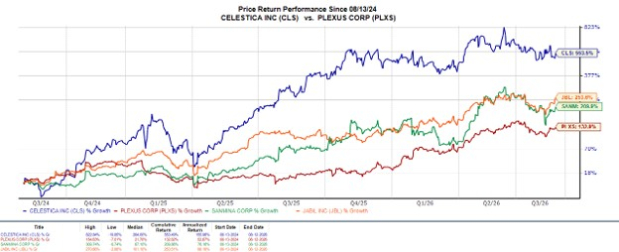
Image Source: Zacks Investment Research
Demand from hyperscale customers for AI compute and high-performance networking infrastructure has supported Celestica’s rapid expansion, particularly as data centers migrate toward faster 400G and 800G networking technologies.
Following Celestica’s Q2 results in July, management raised its full-year 2026 revenue forecast to $20.5 billion (65% growth) and adjusted EPS guidance to $11.30 (86% growth).
More importantly, Celestica expects its growth rate to accelerate further in 2027, supported by AI compute, networking, and rack-level programs. The EMS leader has moved beyond conventional contract manufacturing toward higher-value integrated technology solutions, which could help it capture a larger share of spending as AI infrastructure becomes more complex.
Continued investment in engineering, manufacturing capacity, and product innovation should further strengthen Celestica's competitive position. Hyperscalers require suppliers capable of handling sophisticated products at considerable scale, and Celestica's expanding capabilities make it well positioned to participate in the next phases of the AI data-center buildout.
Analyst revisions are starting to play catch-up with Celestica’s much stronger-than-expected guidance, and the current Zacks Consensus projects next year's sales to surge another 57% to nearly $32 billion with FY27 EPS expected to spike another 60% to $17.34.
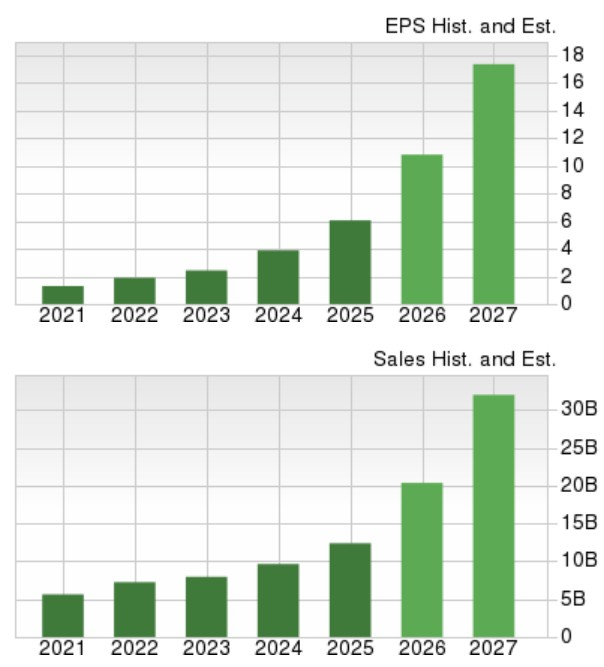
Image Source: Zacks Investment Research
Plexus, Zacks Rank #1 (Strong Buy), Stock Price: $271, YTD Performance: +85%
Plexus (PLXS - Free Report) has the strongest YTD performance of the group and offers a somewhat different way to participate in the strength of the EMS industry.
Rather than concentrating primarily on hyperscale AI infrastructure, Plexus has significant exposure to higher-complexity markets including healthcare and life sciences, aerospace and defense, and industrial applications.
That diversification gives Plexus access to several long-term growth trends, including medical technology, automation, robotics, data-center-related industrial equipment, and increasingly sophisticated aerospace and defense electronics.
The company's positioning in specialized, higher-complexity manufacturing markets is an important advantage. These products frequently require extensive engineering expertise, stringent quality standards, and close, long-term customer relationships, potentially creating greater barriers to entry than lower-value electronics assembly.
With multiple end markets contributing to growth and new manufacturing programs ramping, Plexus provides investors with exposure to the broader expansion of advanced electronics manufacturing rather than relying exclusively on one technology cycle.
Plexus' top line is now expected to expand nearly 20% this year, with FY27 sales projected to increase another 14% to $5.53 billion. Plus, annual earnings are expected to increase over 14% for the foreseeable future, with FY27 EPS projections at $9.74.
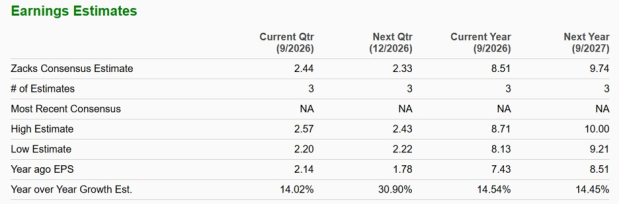
Image Source: Zacks Investment Research
Sanmina, Zacks Rank #1 (Strong Buy), Stock Price: $208, YTD Performance: +39%
Sanmina (SANM - Free Report) is strengthening its position in the AI infrastructure market while maintaining exposure to a diversified collection of industrial, medical, defense, aerospace, automotive, and communications customers.
The company's vertically integrated manufacturing model enables it to provide customers with engineering, component, and manufacturing capabilities across much of the product lifecycle.
Cloud and AI infrastructure have become particularly important growth drivers. Sanmina is expanding manufacturing capacity and AI systems capabilities to address rising demand for accelerated computing platforms, while investing in areas such as automation, liquid cooling, and engineering.
Furthermore, the addition of hyperscale and OEM programs is increasing its opportunity to participate as cloud providers continue building increasingly powerful AI infrastructure.
Sanmina has further expanded its exposure to accelerated compute and cloud infrastructure by acquiring ZT Systems, a global provider of advanced server and data center solutions. Along with organic program growth, the acquisition has contributed to strong revenue expansion and has strengthened Sanmina's vertically integrated manufacturing capabilities.
Meanwhile, Sanmina has been translating higher revenues into improved profitability through favorable business mix, cost controls, operating leverage, and its greater vertical integration. Management subsequently raised its fiscal 2026 outlook while continuing to invest in capacity and automation.
That combination of AI-related growth and exposure to several other sophisticated end markets could be particularly valuable. Even if growth rates vary across individual markets, Sanmina's broad customer base provides multiple avenues for expansion, while its growing AI infrastructure presence gives it exposure to one of technology's largest investment cycles.
With FY26 EPS expected to soar roughly 97% to $11.89, it’s noteworthy that Sanmina stands out with the cheapest forward P/E multiple on the list at 19X.
More intriguing is that FY27 EPS is projected to climb another 17%. This comes as Sanmina’s annual sales are forecasted to spike 74% this year and are projected to leap another 16% next year to $16.4 billion.
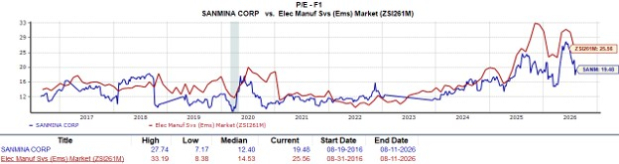
Image Source: Zacks Investment Research
Jabil, Zacks Rank #2 (Buy), Stock Price: $366, YTD Performance: +60%
Jabil (JBL - Free Report) is another major beneficiary of accelerating AI infrastructure investment. Its broad manufacturing platform spans cloud and data-center infrastructure, healthcare, automotive, industrial, and other markets, but AI has increasingly become the company's primary growth engine.
Jabil has built capabilities across a wide portion of the AI hardware ecosystem, including compute, storage, networking, optics, power, cooling, and rack integration. Strong demand from cloud and hyperscale customers led management to raise its FY26 AI-related revenue outlook to approximately $13.6 billion, compared with roughly $9 billion generated last year.
Jabil has also added a third hyperscale customer, expanding its addressable opportunity as AI infrastructure spending continues to grow.
The company isn't simply benefiting from higher industry demand; it is investing to expand its ability to serve that demand. Jabil continues to increase manufacturing capacity and automation while developing capabilities around AI servers, liquid cooling, and advanced optical technologies. These investments should allow the company to support increasingly complicated infrastructure deployments while potentially improving manufacturing efficiency.
Diversification remains another important advantage. Beyond AI infrastructure, Jabil serves healthcare, automotive, industrial, and connected-device markets, reducing its dependence on any single end market. Management also raised its full-year revenue outlook to roughly $35 billion (17% growth).
Zacks estimates call for Jabil’s annual sales to leap another 20% next year to $42.19 billion, with 30% EPS growth expected in FY26 and FY27. The expansive outlook still makes JBL shares attractive at a reasonable 30X forward earnings multiple despite having the most expensive stock price on the list.
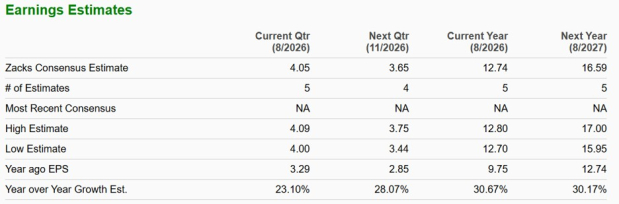
Image Source: Zacks Investment Research
Bottom Line: AI Is Creating a Massive Opportunity for EMS Providers
The AI investment cycle is often associated primarily with semiconductor designers and cloud providers, but the physical infrastructure behind AI must ultimately be engineered, manufactured, assembled, and deployed. That is creating a significant opportunity for EMS companies capable of handling the complexity and scale associated with next-generation data centers.
At the same time, healthcare technology, aerospace and defense electronics, industrial automation, robotics, and other advanced applications are providing additional sources of demand. This combination is helping transform leading EMS providers from traditional contract manufacturers into increasingly important engineering and technology partners for some of the world's largest companies.


Comments
Log in or sign up to join the conversation.