


More tidbits today that I hope will be interesting.
First, I sat in on another autocallable webinar from ProShares, and something clicked. I've talked about feeling like I don't completely understand the risks with these. Kind of a repeat comment, but I have a better understanding than I did. Autocallables generate yield from equity risk, not risk taken in bond markets.
That an autocallable yields 18% or 9% tells you that the 18% yielder will be more volatile and probably be riskier than the 9% yielder, but the risk relates to equities going down a lot, not yields going up a lot. There could be a second or third-order effect from interest rates' influence on pricing volatility, but the story is equity risk and volatility. The way most of them are structured, down a little isn't really a problem for the funds. At varying points of down a lot for equities, some or all of the distributions can be disrupted if the "barrier" level is breached. Down 35% becomes problematic for ProShares ACSP (ACSP), for example.
If you use a covered call or put-selling fund, you think about equity market risk; funds like JEPI or WTPI create yield from equity volatility and risk. In that way, autocallables do the same thing. Zoom in, and you will see there are structural differences, and I would say more complexity, but as one webinar said, derivative income and autocallables are cousins.
Some of these funds are very volatile and some not. As a generalization repeated from above, I would expect that the higher the yield, the more volatile, but I am still working on these, trying to learn. Certainly, ProShares ACSP, which targets 18-19%, is more volatile than CAIE, yielding 14%, which is more volatile than JELM from Janus (JHG), which targets a 9% yield.
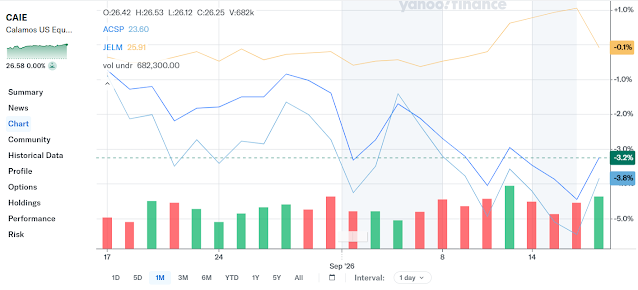
ACSP is brand new, which is why the chart is so short. I said this the other day: a 9% yield is fantastic and for me, it's not worth burning my fingers trying to hold onto ACSP. To be clear, I don't own JELM anywhere; I'd like to see the market go through some adversity before considering JELM or any other less volatile autocallable fund. I will reiterate, though, that some pay ROC like ACSP and CAIE and some don't--pretty sure JELM will be ordinary income, but please leave a comment if you know otherwise.
If we're talking about harnessing volatility (which we are), this chart is interesting.
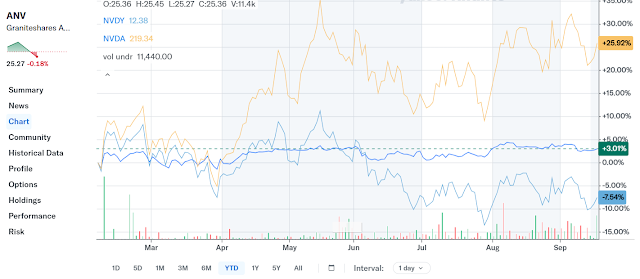
ANV is the GraniteShares Nvidia Autocallable ETF, so it is a single-stock autocallable. NVDY is the YieldMax NVDA ETF, and then the common stock in yellow. NVDY "yields" 38% versus close to 14% of ordinary income for ANV. Fourteen percent is a fantastic yield. ANV hasn't deteriorated because the stock has gone up a good amount. ANV doesn't capture the common's volatility the way NVDY does.
Things have gone very well for ANV, but I am still not sure that single-stock autocallables are a good idea; just pointing out that these are not automatically NAV incinerators. The chart is also quite clear that buying ANV is not buying the common stock; there should be no expectation of any sort of significant upcapture. Six months of trading tells you there might be zero upcapture. The fund owns a lot of different autocallables on NVDA, but in some sort of hideous decline for the common, eventually ANV would start to go down with the common.
Yesterday we took a look at a paper from AQR about protecting a portfolio against inflation. There was a reference in there to long/short quality equities. AQR has mentioned that a few times, and at some point I said there wasn't really a way to access that effect in an ETF or mutual fund, and there still isn't, as far as I know, but there used to be. It closed a few years ago, but QMJ was the Direxion Quality Minus Junk ETF. I guess the fund was ahead of its time.
Corey Hoffstein posted a fun article on Twitter that compared and contrasted adding buffer funds to a portfolio versus managed futures and concluded there is room for both. I took it as a prompt to play around with a few different things related to combining buffers, managed futures, as well as PPFIX, which is a client holding that sells puts that are very far out of the money such that the fund is a horizontal line that tilts upward. The reason to include PPFIX is that Corey talked about buffers being equities with an option overlay on top. That's probably correct, but I don't really think of them that way.
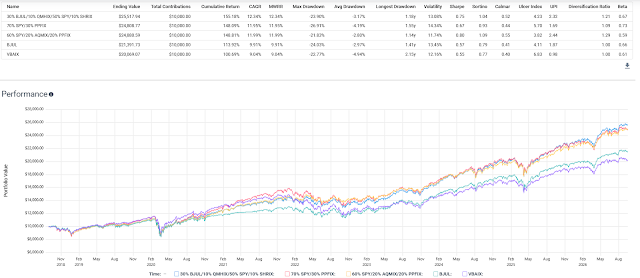

I use BJUL in these backtests because I believe it is the oldest buffer fund, so we get the longest backtest. None of these ideas helped much during the various fast declines along the way, but they did help quite a bit in 2022.
Buffers and managed futures, as presented, are an interesting combo that I will try to dig more into in future posts.


Comments
Log in or sign up to join the conversation.