
No.70 - Comparing Q1 FY2026 (April 30, 2026) → Q2 FY2026 (July 30, 2026)
Three months ago, LPL Financial’s April call was organized around a single tension: the firm was executing well operationally, but the story it told investors was hedged, conditional, and carefully time-stamped. Recruiting pipelines were at record levels “exiting Q1.” Organic growth would improve “over the course of the year.” The pricing review was underway, the work was real, but no timeline was offered. The cash monetization question — the structural one, the one that had been haunting the sector — received a response that was substantively honest about its own incompleteness: “this is grounded in a lot of complex work,” and “it’s going to take some time.”
July’s call walked in with results that validated most of what April had projected. The question is whether the narrative caught up to the performance — or whether some of the hedging has quietly been retired without acknowledgment.
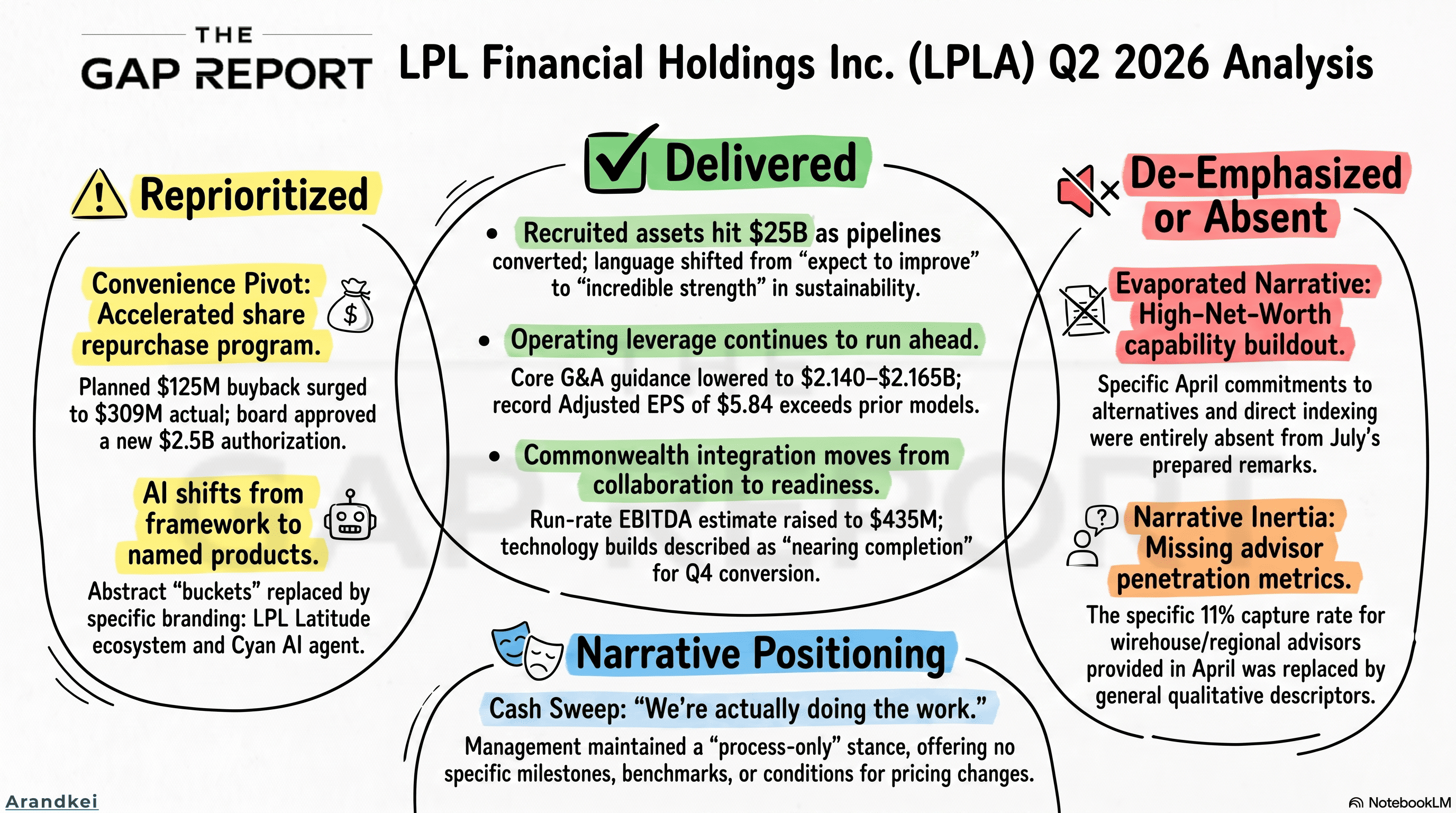
Delivered
Recruiting Pipeline → Converted
April’s most prominent forward-looking commitment was a specific one: record pipelines would translate into improved organic growth as the year progressed. The mechanism was explicit — as Commonwealth diligence wound down, recruiting capacity would return to the external market, pull-through rates would rise, and pipeline would convert.
By July, LPL reported $25 billion in recruited assets for the quarter — described as the strongest recruiting quarter in nearly two years outside of large institutional wins. The record pipeline built in April not only held but expanded further, setting up what Steinmeier described as a confident posture heading into the second half. Net new assets came in at $23 billion, representing a 4% annualized growth rate, up from Q1’s same 4% figure but on a recovering base after earlier market disruption.
The language shift here is worth noting. April’s language was built around sequence — “we expect the pull-through to improve over the course of the year.” July’s language is built around confidence — “we feel incredibly strong in our ability to not only sustain our performance, to improve it over the latter half of the year.” The commitment wasn’t just met; the framing moved from expectation to conviction.
Operating Leverage → Running Ahead
April signaled meaningful progress on operating efficiency, guiding full-year Core G&A to $2.155–$2.190 billion and noting that Q1 had already come in below the low end of prior guidance. The mechanism described was ongoing — automation, AI-driven efficiencies, cost-to-serve reduction — framed as an “evergreen” program rather than a one-time event.
July lowered the full-year Core G&A range again, to $2.140–$2.165 billion, with Q2 coming in at $519 million, once again below the low end of the guided range. Audette’s framing in Q&A made the structural claim explicit: “I think it’s been a couple of quarters in a row where we’ve been able to deliver more efficiencies than we expected.”
Adjusted pre-tax margin reached approximately 39.3% in Q2, up from 38% in Q1. Record adjusted EPS of $5.84, following Q1’s record of $5.60.
The narrative around operating leverage is one of the cleaner deliveries in this comparison set. April described the direction; July confirmed the pace exceeded the model.
Commonwealth Integration → On Track, Retention Unchanged
In April, management stated that asset retention was “in the mid-80s” and that the firm continued to “track towards our target of 90% retention.” The Q4 onboard timeline was affirmed. The case management platform — described as a foundational element for maintaining Commonwealth’s service culture — was presented as a work-in-progress with clear purpose.
July reports the same mid-80s retention figure. The target of 90% is reiterated. The Q4 onboard timeline holds. The case management platform, now joined by a household modernization initiative and a single relationship agreement, is described as “nearing completion.”
A small language movement: April said they were “working closely with our Commonwealth partners to jointly map the path forward.” July says they are “nearing the completion of the technology and capability builds needed to help facilitate a seamless conversion.” The register shifted from collaborative process to operational readiness. Same headline, tighter clock.
The run-rate EBITDA estimate for Commonwealth once fully integrated moved from $410 million in April to $435 million in July — attributed to “current market levels” recovering from Q1’s downturn. Audette had previewed this direction in April’s Q&A, noting the Q1 decline was purely market-driven and that recovery would push the figure back toward $425 million. The actual Q2 mark came in above that, at $435 million, reflecting both market recovery and asset growth.
Reprioritized
Share Repurchases: From Opportunistic Resume to Accelerated Program
April’s prepared remarks mentioned that LPL had “opportunistically resumed buybacks earlier this month with roughly $125 million planned for Q2” — a modest, carefully qualified restart following the pause taken when the Commonwealth deal was announced. The language was measured: “we will continue to remain flexible and dynamic with our capital deployment.”
The Q2 outcome was a significant departure in scale. LPL repurchased $309 million in the quarter — more than twice the stated plan — citing “dislocation in our share price.” The board approved a new $2.5 billion repurchase authorization in July, with $300 million planned for Q3.
The posture didn’t change — capital discipline, returns-focused framework, flexibility as a principle — but the quantum jumped materially. What was framed in April as a cautious, opportunistic return to buybacks arrived in July as an accelerated program with a fresh multi-year authorization. 🟡 Convenience Pivot applies here in a mild form: the framing of “remaining flexible” absorbed a significantly larger commitment without updating the framework description.
Institutional Channel: Pause Acknowledged, Pipeline Rebuilding
April’s language on the institutional segment was positive but carefully scoped. Steinmeier noted that some institutional pipeline conversations had “long lead times” and that there was “a little bit of overhang in some of those discussions just because of the movement in M&A that exists inside of financial institutions.” He described the segment as capable of being “a meaningful contributor that adds on to that organic growth.”
July brought a more direct acknowledgment of the pause — “we had to take an intentional pause, not necessarily in our engagement in the marketplace, but around our ability to onboard” — followed by a rebuilding narrative: the capability build for Commonwealth is clearing, conversations with larger banks are increasing, and the institutional pipeline is moving again. The reference to Prudential as a “signature client” was an April theme that survived into July — now joined by First Horizon (introduced for the first time in this call) and paired with a point about the scale of LPL’s institutional footprint relative to competitors (”$590 billion of client assets in their wealth businesses, and that’s multiples greater than those of our next closest competitor”).
April described the institutional segment as a long-lead-time opportunity. July describes it as “clearing the decks” to re-engage. The shift is one of posture more than substance — from patient positioning to active re-entry.
AI Narrative: From Framework Bucket to Named Product
April spent considerable time in Q&A describing LPL’s AI strategy in three buckets: directly serving advisors, process automation and straight-through processing, and foundational coding improvements. The language was architectural — framing, positioning, strategic intent. No products were named. GitHub Copilot, Cursor, and Cloud Code were cited as external tools in use; nothing internal carried a brand.
July introduced two named products: LPL Latitude (the unified technology ecosystem) and Cyan (the AI agent embedded within it). The language moved from bucket descriptions to use-case demonstrations — address changes propagated automatically, financial plan synthesis, growth opportunity identification through natural language queries. The PGA of America partnership also appeared, framed as a brand awareness play for high-net-worth end investors.
The analytical structure remained consistent — same three buckets, same logic — but July’s language shifted from “here is how we think about it” to “here is what we built.” This is a meaningful evolution in narrative specificity, and one that will create testable commitments heading into the next call. Latitude and Cyan are now on record.
De-Emphasized or Absent
High-Net-Worth Capability Buildout
April’s prepared remarks included a specific call-out: “we’ve continued to advance our capabilities to better meet the needs of high-net-worth individuals. We’ve expanded the inventory of alternative investment products available on the platform and are delivering more personalized investment solutions through enhanced direct indexing and tax loss harvesting capabilities.”
This passage had no mirror in July’s prepared remarks. High-net-worth as an explicit strategic priority — named, with specific capability examples attached — did not appear. The subject surfaced tangentially in Q&A around Commonwealth advisor solutions and liquidity and succession, but the direct framing of HNW capability advancement as a distinct initiative was absent. 🔴 Evaporated Narrative.
This is notable because April’s language had the structure of a forward commitment — “we’ve expanded,” “we’re delivering.” July’s call moved on without returning to either the alternatives inventory expansion or the direct indexing and tax-loss harvesting progress. No update. No acknowledgment of status.
Wire House and Regional Advisor Penetration Rate
April’s Q&A offered a specific data point: “We’re up to capturing now 11% of the advisors in that segment in motion, up from 9% just a couple of years ago.” The wirehouse and regional employee advisor space was described as a distinct growth vector — a market where LPL was actively increasing consideration and win rates.
July referenced wirehouse and regional advisor movement in more general terms — “when we look at the wire house and regional advisor movement, largely we have been continuing to gain consideration” — but without the percentage benchmarks. The specific progression metric (11%, up from 9%) did not resurface.
What was measured in April was described in July. Whether the rate continued to improve, held, or reversed is not answerable from the call. The absence of the metric, where a specific number had been provided before, is at minimum a signal worth tracking. 🟠 Narrative Inertia — language remains positive while the underlying measurement disappeared.
Narrative Positioning
Cash Sweep Monetization: From “We’re Doing the Work” to Still “We’re Doing the Work”
This is the most closely watched topic in LPL’s investor narrative, and the most revealing section of the July call for what it did not resolve.
In April, Steinmeier introduced the pricing review with deliberate care: “we’re doing the work to properly assess the opportunities and risks of reducing our reliance on cash sweep economics over time.” He framed it as complex, multi-stakeholder, and appropriately time-consuming. The language was careful not to commit to an outcome or a direction — only to a process.
Three months later, the update was structurally identical. “We’re actually doing that work.” The reasons for the extended timeline were explained in detail — the complexity of serving 32,000 advisors and 1,000+ institutions with different business models — but the timeline itself remained open. “We don’t have any precise updates on the completed work to date, but we’ll make sure to update you when there’s more to share.”
Steven Chubak from Wolfe Research asked directly what milestones would need to be met for the board to feel comfortable adopting any changes. Steinmeier did not answer that question. He addressed the evaluation process — “well-considered,” “looking at it from all angles,” “aligned with our long-term strategy” — but offered no milestones, no benchmarks, and no conditions.
When Mike Brown from UBS followed up asking whether the work represented a contingency playbook or a proactive shift, Steinmeier’s answer was the only moment in the call where the framing departed from process language: “If the question is whether we are going to be a leader or a follower, I think the most important thing is we actually need to get the right answer.” He then added: “we’re already in that position, and we’re comfortable making decisions that lead the market if that’s where things land.”
That last phrase — “if that’s where things land” — preserved optionality without conceding direction. It was the most direct the call ever got on the subject, and it stopped precisely at the edge of commitment.
The broader ICA yield management activity tells a different story from the cash sweep review. LPL announced a shift from asset-based to cash-balance-based tiering in its sweep rate methodology, with a 20 basis point full run-rate yield improvement expected from the change. Because the adjustment takes effect in August — mid-quarter — only half of that benefit lands in Q3 (the 10 basis point figure cited in prepared remarks), with the remainder arriving in Q4. These are real, mechanical adjustments to cash economics. They were introduced in July’s prepared remarks and Q&A without being framed as outputs of the pricing review. The strategic review of cash sweep monetization and the operational optimization of the ICA portfolio are being presented as distinct workstreams. Whether they remain analytically separate is a question the next call will need to answer.
Q&A: Response Quality Tracker
Steven Chubak, Wolfe Research — Asked what milestones need to be met for the board to be comfortable adopting pricing changes, and specifically what the key conditions for implementation are. Management’s response: described the evaluation criteria (well-considered, all angles, long-term strategy, value for advisors and institutions) without naming a single milestone. Indirect. The question asked for conditions; the answer described principles.
Mike Brown, UBS — Asked whether the pricing review is a contingency plan or a proactive initiative, and whether moving first creates value if competitors don’t follow. Steinmeier: “if the question is whether we are going to be a leader or a follower, I think the most important thing is we actually need to get the right answer.” Partially direct. The leader/follower binary was engaged but not resolved. The competitive dynamics question — what happens if others don’t follow — received no specific answer.
Alex Blostein, Goldman Sachs — Asked about organic growth sustainability into H2 and whether NNA can sustain above 5%, in the context of a competitive recruiting environment. Steinmeier provided substantive, specific color: advisor movement normalizing, Commonwealth diligence winding down, pipeline at records, mid-to-high single-digit growth confidence. Direct. No deflection, concrete drivers named.
Bill Katz, TD Cowen — Asked for Commonwealth cash levels and July trend data on flows and client cash. Audette answered both: Commonwealth at just above 1% cash versus LPL’s just above 2%; July cash down approximately $2.8 billion from advisory fees, flat otherwise, landing around $54.1 billion; July organic growth tracking around 3%. Direct. Notably, Audette acknowledged the operator’s one-question rule (”Very aggressive, Bill. Operator said one. I’ll do two.”) and answered both parts anyway — one of the few moments of genuine texture in the Q&A.
The Gap Report is narrative intelligence, not investment advice.
Quotes are verbatim from publicly available earnings call transcripts. This analysis reflects an interpretation of language and tone shifts between calls
Comments
Log in or sign up to join the conversation.