

Inside the World’s $15 Trillion
Key Takeaways
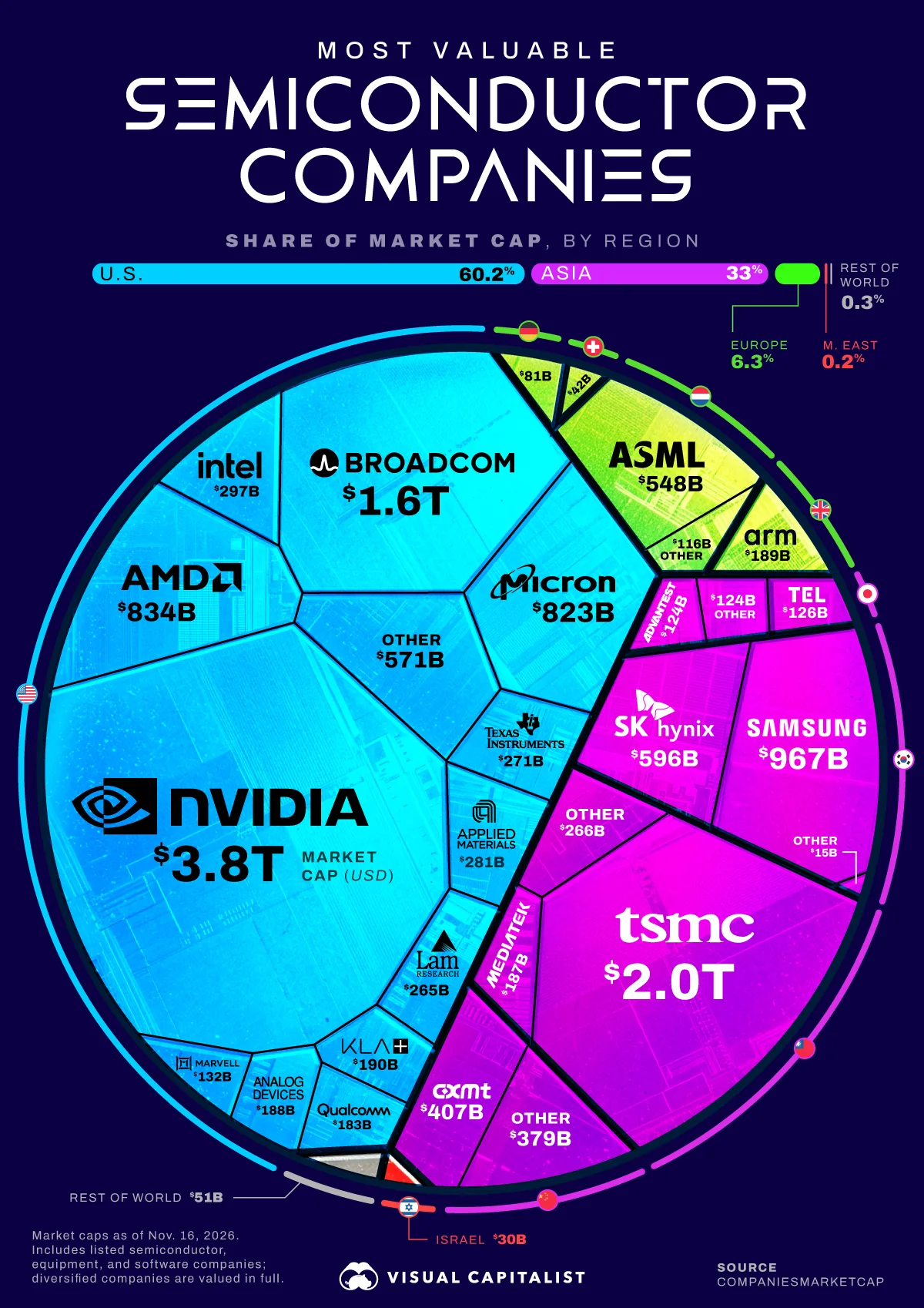
Nvidia alone accounts for roughly a quarter of the combined market value of the world’s semiconductor companies.
Just three companies, Nvidia, TSMC, and Broadcom, are collectively worth $7.3 trillion.
Asian semiconductor companies account for roughly a third of the industry’s combined market capitalization.
The global race for computing power has created some of the most valuable businesses in history. From AI processors to advanced manufacturing equipment, semiconductor companies now have a combined market capitalization of over $15 trillion.
This graphic visualizes the world’s most valuable semiconductor companies using November 2026 data from CompaniesMarketCap.
The dataset includes publicly traded chipmakers, equipment suppliers, and software companies. Diversified businesses such as Samsung and Broadcom are valued in full, including their non-semiconductor operations.
The Big Three Semiconductor Companies
The three most valuable semiconductor companies specialize in different parts of the computing ecosystem: Nvidia designs powerful processors, TSMC manufactures advanced chips, and Broadcom supplies custom silicon and networking technology.
Nvidia, the world’s most valuable semiconductor company, has a market capitalization of $3.8 trillion, more than the combined value of TSMC ($2 trillion) and Broadcom ($1.6 trillion).
The table below ranks major semiconductor companies by market capitalization in November 2026, with smaller companies grouped by geography.
Rank | Company | Market Cap (billions $) |
|---|---|---|
1 | 🇺🇸 Nvidia | 3,767.2 |
2 | 🇹🇼 TSMC | 1,957.5 |
3 | 🇺🇸 Broadcom | 1,589.9 |
4 | 🇰🇷 Samsung | 967.1 |
5 | 🇺🇸 AMD | 833.7 |
6 | 🇺🇸 Micron Technology | 823.2 |
7 | 🇰🇷 SK Hynix | 596.0 |
8 | 🇳🇱 ASML | 548.3 |
9 | 🇨🇳 CXMT | 406.8 |
10 | 🇺🇸 Intel | 296.6 |
11 | 🇺🇸 Applied Materials | 280.6 |
12 | 🇺🇸 Texas Instruments | 271.0 |
13 | 🇺🇸 Lam Research | 264.7 |
14 | 🇺🇸 KLA | 189.6 |
15 | 🇬🇧 Arm Holdings | 189.3 |
16 | 🇺🇸 Analog Devices | 187.9 |
17 | 🇹🇼 MediaTek | 186.6 |
18 | 🇺🇸 QUALCOMM | 183.2 |
🇺🇸 Others (U.S.) | 149.4 | |
19 | 🇺🇸 Marvell Technology | 132.5 |
20 | 🇯🇵 Tokyo Electron | 125.9 |
21 | 🇯🇵 Advantest | 124.3 |
🇨🇳 Others (China) | 106.6 | |
🇹🇼 Others (Taiwan) | 88.5 | |
22 | 🇺🇸 Synopsys | 85.0 |
23 | 🇨🇳 Cambricon Technologies | 84.6 |
24 | 🇹🇼 ASE Group | 73.2 |
25 | 🇩🇪 Infineon | 71.9 |
26 | 🇳🇱 NXP Semiconductors | 65.5 |
27 | 🇺🇸 Monolithic Power Systems | 64.3 |
🇯🇵 Others (Japan) | 62.5 | |
28 | 🇨🇳 NAURA Technology | 59.6 |
🌐 Others | 51.1 | |
29 | 🇨🇳 SMIC | 50.3 |
30 | 🇺🇸 Coherent Corp. | 40.4 |
31 | 🇨🇭 STMicroelectronics | 40.1 |
32 | 🇳🇱 ASM International | 36.7 |
33 | 🇺🇸 Astera Labs | 36.3 |
34 | 🇹🇼 United Microelectronics | 36.3 |
35 | 🇹🇼 Nanya Technology | 36.1 |
36 | 🇨🇳 AMEC | 33.5 |
37 | 🇺🇸 Microchip Technology | 32.3 |
38 | 🇹🇼 Global Unichip Corp. | 32.0 |
39 | 🇯🇵 Renesas Electronics | 31.3 |
40 | 🇯🇵 Disco Corp. | 30.2 |
🇫🇷 Others (France) | 29.8 | |
41 | 🇺🇸 ON Semiconductor | 26.7 |
42 | 🇺🇸 Cerebras Systems | 24.8 |
43 | 🇺🇸 Qnity Electronics | 24.1 |
44 | 🇨🇳 GigaDevice Semiconductor | 23.5 |
45 | 🇺🇸 Credo Technology | 23.0 |
46 | 🇺🇸 GlobalFoundries | 22.4 |
47 | 🇺🇸 Entegris | 21.7 |
48 | 🇺🇸 Skyworks Solutions | 20.7 |
49 | 🇨🇳 Hua Hong Semiconductor | 20.6 |
50 | 🇰🇷 Others (South Korea) | 14.5 |
51 | 🇳🇱 Others (Netherlands) | 13.4 |
52 | 🇩🇪 Others (Germany) | 9.4 |
53 | 🇨🇭 Others (Switzerland) | 1.5 |
54 | 🇬🇧 Others (UK) | 0.5 |
Nvidia’s competitive position extends beyond its processors. The company’s extensive software libraries help developers build applications for AI, scientific computing, and other demanding workloads. This combination makes its hardware part of a broader computing ecosystem.
Fellow American company Broadcom benefits from a different part of the same investment boom: custom AI accelerators and networking. Its AI semiconductor revenue reached $16.7 billion in its third fiscal quarter of 2026, up 221% from a year earlier.
Asia: The World’s Manufacturing Center
While American companies lead the industry by market capitalization, much of the world’s advanced chip manufacturing depends on Asian businesses.
Taiwan’s TSMC leads the region by market value, followed by South Korea’s Samsung ($967.1 billion) and SK hynix ($596 billion). These companies occupy critical positions in the global supply chain, from processor manufacturing to advanced memory.
Unlike Samsung, TSMC focuses on manufacturing customers’ chip designs rather than selling competing chips under its own brand. This allows rival chip designers to rely on the same manufacturing specialist.
Memory is another critical ingredient. AI processors need rapid access to enormous quantities of data, driving demand for high-bandwidth memory. This helps explain the high valuations of memory suppliers such as SK hynix.
Europe’s Crucial Role
European companies account for less than 10% of the industry’s combined market capitalization. Yet one Dutch company supplies technology that much of the world’s advanced chip manufacturing depends on.
ASML ($548.3 billion), Europe’s most valuable company, is the world’s only manufacturer of extreme ultraviolet (EUV) lithography systems. These machines use light to print the exceptionally fine patterns needed to produce leading-edge semiconductors.
The geographic distribution of market value tells only part of the story. While the U.S. captures the largest share of the industry’s market capitalization, the technology behind those valuations depends on specialized companies across the globe.
Comments
Log in or sign up to join the conversation.