

War, sanctions, and trade disputes used to be treated as outside shocks to the economy. Today, they are becoming part of the economy itself.
For example, the conflict with Iran is affecting oil routes. U.S. sanctions are putting pressure on China’s energy trade. Russia and Ukraine are consuming huge amounts of military and industrial capacity. Even Canada and the United States, two of the world’s closest trading partners, are now caught in a tariff fight.
Together, you can see a larger, macro-shift:
Globalization is giving way to regionalization and economic nationalism.
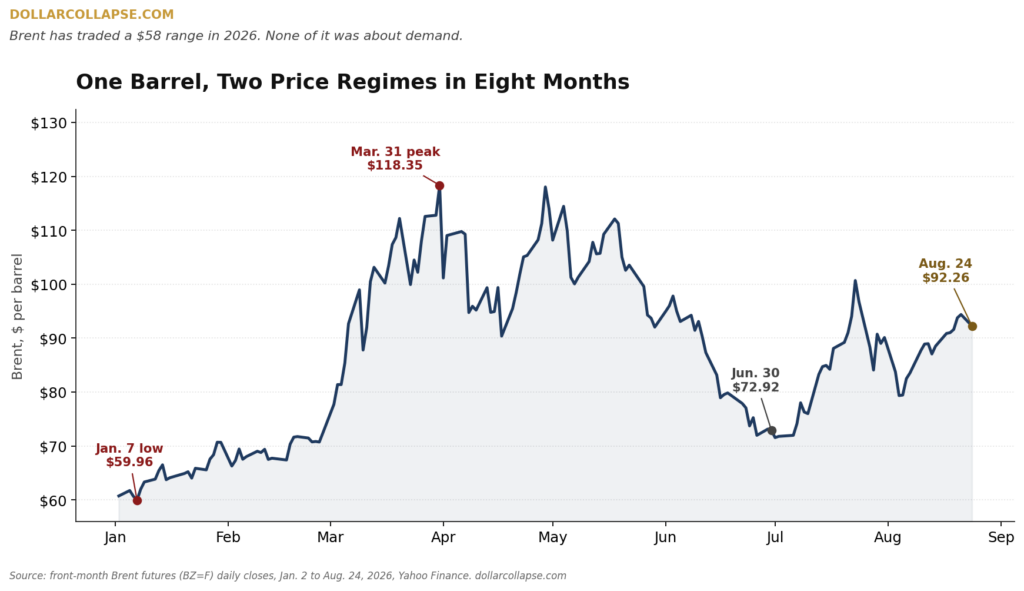
A $58 range in eight months, and none of it was about demand.
For decades, companies asked one basic question: Where can we make this cheapest? Now, governments are increasingly asking a different question: Who can we trust?
The Strait of Hormuz Shows Why Geography Still Matters
Oil markets offer the clearest example. Reuters reported that Brent crude was trading at $92.69 per barrel on August 24 as markets waited for new U.S. measures against Iran. The Strait of Hormuz historically carried about one-fifth of global oil supplies.
Washington has widened the threat of secondary sanctions against countries and companies that continue doing business with Iran. Treasury Secretary Scott Bessent described the campaign as an “economic onslaught.” That means a conflict in one narrow waterway can quickly become a global economic event. Higher oil prices feed into diesel, transportation, farming, manufacturing and consumer prices.
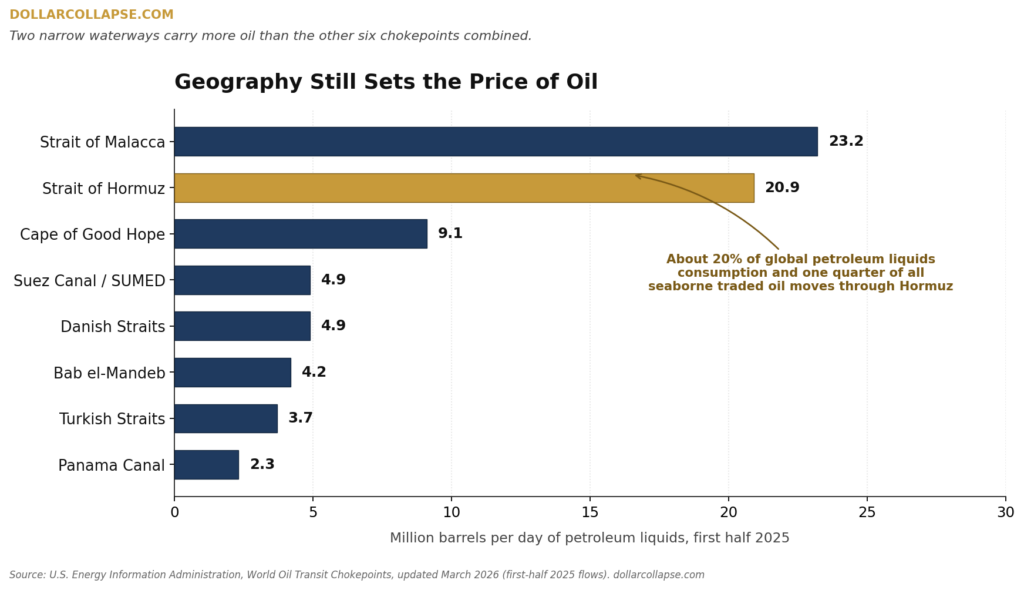
Hormuz carries about 20% of global petroleum liquids consumption and a quarter of all seaborne traded oil.
Sanctions Are Rewiring Trade
China is getting much less oil. Reuters reported that Iranian oil shipments to China fell to about 534,000 barrels per day in August from 823,000 in July as U.S. pressure increased.
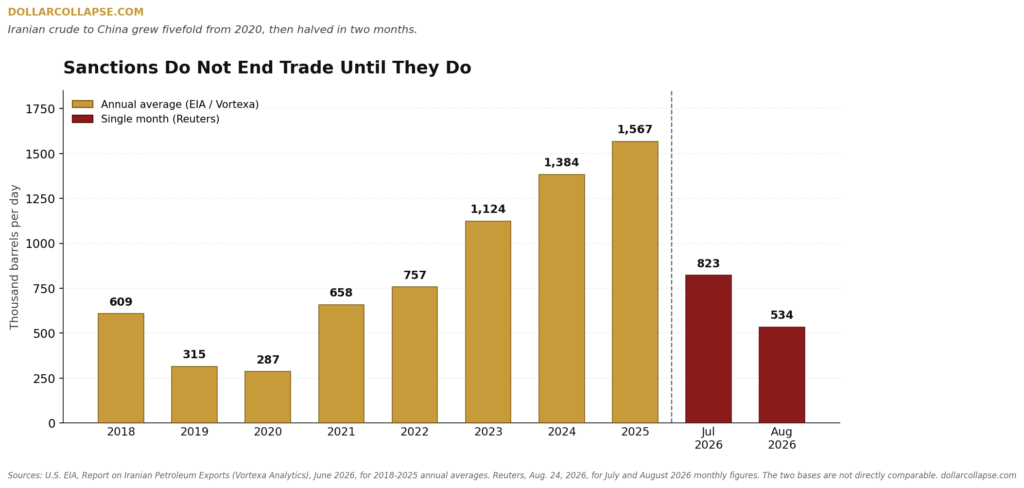
The flow rebuilt fivefold from 2020, then halved in two months.
But sanctions do not always make trade disappear. Often, like what we saw when sanctions were applied to Russia at the start of the war in Ukraine, they change the route. New middlemen appear. For Russia, China has been buying its crude oil, refining it and then reselling it. For Iran, they’re using different systems. Payments are moving into different currencies, and buyers search for alternative suppliers.
China is already looking farther afield for energy. China’s Sinopec plans to increase oil purchases from Brazil, Africa and other regions because Middle East supplies have become less reliable.
The result is a world with longer trade routes, more complicated payment systems and more political risk. All of that adds cost.
The Trade Fight Has Reached America’s Closest Allies
Reuters reported that the United States imposed 50% tariffs on about $20 billion of Canadian exports after trade talks failed. Canada plans dollar-for-dollar retaliation beginning September 8. Then the dispute widened. President Trump threatened 50% tariffs on Canadian cars, trucks and auto parts starting January 1, 2027.
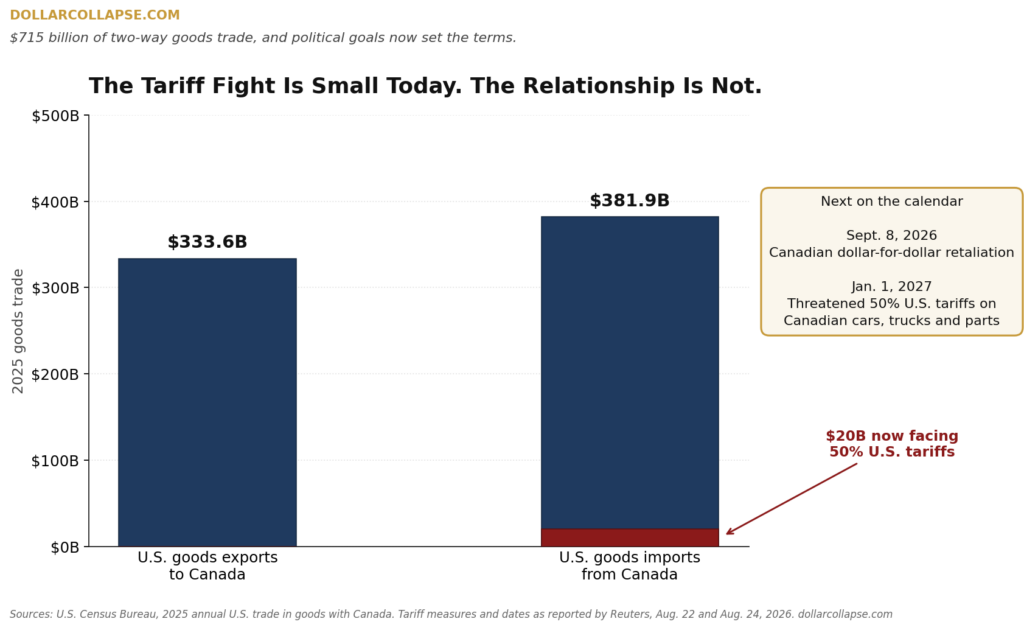
North American supply chains are deeply connected. For example, you may know this, but a car part can cross the border several times before a finished vehicle reaches a dealer. So, a tariff on Canada can raise costs for American factories and consumers too.
Even friendly countries are placing political goals ahead of economic efficiency, which is a change much bigger than a normal trade dispute.
Efficiency Is Being Replaced by Resilience
The old globalization model rewarded efficiency. Businesses used the cheapest supplier, kept inventories low and stretched supply chains across the world.
The emerging model, one brought on by regionalization across the globe, rewards resilience. Governments want domestic factories, trusted suppliers, strategic stockpiles, secure energy and larger defense industries.
Economically, the strategy often looks wasteful. Two factories cost more than one. Larger inventories cost more than just-in-time delivery. Domestic production may cost more than imports. But countries are increasingly willing to pay that price because the extra cost acts like insurance.
Economic Nationalism Has an Inflation Premium
The more likely outcome is that trade is reorganized around political blocs, alliances and strategic resources.
That means more tariffs, longer shipping routes, duplicate factories, larger inventories, higher defense spending and less efficient supply chains.
For roughly three decades after the Cold War, globalization gave the world a powerful economic tailwind. Companies moved production to the lowest-cost location. Energy flowed relatively freely. Businesses focused on efficiency.
That world is not disappearing overnight, but the direction has changed.
Security first. Efficiency second.
The strategy may make nations more resilient, but resilience costs money. If geopolitical fragmentation continues, that cost will increasingly appear in inflation, government budgets, and corporate margins. It will ultimately download into a price consumers pay through inflated prices.


Comments
Log in or sign up to join the conversation.