

Every crisis eventually produces a number.
Unemployment rate. VIX. The Saffir-Simpson scale. We reach for official measurements because they promise something solid to hold onto while everything else is moving.
The trouble is that official numbers arrive late. Government data gets revised. Damage assessments take weeks.
So people improvise, and some of the improvised gauges turn out to be more useful than the real thing.
Wall Street has done this for decades. The Big Mac index compares currencies through burger prices. The lipstick index reads consumer confidence through cosmetics sales. Neither shows up on a terminal, and both keep getting cited anyway, because a scrappy indicator you can check right now beats a rigorous one that lands next quarter.
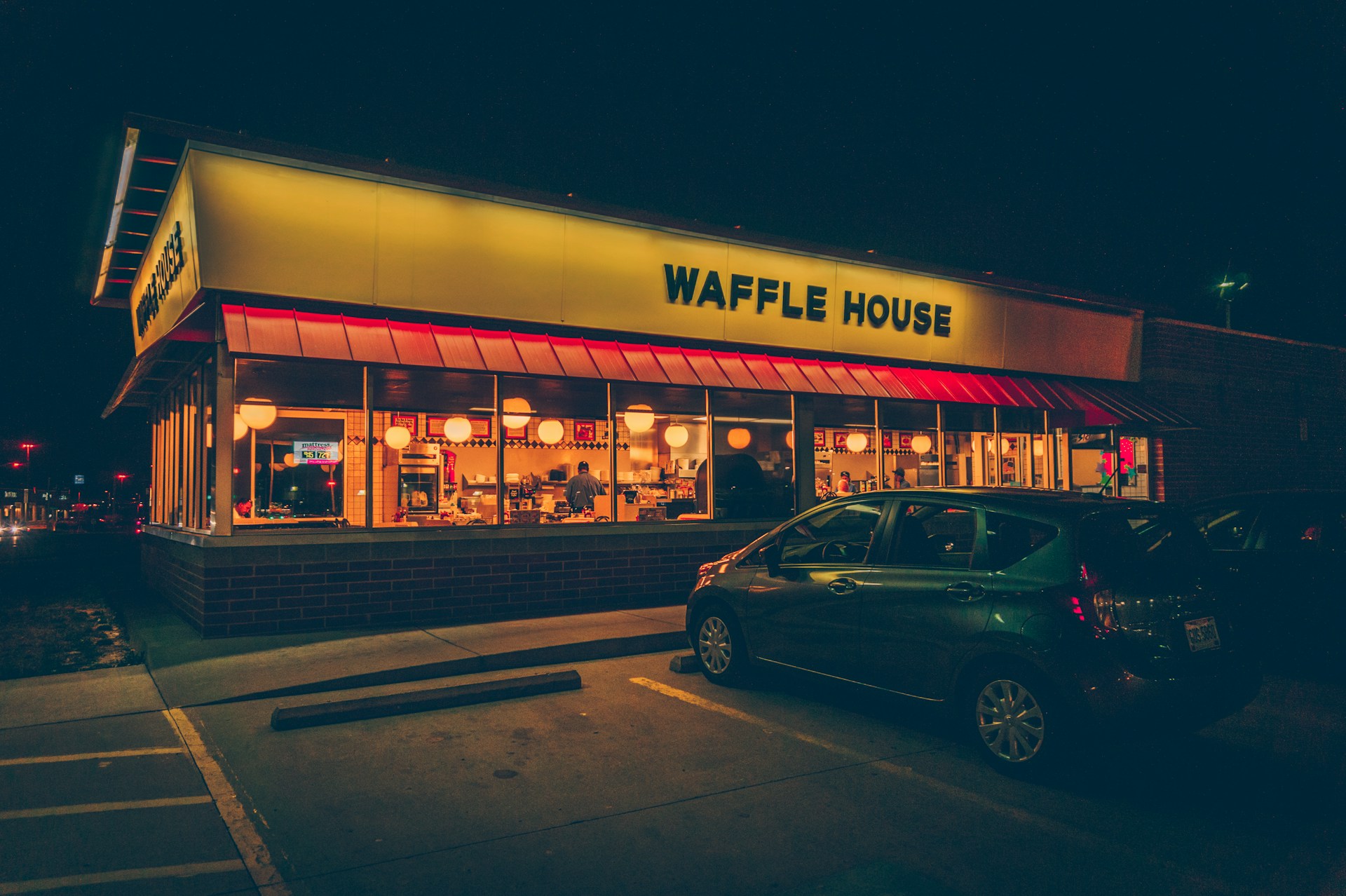
The federal government does it, too. Its favorite improvised disaster gauge is not a satellite feed or a sensor network. It is a chain of 24-hour diners in the Southeast that sells hash browns scattered, smothered and covered.
That gauge has now been optioned by the most valuable company in the world.
Apple (AAPL) has bought a science fiction thriller built around it, and the reason shareholders should care has very little to do with waffles.
How the “Waffle House Index” became a federal disaster gauge
The index works on one assumption: Waffle House almost never closes.
The chain built its reputation on staying open through weather that shuts everything else down, and on reopening fast when it cannot. That preparation, including trained jump teams that reopen damaged stores, made the company’s restaurants a live readout on local conditions.
Craig Fugate developed the index while running Florida’s emergency management agency, then carried it with him to FEMA, where he served as administrator. The gauge runs on three colors, and each one tells a responder something different.
Green means a full menu, which signals limited damage and working power.
Yellow means a limited menu, which signals generator power at best and thinning food supplies.
Red means the restaurant is closed, which signals severe damage or unsafe conditions.
Source: Waffle House
Red is the one that matters. Because the chain plans for outages and keeps a stripped-down storm menu ready, a full closure is rare enough to function as an alarm.
“That’s really bad. That’s where you go to work,” Fugate has said of arriving to find a closed location, according to Waffle House.
The chain is privately held, so there is no ticker to trade on any of this. Its restaurants stretch from the mid-Atlantic through Florida and across the Gulf Coast, which is precisely the geography that hurricanes visit.
If you have ever sat through a hurricane watching a utility map refuse to update, you already understand why the index caught on. A closed diner is information you can verify in one phone call. A federal damage assessment is information you get in three weeks.
That gap between what people need to know and what institutions can confirm is the same gap that makes the Big Mac index useful, and it is the reason a breakfast chain ended up in the emergency response toolkit at all.
Apple Original Films has acquired a sci-fi thriller based on FEMA disaster metric.
Apple’s Waffle House movie lands with Plan B behind it
Apple Original Films picked up the package for a reported seven figures, according to Deadline. Plan B Entertainment is producing, Louis Paxton is directing, and Andrew Nunnelly wrote the script, which landed on the 2025 Black List.
Inde Navarrette will star and executive produce. She was cast as Rogue in Marvel’s coming X-Men film earlier this year, and broke out in the horror hit “Obsession.”


Comments
Log in or sign up to join the conversation.