

The US October Jobs Report Was Unambiguously Positive, Confirming That There Is No Recession In Sight And Validating The Fed’s Decision To Take A Pause In Rate Cuts
The US labor market remains one of the few bright spots around considering that many international indicators point to a weakening in the global economy.
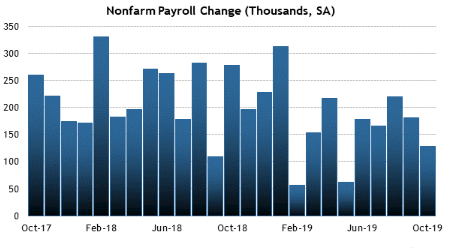
However, the October US job figures were clearly distorted by the GM strike, which resulted in a statistical loss of about 42,000 jobs in the motor vehicles and parts industries.
Otherwise, the October payroll increase of 128,000 would not appear substantially different than the 180,000 jobs created in September. In other words, the payroll gains in October were similarly quite strong.
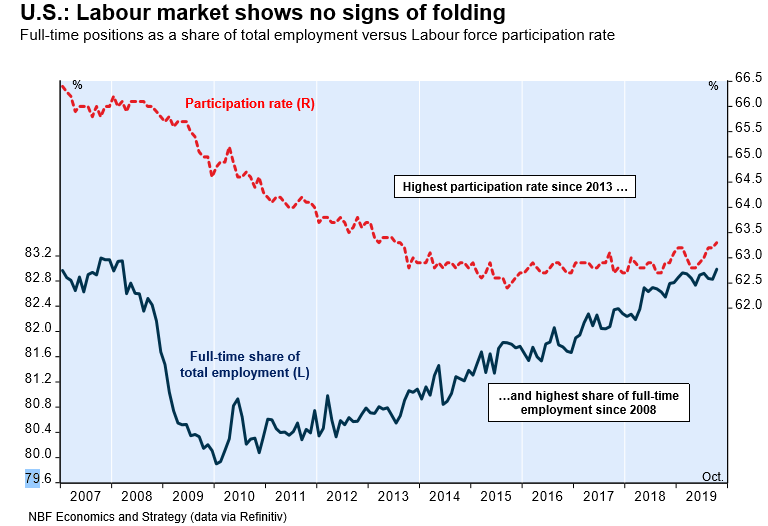
The household survey also reported 241,000 new jobs created in October, and most of the jobs were tilted towards higher-paying, full-time positions. Indeed, in October full-time positions as a share of total employment reached its highest level since 2008.
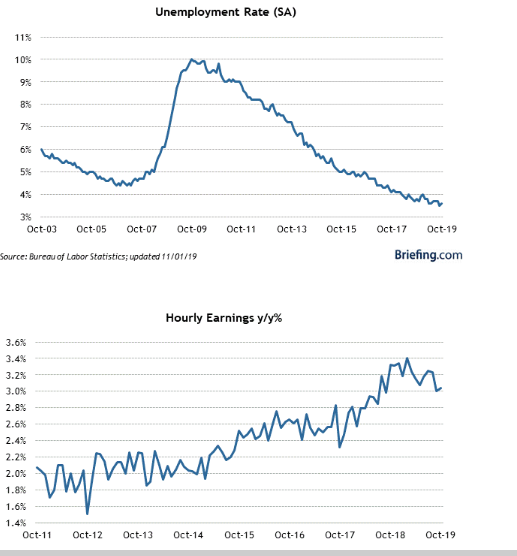
The unemployment rate which is calculated from the household survey hardly changed last month. The unemployment rate was 3.6% in October compared to 3.5% in September, and the October rate continued to remain very near its 50-year low level.
The fact that the labor force participation rate rose to a six-year high of 63.3 % in October should also be recognized as another factor pointing to the strong job market.
As well, the proportion of the unemployed defined as long term (i.e. 27 weeks or more of continuous unemployment) slipped lower to 21.5% in October, while the U6 unemployment rate, which accounts for unemployed and under-employed workers, was 7% in October versus 6.9% in September.
As of October. average hourly earnings rose 3% over the past year, virtually identical to the previous month’s annual wage gain.
In sum, the October jobs report was unambiguously positive for the US economy. The labor market data also clearly supports the Fed’s recent announcement that it will take a pause in its interest rate easing cycle.
Even though employment growth is clearly slower this year than in 2018, nonetheless the unemployment rate is close to a 50-year low. In other words, the job market is very tight, and skilled labor is in short supply.
While we should desire a higher pace of wage growth, nonetheless, wages increasing in the 3% range should be able to support family incomes and consumer spending in the year ahead.


Comments
Log in or sign up to join the conversation.