

“As we approach the 10th anniversary of the global financial crisis we should recall how we got there. In 2003-07, the US government pursued fiscal expansion and financial deregulation – an approach that, even at the time, was recognized as likely to constrain the government’s ability to respond to a recession. If the US continues on its current path, no one should be surprised if history repeats itself. (Jeffrey Frankel, US will lack fiscal space to respond when next recession comes, August 28, 2018)
History suggests that, when it comes to economic policy, the time to get your fiscal house in order is when the economy is doing well. In other words, the time to prepare for the next downturn is when the economy is firing on all cylinders.
As matters currently stand, the US economy is close to firing on all cylinders. The current expansion almost matches the ten-year expansion of the 1990s. The economy recently grew very strongly, 4.2% annualized in the second quarter and 3.5% in the third. Unemployment is at a near record low, corporate profits are soaring, investment spending is on the upswing, and the economy is projected to stay on a steady 2% plus growth path for at least another year or two.
However, the federal budget is deeply in the red, and the deficit next year is expected to top $1 trillion. The Trump Administration’s large tax cuts and expenditure increases made matters far worse.
As economists Christine and David Romer recently pointed out, countries with higher debt to GDP ratios have less ability to offset negative economic shocks when they occur.
That is, countries with low debt ratios can successfully apply anti-recessionary fiscal policy measures much more aggressively than those with less fiscal room. (Why Some Times Are Different: Macroeconomic Policy And The Aftermath OF Financial Crises, October 2017)
Although it is difficult to pinpoint the exact timing of the next economic downturn, the odds are that it is not too distant in the future.
The Federal Reserve, in its attempt to create some room for monetary stimulus should it be required, has been raising short-term interest rates. In other words, the Fed is trying to create room for monetary policy to act by lowering its benchmark interest rates, should it be required.
It is not hard to see that on the fiscal front, the Trump Administration has squandered considerable room to act, should fiscal stimulus be required to offset the next recession.
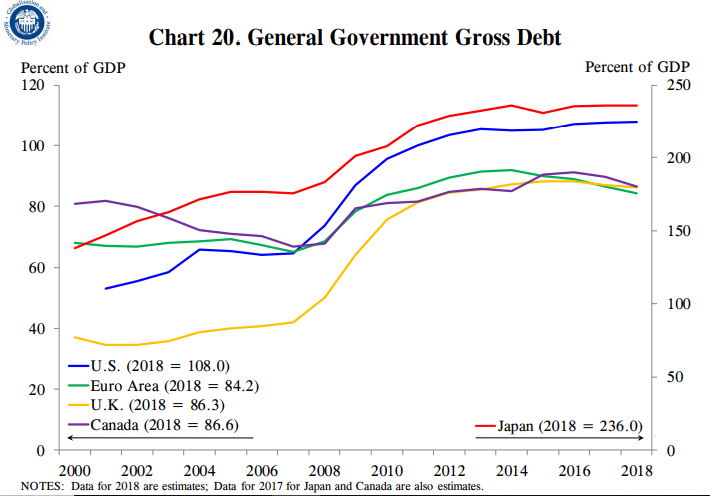
The U.S. general government debt ratio reached 108% this year, though some of the debt is no doubt held by state and local governments. But as the chart illustrates, the general level of debt has been climbing for years and increased unusually fast since 2017.
While it is difficult to pinpoint what the next trigger for a recession might be, the American Government has been pursuing exactly the wrong set of policies, and as a result, it is likely that the next downturn might be severe.
That is, over the past two years the Trump Administration and the Republicans in the Congress have been pursuing a pro-cyclical fiscal policy, rather than a more thoughtful counter-cyclical approach which was needed. The Trump Administration’s embrace of financial deregulation is also procyclical and intensifies financial market swings, as does the Republican Congress’ attempts to weaken the Dodd-Frank financial reforms.
This leaves any Administration facing a new recession in a much weaker fiscal position to manage a new economic downturn.
In closing, as the chart illustrates, the US and Japan have less fiscal room to fight the next recession because their government indebtedness is so high. Other advanced economies are in a more fortunate positions, as the Euro countries, the UK and Canada, have been reducing government borrowing relative to GDP.


Comments
Log in or sign up to join the conversation.