

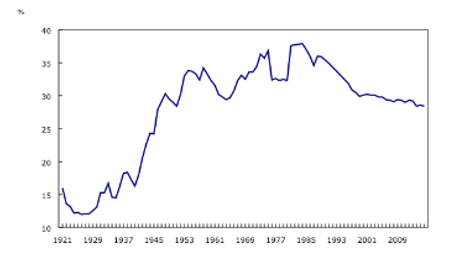
“In 1997, when the Labour Force Survey first collected data on union membership, just under one-third of employees (30.9%) were in a union. This proportion trended downwards over the next 20 years, reaching 28.4% in 2016. From 1997 to 2016, unionization fell in the private sector (from 19.0% to 14,6%) while it increased among public workers (from 69.8% to 73.0%). (Canada Labour Force Survey, August 2017)
The unionization rate in Canada is still declining, and as a result worker economic power in the marketplace has also been shrinking. Employers have gained considerable advantage in the wage setting arena that they did not have in the past.
As a special report by Statistics Canada indicates, the growth of Canada’s trade union movement coincided with the beginning of industrialization at the end of the 19th Century. The decline in the Canadian unionization rate is not a recent phenomenon, since most of the decline took place in the 1980s and 1990s.
While the earlier expansion in unionization was clearly associated with industrialization, its shrinkage in recent years can also be traced to changes in the structure of the Canadian economy. While this does not exactly qualify as classic de-industrialization at work, there is no doubt that the shrinkage of manufacturing jobs in Canada due to rapid technological change and globalization trends has escalated the drop in the unionization rate in the private sector of the economy.
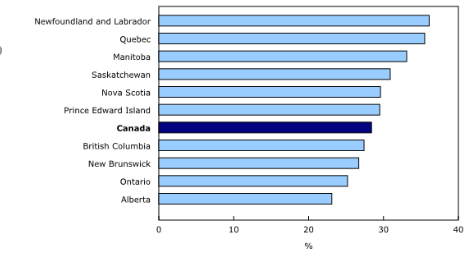
Among the more populous provinces, Quebec had the highest unionization rate in 2016, while Alberta had the lowest.
Longer-term changes in the economy’s structure is clearly an important explanatory factor, as employment shifted from industries and occupations with high unionization rates, such as construction and manufacturing, to industries and occupations with lower rates, such as retail trade and professional services. Note as well, the employment shifts were far larger than shifts in industrial output shifts relative to the economy.
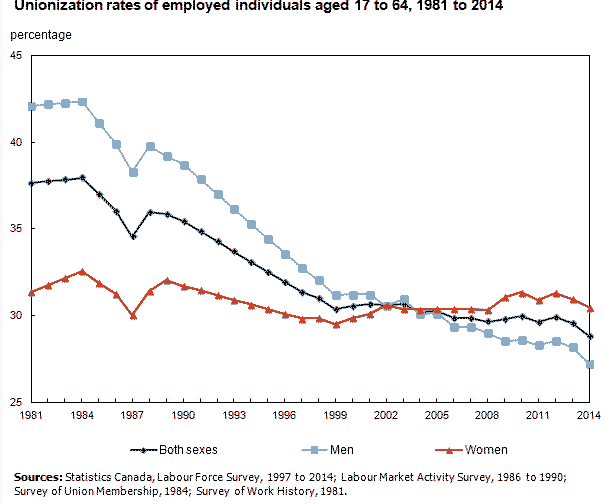
The decrease in the Canadian unionization rate was most evident among men, falling from just over 42% in 1981 to 27% in 2014, a decline of almost 15 percentage points. During the same period, the unionization rate for women was relatively stable, varying between 30% and 32%. In other words, the unionization rate of men in 2014 was 2 points below the rate for women, whereas in 1981, it was almost 11 percentage points higher.
Canada’s Unionization Rate, 1921-2016
The Huge Decline In Male Unionization Since 1981
(Click on image to enlarge)
(Click on image to enlarge)
The Unionization Rate In 2016, Canada And The Provinces


Comments
Log in or sign up to join the conversation.