

The Birth of a New Internet
China’s Great Firewall is often criticized as an attempt by the Chinese government to censor the internet, and to brainwash its people. Western journalists are often satisfied with this answer, and fail to look at the actual effect that it has had on China. China’s internet has become a parallel universe of sorts, where instead of Youtube there is Youku, instead of Google there is Baidu, and instead of Amazon there is Taobao.
However, not everything over the Great Firewall can be compared to what we have in America. Third party mobile payment apps like AliPay and WeChat Pay are making cash obsolete in China. When someone goes out to eat there, more often than not they will scan a QR code using one of these apps, and the money will be taken right out of their bank accounts. Yes, in some ways, this ‘developing’ country is more advanced than us.
The Chinese internet is massive in size, with a total market cap of 7.24 trillion yuan (1.1 trillion dollars), making it second only to America. Not only is it a massive industry, servicing the world’s largest market, but thanks to the Great Firewall, the profits are 100% Chinese.
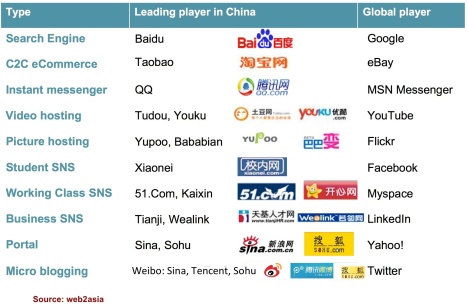
What Companies Lie Beyond the Great Firewall?
There are essentially two major players vying for control over the Chinese web: Alibaba (BABA) and Tencent (TCEHY). With a combined market cap of close to 1 trillion they account for the vast majority of China’s booming internet.
Alibaba:
Alibaba has its roots in E-Commerce, with alibaba.com, a business to business E-commerce platform that, as of 2017, is the largest B2B E-Commerce site in the world. On top of this they own the previously mentioned taobao.com, and AliExpress, e-Commerce for wholesale buyers. They dominate e-commerce in not only China, but the entire world.
Alibaba also created ‘AliPay’ a third party online payment platform with no transaction fees, the first of its kind to be used on a mass scale. This app has, since its genesis in 2004, added features to allow users to pay for their utilities and rent, take out loans, buy money market funds, and invest in wealth management products. On top of this they own Yahoo! China, and Alibaba pictures. They also have an 18% stake in Youku, and a 31.5% stake in Weibo, China’s Twitter, the second most widely used social media website in China.
Tencent:
If Alibaba is Ecommerce, then Tencent is social media. Tencent owns the first and third most widely used social media platforms in China: Wechat and QQ. WeChat in particular is very special in that it is much more than a social media platform; it has grown from a messaging app, to something ubiquitous to every aspect of a Chinese person’s life. Chinese people can use WeChat to pay for their utilities, to order a car, play video games, order food, book hotels, book flights, and even find dates. Even businesses can use WeChat to develop their brands, and sell items with ‘premium’ accounts
On top of this, Tencent owns QQ music, a music streaming app that is part of QQ, a game portal called QQ Games, and has recently acquired a stake in Vipshop (VIPS), a direct challenge to Alibaba’s dominance in ecommerce.
Who will win?
Tencent.
Tencent and Alibaba are two tech giants which both have economies of scale as an advantage. Tencent, however, has an edge. Tencent owns the most widely used social media app in the world, WeChat. WeChat has 900 million active users a day, and the average user over spends 70 minutes on WeChat a day. Weibo, the second largest social media app in China, which Alibaba has a large stake in, pales in comparison, with 340 million monthly active users.
Tencent, thus, can use WeChat to launch new ventures. This is a remarkably powerful tool, as it capitalizes on two tremendously important factors: convenience and trust. It is convenient for Chinese people to use WeChat as virtually anyone who has a phone has WeChat. Further, many people in China use WeChat to run many different aspects of their lives, and thus WeChat has established trust.
This is why, despite AliPay’s larger array of functions and seniority, WeChat Pay has grown from 8.9% to 39.8% of the country's third-party mobile-payment market share from 2014 to 2017.
This is also why when Uber tried to enter China they were edged out by WeChat’s DiDi immediately. Uber has profited tremendously from every new market it entered up until it tried to enter China in 2014, where it lost a billion dollars a year. Many claim that this is because the Chinese market is an anomaly, and use it to illustrate why western firms should stay out of China. However, the Chinese market isn’t an anomaly, and there is still a lot of money to be made there. Uber simply offered a service that was novel when it was created in America, but one that already existed by the time they entered China. This service was already offered at the same price, on an app that every Chinese person already owns and spends over an hour on every day.
The war between Tencent and Alibaba has also moved to Alibaba’s turf in recent years. As mentioned, Tencent’s Wechat Pay is growing at an alarming rate. Further, in 2014 Tencent bought a 15% stake in what has grown to be Alibaba’s biggest competitor: jd.com. In fact, jd.com will soon have an exclusive section on WeChat: if there’s one thing that you should take away from this article, it’s how deadly that is. Tencent also announced that it would partner with jd.com in purchasing a combined 12.5% stake of women’s apparel site VipShop in December 2017, another attack on Alibaba’s e commerce hegemony. It was announced that this site will also be featured on WeChat. Since the announcement, VipShop’s stock has doubled.
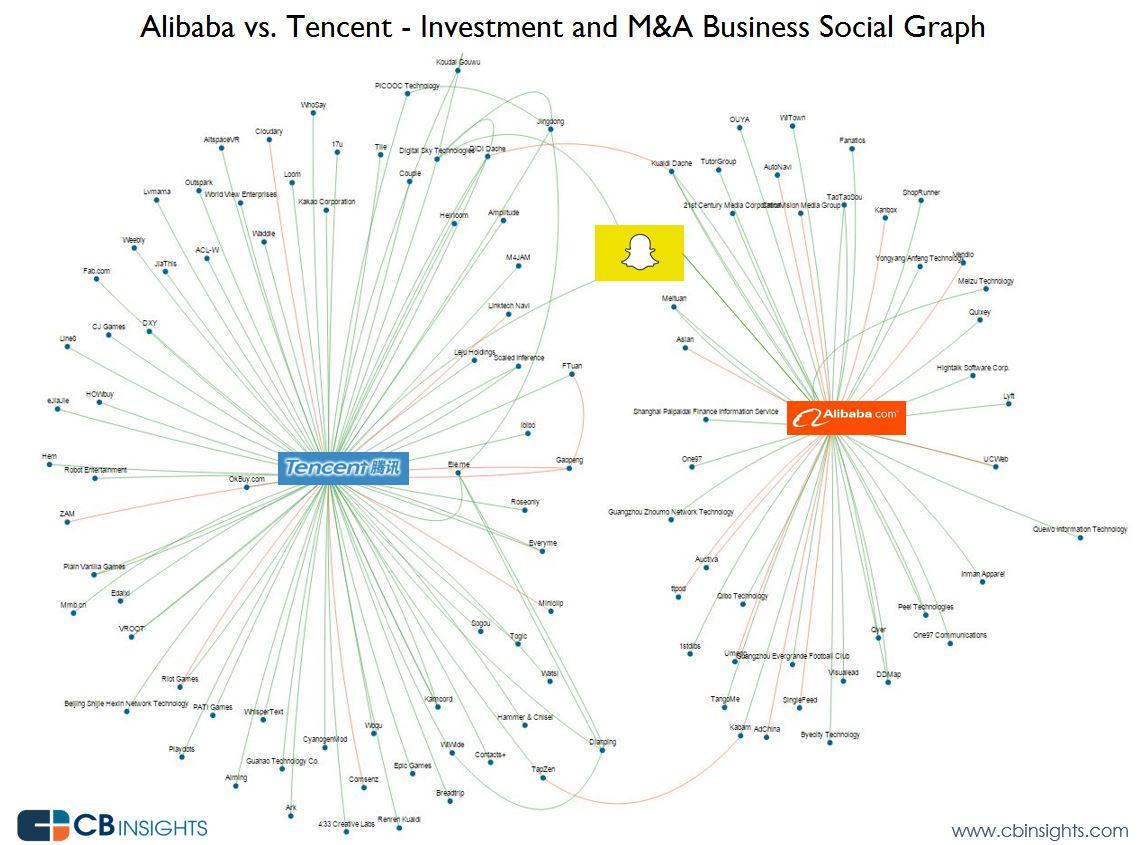
(Click on image to enlarge)
Tencent has already beaten Alibaba in size: in November 2017, it became the first Chinese company to have a market value of more than 500 Billion, with a 60% revenue increase that year. However, Tencent is not done growing. In fact, it is in the middle of consolidating a monopoly over the entire Chinese internet, and arguably, the Chinese life.
Comments
Log in or sign up to join the conversation.