

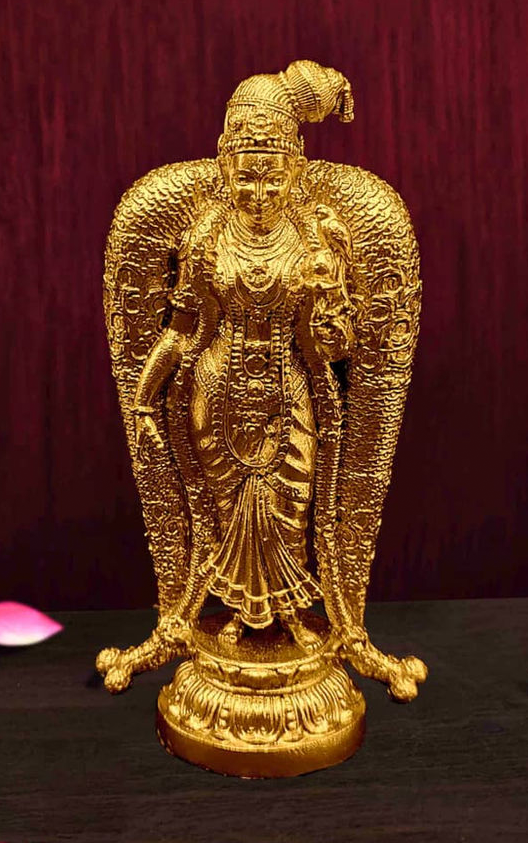
Among the twelve Alvar saints of South Indian Vaishnavism, only one is a woman — and her devotion was so complete that tradition holds she became the bride of the Lord himself. The Andal idol captures this figure at her most iconic: standing gracefully with a parrot on her hand, a symbol of a love so personal that even a bird became her confidant.
Revered across Tamil Nadu as Kodhai, Goda Devi, or simply Andal, she remains one of the most beloved figures in Sri Vaishnava tradition — a poet-saint whose verses are still recited every winter across temples and homes. Her story blends devotion, poetry and divine union in a way few other saints can match, and it continues to inspire the handcrafted brass idols offered through Idol Brass.
Who Is Andal?
Andal is regarded as one of the twelve Alvars, the Tamil Vaishnava saint-poets whose hymns form the foundation of devotional worship to Vishnu in South India. Unlike the other eleven, who were men, Andal is the sole woman among them — and tradition holds that she was not merely devoted to Vishnu but considered herself his intended bride from childhood.
Her Place Among the Alvars
While the other Alvars composed hymns describing Vishnu's glory and grace, Andal's verses are distinct for their deeply personal, almost romantic longing. Her two major works — the Tiruppavai and the Nachiyar Tirumozhi — read less like formal hymns and more like the diary of a devotee yearning for union with the divine, which is part of why her writing is still so widely recited today.
The Symbolism Behind Andal's Devotion
Andal's story is often read as the clearest South Indian expression of Madhurya Bhakti — devotion expressed through the emotions of romantic love and longing rather than formal ritual or awe.
Bhakti as Personal Love
Where many devotional traditions frame the relationship between devotee and deity as one of service or reverence, Andal's verses frame it as something closer to a love affair — complete with longing, jealousy of rivals, and the ache of separation. This is why her hymns are considered a landmark in the emotional, personal strand of Bhakti tradition.
The Parrot as a Symbol
The parrot often shown perched on Andal's hand in sculpture is more than decoration. In her poetry, she is said to have confided in a parrot, asking it to carry messages of her longing to Vishnu — making the bird a symbol of intimate, unguarded devotion.
The Story of Andal
Found Beneath a Tulasi Plant
According to tradition, Andal was discovered as an infant beneath a Tulasi plant in the garden of the Srivilliputhur temple by Periyalvar, a devout gardener-saint who tended the grounds for the deity Vatapatrasayi. Believing her to be a gift from the earth itself, he raised her as his own daughter, and she came to be regarded by many as an incarnation of Bhoodevi, the earth goddess and consort of Vishnu.
A Childhood of Devotion
As she grew, Andal became so absorbed in her love for Vishnu that she began to see herself as his destined bride rather than simply his devotee. She composed verses imagining her own wedding to him, describing the rituals, the guests and the divine groom in vivid, personal detail.
The Secret of the Garland
One of the most cherished episodes in her story involves the flower garland made daily by Periyalvar as an offering for the temple deity. Before it could be presented, Andal would secretly wear it herself, admiring how it looked on her, before returning it to the altar. When Periyalvar discovered this, he was horrified at what he saw as an act of disrespect and stopped the offering for a day. That night, Vishnu appeared to him in a dream, saying he preferred the garland only after Andal had worn it — and the practice was restored, with Andal remembered ever since as Sudikodutha Nachiyar, "she who gave what she first wore."
Union at Srirangam
As she came of age, Andal is said to have insisted that she would marry no one but Vishnu himself, in his form as Ranganatha at Srirangam. Tradition holds that she was taken there for the wedding and, upon reaching the sanctum, merged into the deity — her human life completing itself in divine union.
The Temple Connection
The Srivilliputhur Andal Temple, one of the 108 sacred Divya Desams of Vaishnavism, marks her birthplace and remains her principal shrine, instantly recognizable by its towering gopuram. The Srirangam Ranganathaswamy Temple, where her legendary union with Vishnu is said to have taken place, is closely linked to her story as well.
Each year during the Tamil month of Margazhi, devotees recite all thirty verses of the Tiruppavai over thirty consecutive days, culminating in celebrations around Vaikunta Ekadashi — a tradition that keeps Andal's voice alive in temples and homes across Tamil Nadu even today.
Spiritual Significance of Andal
Devotion without reservation — Andal's life reflects a love for the divine so complete that it left no room for a worldly one.
The dignity of longing — her poetry shows that yearning and vulnerability can themselves be forms of worship.
Women's voice in Bhakti tradition — as the only female Alvar, she holds a singular place in Tamil devotional literature.
Union as fulfillment — her story frames spiritual union not as an ending, but as the completion of a devotee's purpose.
Why Is Andal Different from Other Goddess Forms
Unlike goddesses such as Meenakshi or Lakshmi, who are worshipped primarily in their divine, cosmic roles, Andal is remembered first as a human devotee — a poet-saint whose intense personal love elevated her to divinity. This makes her story more intimate and relatable than that of most goddesses, closer to a devotee's own possible journey than to a distant cosmic figure.
Conclusion
Andal's life stands apart in the Bhakti tradition for its intimacy — a devotion so personal it reads like love itself, and a story that ends not in loss but in union. Through her verses and her enduring worship at Srivilliputhur and Srirangam, she continues to remind devotees that longing for the divine can be its own form of grace.
Comments
Log in or sign up to join the conversation.