

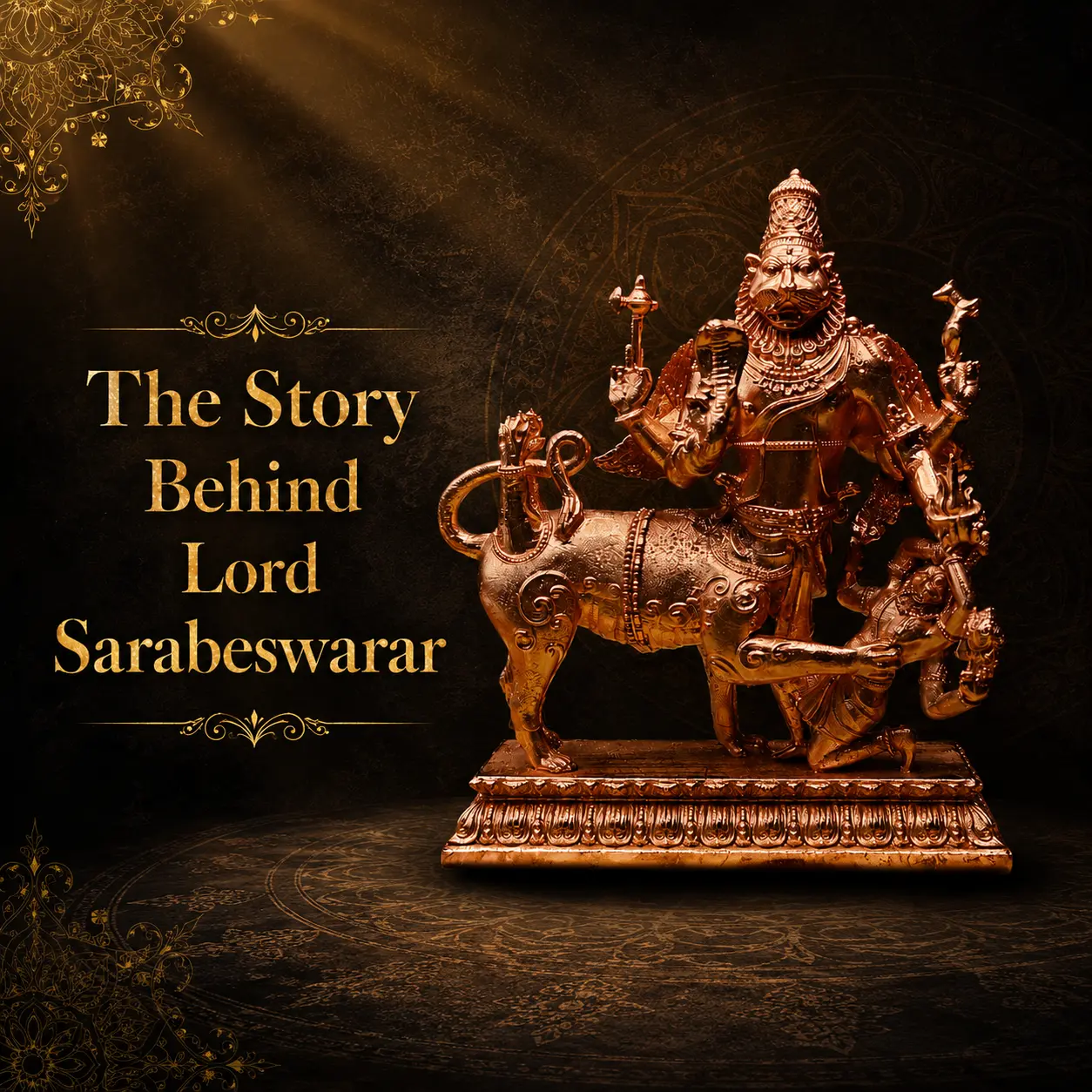
Who is Sarabeswarar?
Sarabeswarar is one of the rarest and most powerful forms of Lord Shiva in Hindu mythology - a composite being that is part lion, part bird, and part man. Unlike Shiva's more commonly worshipped forms, Sarabeswarar represents supreme, almost incomprehensible power, manifested not to destroy, but to restore balance to a universe thrown into chaos. He is especially revered in Shaivite tradition across Tamil Nadu, where his story carries deep philosophical meaning about the responsible use of strength.
Origin Story
The legend of Sarabeswarar traces back to one of the most dramatic episodes in Hindu mythology - the aftermath of Lord Vishnu's Narasimha avatar. After Narasimha destroyed the demon Hiranyakashipu in a fit of divine fury, his rage did not subside. Instead of returning to a calm, balanced state, Narasimha remained locked in an uncontrollable, destructive fury that began to threaten the stability of creation itself. The very energy that had been unleashed to protect dharma now risked becoming a force of unchecked destruction.
Narasimha Connection
Multiple attempts were made to pacify Narasimha's anger. Shiva first sent Veerabhadra, and later took the form of Rudra, but even these powerful manifestations could not calm the fury. This escalating cycle - one immense power needing an even greater one to restrain it - set the stage for Shiva's most extraordinary transformation. It became clear that only a force beyond both Narasimha and Rudra could bring resolution.
Why Shiva Took Sarabeswarar Form
To finally restore cosmic order, Shiva manifested as Sarabeswarar - a mysterious, composite form combining the ferocity of a lion, the wings of a bird, and the form of a man, considered more powerful than Narasimha himself. Importantly, Sarabeswarar did not appear to fight or destroy Narasimha. His very presence - calm, immense, and absolute - was enough to pacify the uncontrollable rage and bring Narasimha back into balance. This distinction is central to the legend: true power lies not in continued aggression, but in the ability to restore peace.
Symbolism
Sarabeswarar's form carries layered symbolic meaning. The lion represents raw, untamed power; the bird represents the ability to rise above chaos and see the bigger picture; and the human form represents wisdom and control. Together, they illustrate a being who possesses immense strength but uses it with restraint and purpose. He is often understood as a symbol of controlled power - the idea that the highest form of strength is the wisdom to know when not to use it destructively.
Worship & Significance
Devotees pray to Sarabeswarar for a range of specific reasons rooted in this symbolism - overcoming excessive anger and ego, gaining protection from powerful negative forces, restoring balance during times of personal or external chaos, and cultivating courage that is tempered with humility rather than aggression. In certain regional traditions, he is also invoked for protection against black magic and to ease the effects of difficult planetary periods. A well-known temple for this form is the Sri Sarabeswarar Temple in Thirubhuvanam, near Kumbakonam, Tamil Nadu. One of the few temples in India where Sarabeswarar is the primary deity.
What are the benefits of praying to Sarabeswarar?
In Hindu tradition, especially within Shaivite worship in Tamil Nadu, praying to Sarabeswarar is associated with several specific benefits, rooted in what this fierce form of Shiva represents:
1. Control over anger and ego Since Sarabeswarar's story centers on Shiva calming Narasimha's uncontrollable rage, devotees pray to this form specifically to overcome excessive anger, arrogance, or an unchecked ego — both in themselves and in difficult people around them.
2. Protection from powerful negative forces Because Sarabeswarar is depicted as more powerful than even Narasimha, he's considered a protector against overwhelming obstacles, enemies, or situations that feel impossible to control on your own.
3. Restoring balance and harmony The core theme of the legend is cosmic balance being restored after chaos. Devotees often pray to Sarabeswarar during times of conflict, instability, or when they feel life has spiraled out of control — seeking a return to order and calm.
4. Neutralizing black magic and negative energy In folk and temple traditions, Sarabeswarar is sometimes invoked for protection against black magic, curses, or malevolent supernatural influences, given his role as a subduer of destructive power.
5. Courage combined with humility Since he embodies immense strength used with restraint (rather than unleashed destructively), worshippers pray to him for a balanced kind of courage — the strength to face challenges without being consumed by aggression or pride.
6. Relief from planetary afflictions (in some traditions) In certain regional practices, Sarabeswarar worship is also linked to easing the effects of difficult planetary periods (like a challenging Saturn or Rahu-Ketu phase), though this varies by region and temple tradition.
Why Bronze Idol is the Preferred Choice for Sarabeswarar
Given the immense power this form represents, the material used matters. Bronze idols are the traditional choice because:
Strength & permanence - A solid bronze sculpture reflects Sarabeswarar's unmatched power far better than lighter materials.
Panchaloha casting - Authentic idols use the ancient lost-wax panchaloha method, perfected over centuries.
Energy retention - Like most god idols made of metal, bronze is believed to hold and channel spiritual energy more effectively.
Fine detailing - The composite lion-bird-man form demands intricate craftsmanship, which skilled bronze artisans are known for.
Bronze Idols in Chennai - Finding Authentic Craftsmanship
For those specifically looking for bronze idols in chennai, it's worth noting that most authentic pieces - including rare forms like Sarabeswarar - originate from the traditional artisan clusters of Swamimalai and Kumbakonam, and are supplied to shops and craftsmen across Chennai. When sourcing such a specialized idol, it helps to work with artisans experienced in mythological and lesser-common forms, since not every workshop is equipped to sculpt the intricate composite structure of Sarabeswarar accurately.
Comments
Log in or sign up to join the conversation.