

The April 2021 jobs report was disappointing, to say the least. Instead of reporting that at least one million Americans had returned to work in April 2021 with the lifting of state and local government lockdowns in high population states, the U.S. Bureau of Labor Statistics reported number of additional working Americans rose by about one-fourth of that widely expected number. Which of course meant that stock prices rose on the disappointment!
It's somewhat counterintuitive, but stock prices rose on the much worse than expected news because it means the Federal Reserve will keep its "super-easy" monetary policies in effect for longer. Prior to the report, stock prices kept running toward the lower end of the redzone forecast range on our alternative futures chart, mainly because the expectation of rising inflation would mean the Fed would be forced to move away from its super-easy policies much sooner than they would want to rein in rapidly escalating prices.
(Click on image to enlarge)
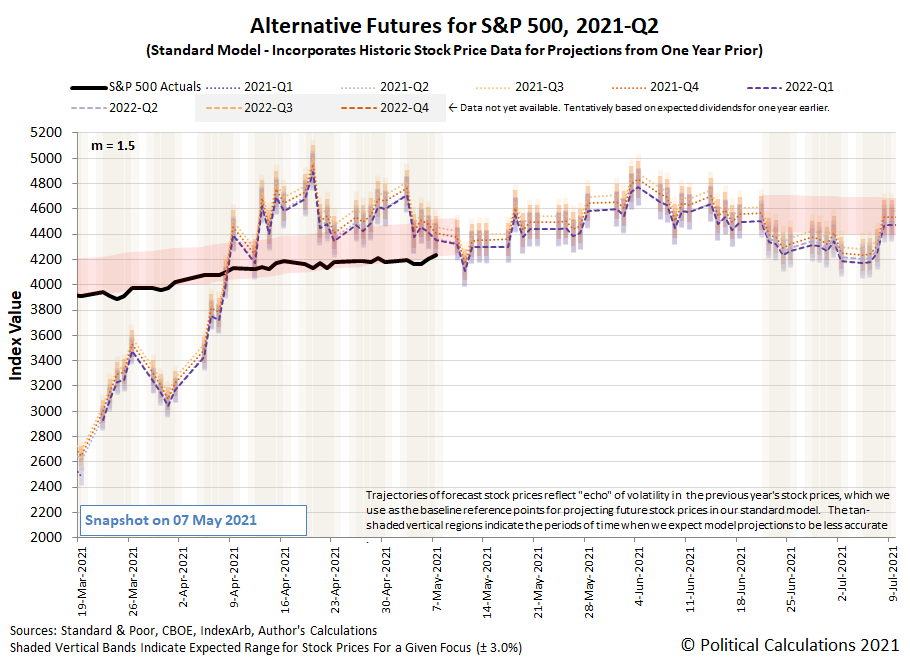
This is also a good time to review the full forecast performance of our latest redzone forecast. Our need to provide these forecasts is driven by the dividend futures-based model's use of historic stock prices as the base reference points from which it projects future stock prices. When those historic prices involve high levels of volatility, the echo of that volatility affects the model's projections.
To get around that seeming limitation, we identify the period in which the volatility echo affects the model's projections and pick points on opposite sides of it, one before it begins and one after it ends. We then connect the dots with a straight line and draw in a red-shaded range on either side of it to reflect the amount of 'typical' volatility we expect to see.
The trick in doing all this is to pick the right starting and ending points. For the nearly-just-completed redzone forecast range, we anchored a point associated with the expectations for 2020-Q2 in the "before" range, and selected a point associated with the expectations for 2020-Q4 on the future end of the forecast range. In terms of the dividend futures-based model, we assumed investors would begin the forecast range being by focusing on the current quarter of 2021-Q2 in setting stock prices, then would shift their forward-looking focus out to the more distant future of 2021-Q4 some eleven weeks later.
As we mentioned several weeks ago however, it became clear investors were holding their forward-looking focus on 2020-Q2 rather than shifting it. In the following animated chart, we compare what our results were during the eleven week period of the redzone forecast range, and what our results would have been if we had assumed investors would keep their attention only on 2021-Q2 instead:
(Click on image to enlarge)

This is one of the longest periods in which we've attempted to push the limits of what we can do in forecasting stock prices. With our original assumption that investors would start the redzone forecast period focused on 2021-Q2 and shift that focus to 2021-Q4 by its end, 85% of the S&P 500's daily closing values fall within the range, and 15% fall below it. As our redzone forecasts go, this latest example is one of the worst we've done.
But the alternate hypothesis of investors focusing only on the expectations associated with 2021-Q2 in setting current day stock prices would have seen the S&P 500 fall within its projected range on 95% of the trading days, with just 5% falling below the range.
Looking forward, we think the trajectory of the S&P 500 is likely to undershoot the dividend futures-based model's standard projections in the weeks ahead, mainly because the spector of inflation has been let loose. Even if the Federal Reserve keeps its "super-easy" policies, the longer that situation continues, the more expectations among investors will grow that the Fed will be forced to change course.
Comments
Log in or sign up to join the conversation.