

Over the past week, Federal Reserve officials have worked hard to set the expectation they're going to be aggressive in hiking short-term interest rates in the U.S. At this point, the odds that 2022-Q2 will see two half-point rate hikes have risen over 80% according to the CME Group's FedWatch tool.
But the real question for S&P 500 (Index: SPX) investors is what will they do in 2022-Q3? The FedWatch tool gave a 2 out of 3 chance of a third half-point rate hike in July 2022, and only foresees quarter-point rate hikes after that point, raising questions about how many larger rate hikes there will be.
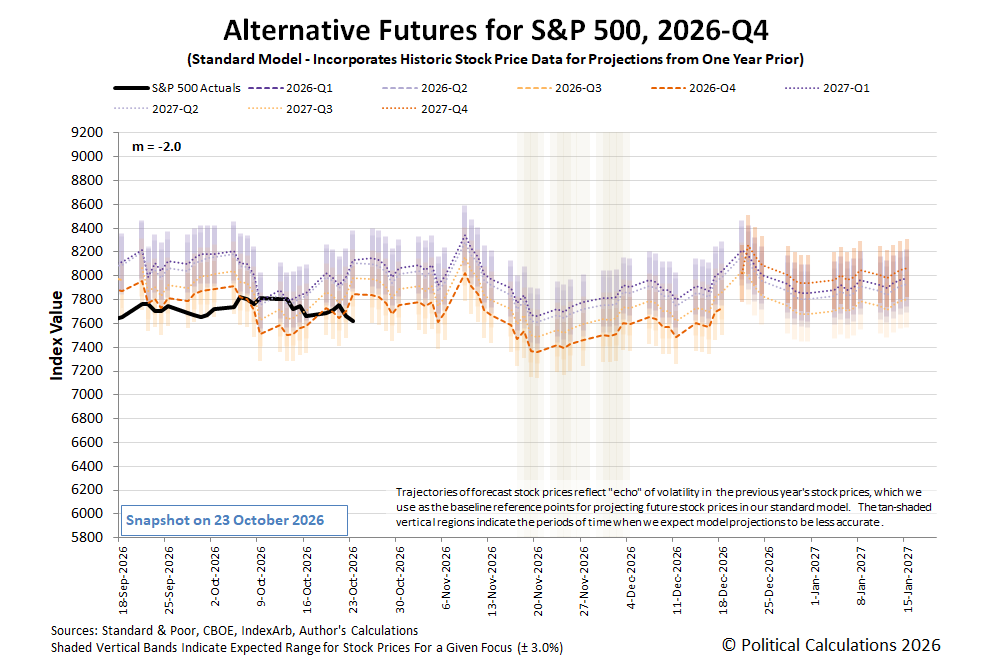
With that kind of information to digest, it's little wonder we find investors continuing to focus on 2022-Q3 in setting current day stock prices, as indicated in the freshly minted alternative futures forecast chart for 2022-Q2.

We've added a new red zone forecast to the chart because we're coming up on another one of those periods where the echoes of past volatility in stock prices affect the dividend futures-based model projections. This situation arises for the model because it directly incorporates historic stock prices as the base reference points from which it projects the potential futures for the S&P 500.
The red zone forecast range is a simple technique we've developed to work around the echo effect from the past volatility of stock prices, where we simply connect the dots on both sides of an upcoming period where the model's forecast accuracy will be impacted. The newest forecast range is based on the assumption investors will continue focusing on 2022-Q3 for the next several weeks.
Should there be no erosion in the expected level of dividends for stock prices, and no shift in focus toward a different point of time in the future, the model projects stock prices will slowly rise over the next several months. This projection represents what we called the "best-case scenario" described by Ed Yardeni in the previous edition of our S&P 500 chaos series.
Here is our selection of market-moving headlines that influenced investor expectations during the first week of April 2022.
Monday, 4 April 2022
- Signs and portents for the U.S. economy:
- Fed minions claim they'll be watching economy closely while hiking rates:
- Bigger trouble developing in the Eurozone, Russia, China:
- ECB minions unexpectedly sets date for rate hike:
- S&P 500 rises on megacap stock boost, Twitter surge
Tuesday, 5 April 2022
- Signs and portents for the U.S. economy:
- Fed minions say no recession ahead, want to stop buying and shrink holdings of U.S. Treasuries sooner:
- Bigger trouble developing in East Asia and Pacific nations:
- Mixed signs in the Eurozone:
- ECB minions threaten to hike rates back up to 0%:
- Wall Street tech shares stumble on fears of aggressive Fed
Wednesday, 6 April 2022
- Signs and portents for the U.S. economy:
- Fed minions signing up for bigger rate hikes and shrinking balance sheet, think they have time to act:
- Bigger trouble, stimulus developing in China:
- Bank of Canada minions signing up for bigger rate hikes too:
- ECB minions worry they'll crash Eurozone economy with rate hikes if they fight inflation:
- S&P 500 ends lower after Fed minutes
Thursday, 7 April 2022
- Signs and portents for the U.S. economy:
- Fed minions pitch using velvet hammer when hiking rates higher, executing new 'QT' plan:
- ECB minions thinking about not doing quite so much stimulus as way to cool inflation:
- S&P 500 ends higher, lifted by Tesla
Friday, 8 April 2022
- Signs and portents for the U.S. economy:
- Bigger stimulus developing in China, Eurozone:
- Positive growth signs out of Taiwan:
- ECB minions working to keep Eurozone stimulus alive despite rate hikes!
- Dow gains, S&P 500 ends lower as market weighs Fed rate hikes
The CME Group's FedWatch Tool is still projecting Fed's next moves will be three consecutive half point rate hikes in May, June, and July (the first two in 2022-Q2, the third in 2022-Q3). After which, the FedWatch tool foresees five quarter point rate hikes at six-week intervals.
The Atlanta Fed's GDPNow tool's latest estimate of real GDP growth in 2022-Q1 dropped down to 1.1% after factoring in the latest international trade data into its projections.
Comments
Log in or sign up to join the conversation.