


Image Source: Marga Santoso on Unsplash
Holiday weekends tend to produce strange market behavior. I've seen it happen dozens of times over the years. Human traders leave their desks early. The algorithms take over with one less day in the trading week. Last week was no exception. Markets experienced a sharp rebound after breaking through a key technical level.
The big debate right now is whether stocks are retesting former support as resistance, or whether we just witnessed a false breakdown. Time will give us the answer shortly. But as keen sector observers, we know exactly what to look for coming out of a low.
There's a niche theme developing that most traders are completely ignoring.
Forget Mega-Cap Tech, Focus on This Instead
For years, the entire market narrative revolved around seven stocks. The Magnificent Seven dominated every headline and every fund flow report. Add names like AMD, Palantir, and Broadcom to the mix, and you get a Magnificent Ten. That group accounts for roughly 40% of the S&P 500.
That concentration worked beautifully on the way up, yet it has been a drag on the tape since October. These names have attempted to find support in recent weeks. They still face major headwinds before we get any kind of "all clear" signal.
Earnings expectations remain elevated. The AI spending cycle is facing tougher scrutiny from investors who want to see actual returns on massive capital expenditures. But I've noticed something much bigger brewing underneath the surface.
The Russell 2000 has outperformed the large cap indices by a wide margin during this correction. When small-caps hold up better than large-caps during a selloff, it tells you that capital is rotating, not leaving.
This got me thinking about a more specific slice of the market: small-cap tech stocks. Take a look at this ratio chart.
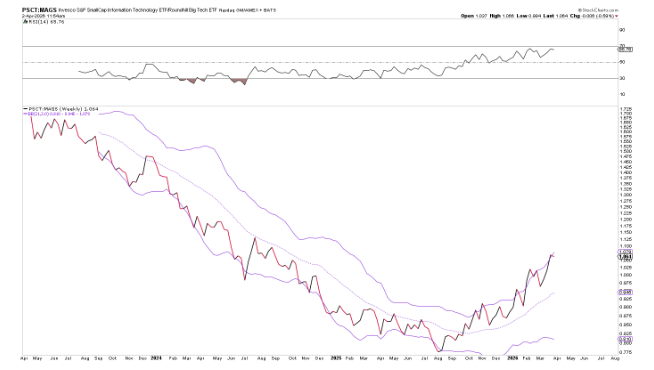
This chart compares small-cap tech stocks to the Magnificent Seven. Up until about August of 2025, the big tech names were dominating the relationship.
Since then, the trend has quietly reversed. Small-cap tech names have been steadily outperforming their mega-cap counterparts. The ratio has been making higher lows and recently pushed to a new relative high. Most traders are seemingly not paying any attention to this at all.
Why This Matters for Your Portfolio
Traders are still obsessed with whether Nvidia will hold its 200-day moving average or whether Apple can reclaim its highs. Meanwhile, the real relative strength is showing up in smaller, less-followed names.
History shows that when leadership shifts like this, it tends to persist for months. Consider what happened during previous rotation cycles:
In late 2020, small-caps outperformed large-caps by over 30% in just a few months after a similar divergence appeared
In early 2016, small-cap tech led the recovery out of the January-February correction well before mega-caps joined the party
In 2018, the October selloff saw small-caps bottom first and lead the snapback rally into year-end
The pattern is consistent. When the mega-cap trade gets crowded and starts to unwind, capital flows into the next best opportunity. Right now, that opportunity is sitting in small-cap tech.
Once the indices sort out this volatility, keep close tabs on this space. Small-cap tech stocks are setting up to be serial outperformers in 2026. The ratio chart is confirming it. The relative strength is confirming it. The rotation out of mega-caps is confirming it.
I will keep you posted.



Comments
Log in or sign up to join the conversation.