

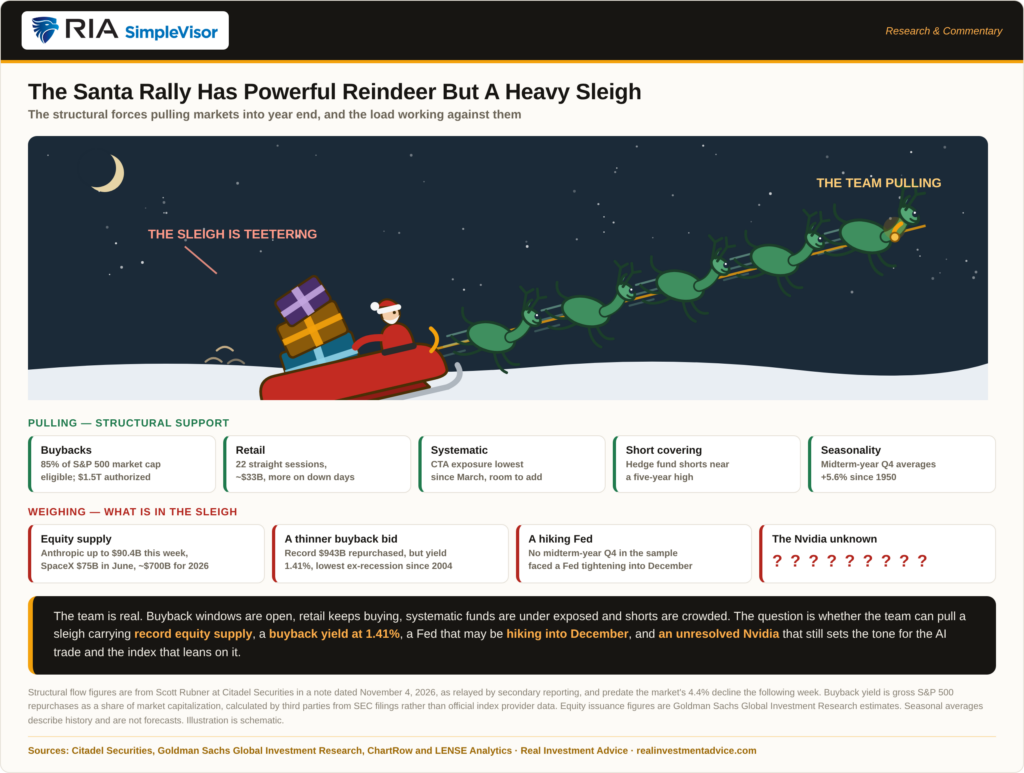
Scott Rubner at Citadel Securities lays out a strong case for a Santa Claus rally with a number of powerful reindeer pulling it. For starters, most corporate stock buyback windows reopened after earnings, and there are $1.5 trillion in new buyback authorizations. Further, retail investors have bought for 22 consecutive sessions, totaling about $33 billion, and have generally bought more heavily on down days. On the institutional side, systematic funds cut equity exposure to the lowest levels since March, and hedge fund equity shorts sit near a five-year high. Both have plenty of room to add equities and should chase a rally to avoid falling behind. Lastly, history is on the market’s side, with fourth quarters of midterm years averaging 5.6% since 1950, versus 2.9% for all years.
We find that structural basis for a rally persuasive and tend to agree with Scott, but we are very mindful that Santa’s sleigh is heavier than normal this year.
As we wrote in Tuesday’s Commentary, Anthropic is likely pulling about $90 billion out of the market this week, following SpaceX’s $75 billion in June, and in a year of roughly $700 billion in total equity issuance. This year, the buyback reindeer is smaller than it looks. Gross repurchases hit a record $943 billion last year, yet the buyback yield fell to 1.41%, the lowest outside a recession since 2004, because market capitalization grew faster than the buying.
Furthermore, there are two heavy weights in the sleigh that the market hasn’t had to contend with in the past. First, every midterm year fourth quarter in that sample arrived without a Fed hike in December. This one will likely see a Fed rate hike. Second, given how heavily the market leans on the AI trade, whatever may happen with Nvidia may set the December tone.
Rubner published his bullish missive on November 4, before the market fell 4.4% following the election and the Nvidia news broke. His thesis is being tested early but still holds water. The buyers and potential buyers are real, underpositioned, and have seasonality behind them. However, we recognize that this sleigh carries a load that the prior Santa rally did not have to bear.
What To Watch Today
Wednesday, November 18, 2026. All times ET.
Economy
Time (ET) | Release (Period) | Prior | Consensus | Forecast |
|---|---|---|---|---|
8:30 a.m. | Housing Starts (Oct) | 1.221M | 1.27M | 1.20M |
8:30 a.m. | Building Permits, Prelim (Oct) | 1.398M | 1.38M | 1.36M |
10:00 a.m. | Pending Home Sales MoM (Oct) | -7.3% | -2.1% | -1.0% |
1:00 p.m. | 20-Year Bond Auction | 5.469% | n/a | n/a |
2:00 p.m. | FOMC Minutes (Oct 27-28 meeting) | n/a | n/a | n/a |
Source: Trading Economics, confirmed against the Census Bureau and Federal Reserve release schedules. As of Nov. 17, 2026. Real Investment Advice | RealInvestmentAdvice.com | ||||
Earnings
Company (Ticker) | Timing | EPS est. | Rev. est. |
|---|---|---|---|
Target (TGT) | Before open | $2.05 | $26.39B |
Lowe’s (LOW) | Before open | $2.87 | $22.38B |
TJX Companies (TJX) | Before open | $1.34 | $15.86B |
Palo Alto Networks (PANW) | After close | $0.97 | $3.31B |
Source: Trading Economics, confirmed against Earnings Whispers and company announcements. Nvidia (NVDA) reported Tuesday after the close, so today is the reaction session. As of Nov. 17, 2026. Real Investment Advice | RealInvestmentAdvice.com | |||
Fed speakers: Governor Barr at 1:35 p.m. and New York Fed President Williams at 2:30 p.m., bracketing the 2:00 p.m. FOMC minutes.
Market Trading Update
On Monday, we looked at who is at risk due to Nvidia’s circular financing after Jensen Huang’s exit. Today, I want to answer the question clients keep asking. Has the AI selloff already priced in a data center bust? Our stress test says it has priced in a slowdown, BUT not a bust.
The setup is simple. We took consensus forward earnings for Microsoft, Amazon, Alphabet, and Meta, plus Nvidia and AMD, and broke them. For the hyperscalers, the worst case keeps cash earnings flat while depreciation continues to climb. Capex currently runs roughly 2.7 to 5.7 times depreciation, so that bill arrives whether AI revenue shows up or not. For the chipmakers, the worst case cuts data center sales in half from today’s run rate.
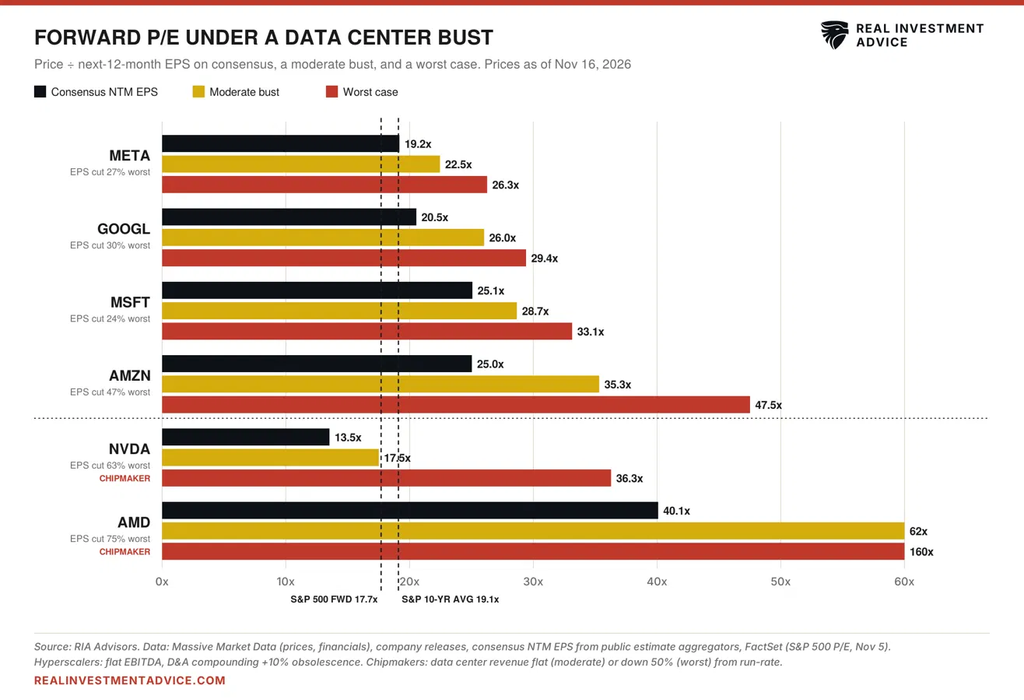
Notice the gap between the black and red bars. On consensus, Meta trades at 19 times forward earnings and Alphabet at 20.5 times, not far from the S&P 500’s 17.7 times as of November 5. On worst-case earnings, every name sits above 26 times. The “cheap” valuations only exist if the earnings show up.
The chipmakers carry the most risk because their worst case is the hyperscalers’ best case. If buildouts stop, capex collapses and hyperscaler free cash flow jumps. Meta’s yield would rise from 1.8% to 6.1%. That’s the moment Goldman’s Delta One desk flagged, when hyperscalers stop buying capacity at any cost and start optimizing returns on what they’ve built. That same capex is Nvidia’s and AMD’s revenue. Despite Nvidia’s stellar earnings report last night, one quarter doesn’t settle this, but its customers’ 2027 capex guides will.
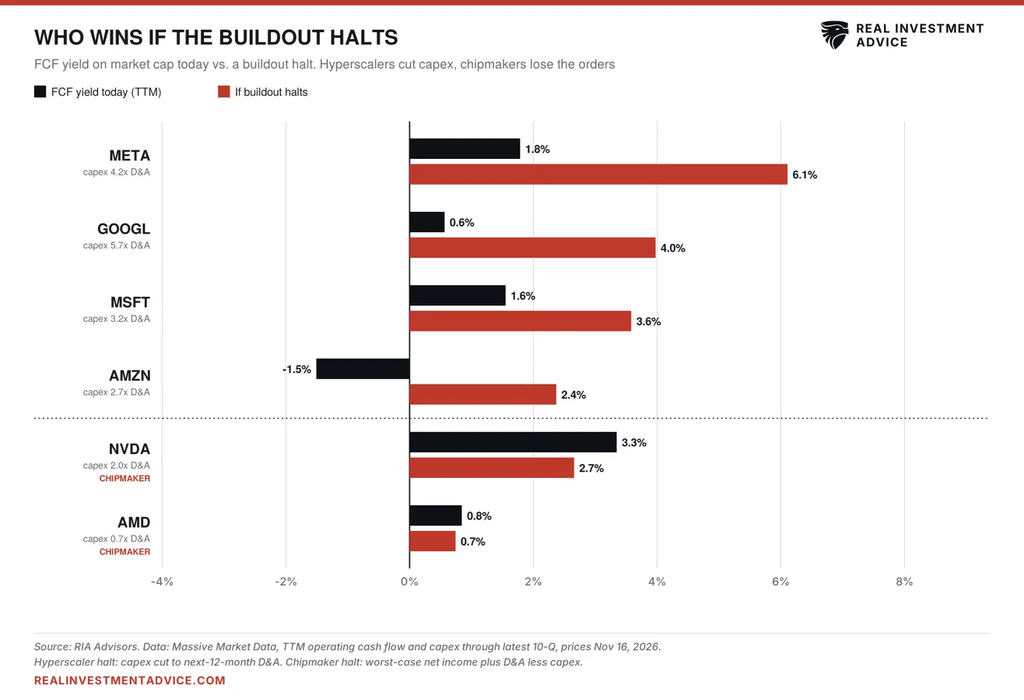
Here’s where prices land if the worst gets priced in, at 18 to 24 times worst-case earnings. Meta sits about 20% above the midpoint of its range, and Alphabet roughly 29%. Amazon is 56% above, and AMD a punishing 87%.
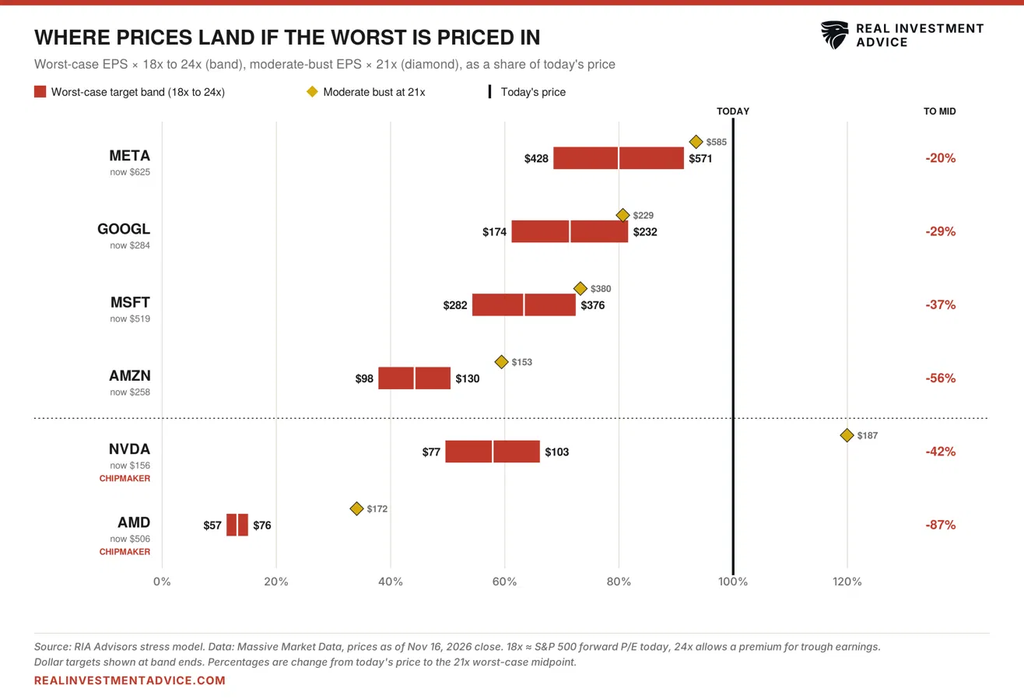
The obvious pushback is that nobody values trough earnings at a market multiple. Fair enough. This is a hypothetical model of the worst case, and reality tends to land somewhere in between. So the real question is whether enough of a “weaker” case has been priced in yet?
The moderate-bust diamonds on the chart answer that. Meta trades only about 6% above its moderate-case value, while Nvidia already trades below its own. Alphabet sits roughly 19% above, Microsoft 27%, Amazon 41%, and AMD a full 66%. In other words, the market has priced a slowdown into a few names but not across the group.
So what do we do? Owning quality hyperscalers is fine, but size them for the bust, not the boom. Trim chipmaker exposure back to target weight, since their downside in a capex slowdown is the steepest. Favor Meta and Alphabet over Amazon on any adds, and buy in tranches as prices approach the worst-case bands. Keep stops honest and some cash on hand.
Such is the price of owning the buildout. The bill for overbuilding always arrives after the party ends.
The Housing Deep Freeze
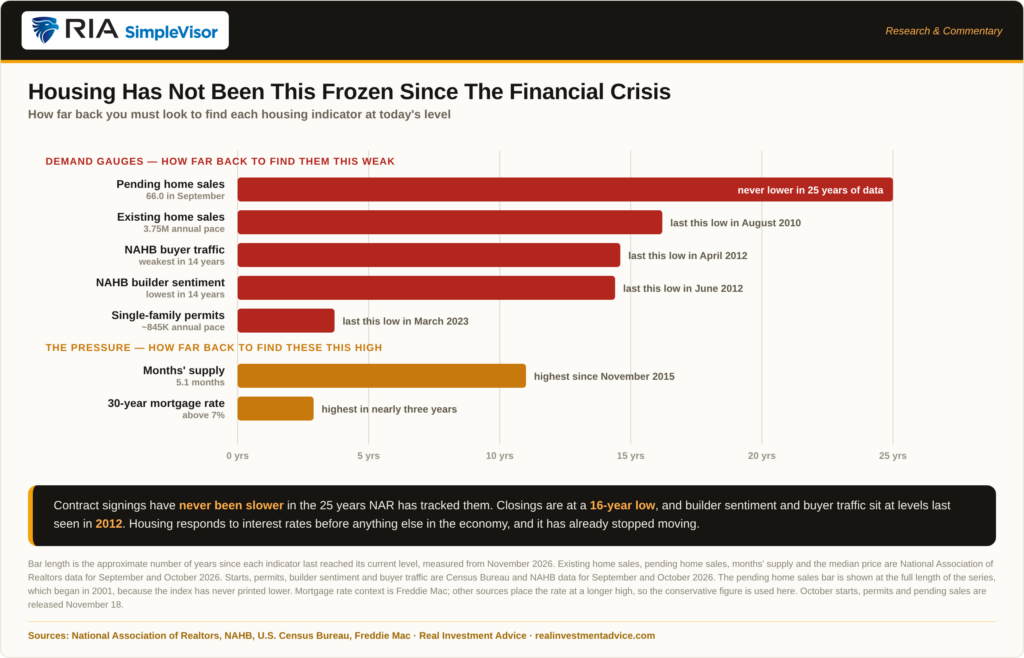
The housing market has stopped moving, and the Fed appears set to tighten further, likely freezing it up more. Consider that existing home sales fell 5.5% in October to 3.75 million annually, the lowest since August 2010 and nearly 9% lower than a year ago. The pending home sales index, which leads closings by a month or two, dropped to 66.0 in September. That is the lowest reading since NAR began tracking the series in 2001.
New home builders tell the same story. Single-family starts fell to roughly 859,000 in September, and single-family permits slipped to about 845,000, the weakest since March 2023. Because permits lead starts, we expect the construction pipeline to weaken further. Meanwhile, the NAHB sentiment index sits at its lowest since June 2012, with prospective buyer traffic the worst since April 2012.
The cause is obvious: the 30-year mortgage rate has been above 7% since mid-September and recently reached its highest level in nearly three years. At those rates, the roughly $417,000 median existing home is out of reach for many first-time buyers, and first-time buyers fell to 29% of sales from 32% a year ago.
Here is what concerns us. Housing is the most rate-sensitive sector of the economy, and it is already operating at levels last seen after the financial crisis. Yet a December rate hike is likely. The Fed is weighing further tightening to address inflation, while the part of the economy that responds first to interest rates has already stalled and is weakening further after the last rate hike.
Bear in mind that housing’s reach extends well beyond the homebuilder sector, accounting for roughly 15.7% of GDP and some 3.3 million construction jobs, which have declined for twenty consecutive months. Shelter also makes up about a third of CPI, but because it is measured predominantly off rents with a long lag, a frozen market delivers no near-term inflation relief to the Fed.
Tweet of the Day


Comments
Log in or sign up to join the conversation.