

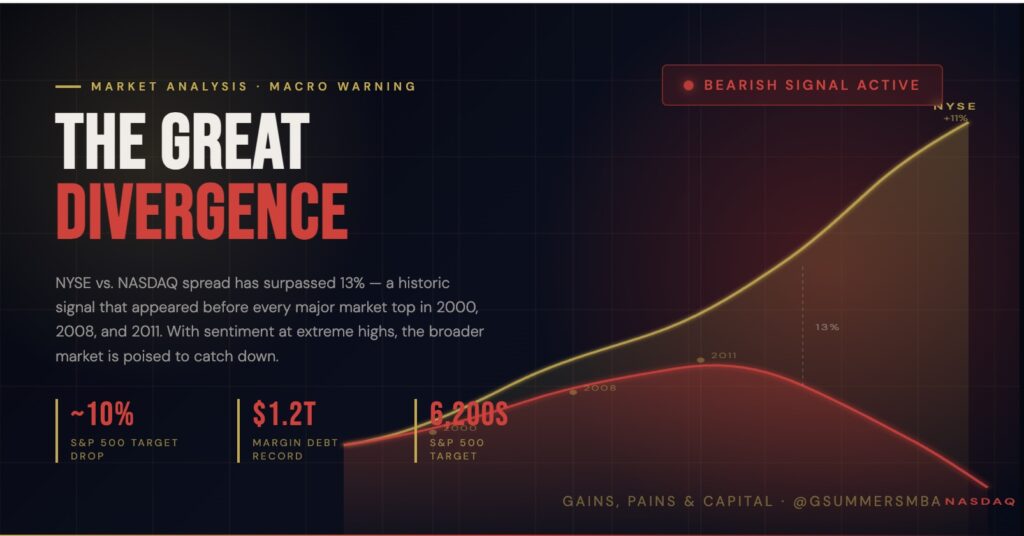
The spread between tech stocks and the rest of the market has reached historic levels.
For weeks now, the MAG-7/ Big Tech have been correcting while the broader market index (the S&P 500) has rallied due to defensive sectors (Industrials, Consumer Staples, Energy) igniting.
In this context, the #1 question concerning the market is…
Are the Mag-7 about to rip higher and rejoin the bull market… or is the overall market going to drop down to the MAG-7?
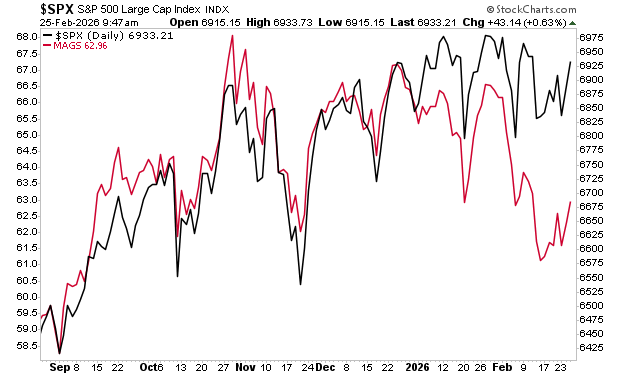
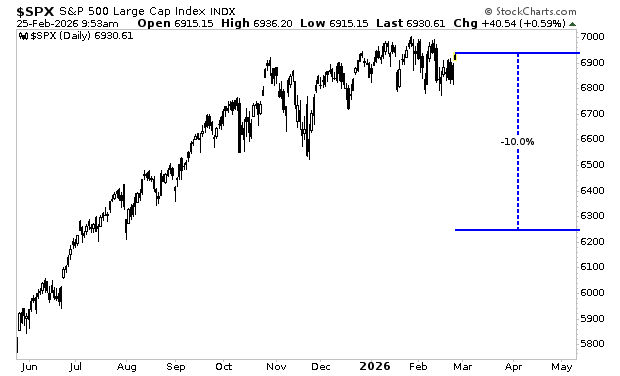
I now believe the rest of the market is about to play catch-up to the downside. And ultimately, I believe the S&P 500 will drop ~10%, bringing it to the 6,200s.
Why?
Everything changed in the market’s structure in the last two weeks. Specifically, the spread between the NYSE (old economy) and the new economy (the Nasdaq) surpassed 11% (meaning the NYSE is up 11% vs. the Nasdaq since the latter’s peak).
Historically, in the context of raging bullish sentiment (more on this shortly), a spread of this magnitude between the NYSE and Nasdaq has resulted in a MAJOR top. This was the case in 2000, 2008, and in 2011.
By the way, the spread is currently over 13%.
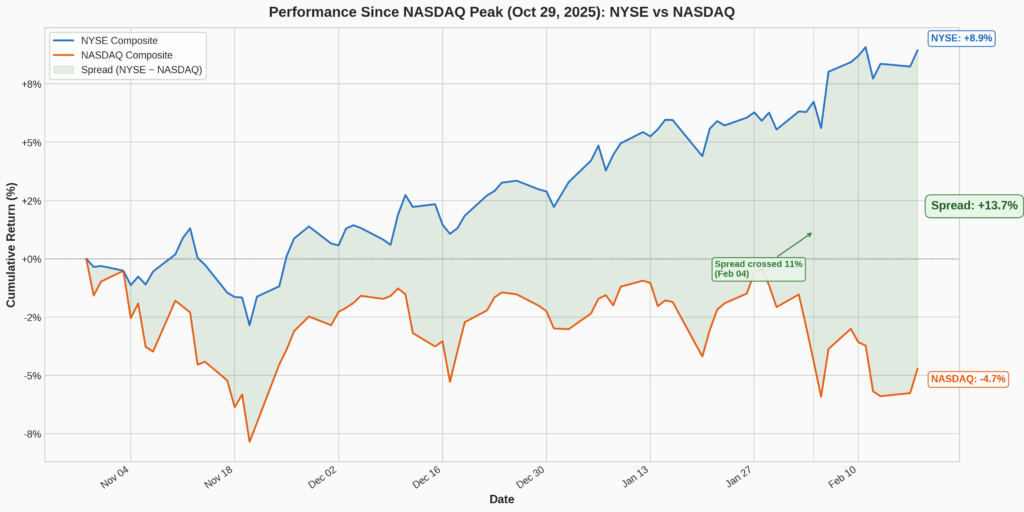
I want to stress that sentiment is a critical component in this analysis. There are other occasions when the NYSE has outperformed the Nasdaq by 11% or more… but those took place in the context of VERY different market conditions.
Today, investors are ragingly bullish. US ETFs saw RECORD inflows of $156 BILLION in January.
Moreover, margin debt (debt investors take on to invest in stocks) has been at RECORD highs for seven straight months! As I write this, it stands at $1.2 TRILLION.
Put simply, investors are ALL IN on stocks. Every dip is being aggressively bought, and investors have borrowed over $1.2 TRILLION to invest in the stock market.
This is RAGING bull market/ bubble territory as far as sentiment is concerned. Indeed, just a few weeks ago, the American Association of Individual Investors (AAII) survey recorded its 1-year high for bulls (49.5% of investors). And for the two weeks following that reading, bulls remained above 40%.
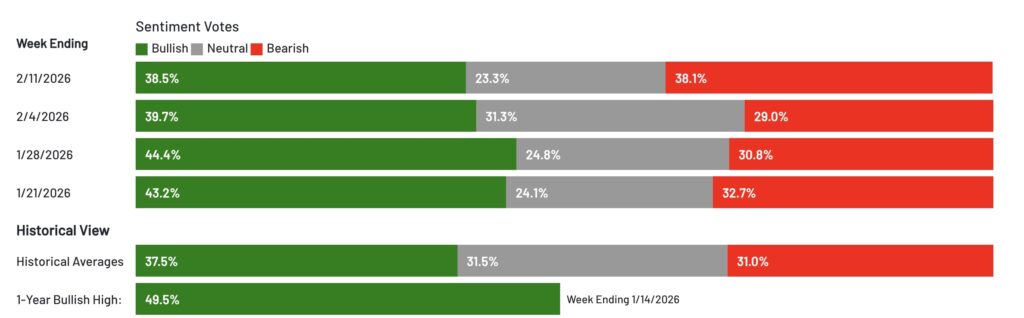
This is the kind of sentiment you see at TOPs, not bottoms.
In this context, the spread between the Nasdaq and NYSE is EXTREMELY bearish. Historically, this kind of spread, in the context of frothy sentiment, has marked significant tops that have led to the NYSE/ S&P 500 dropping 10% to play catch up to the downside.
That means the S&P 500 down to the 6,200s.
In terms of preparing for a market collapse, I rely on a proprietary indicator that has triggered before every major meltdown in the last 50 years. This signal caught the 1987 crash, the Tech Crash, the Great Financial Crisis and more.


Comments
Log in or sign up to join the conversation.