

Lakshmi Narasimhar - Picture the moment right after the storm — not the lightning, but the silence that follows it. He tore a pillar apart with his bare hands, took the form of half-man, half-lion to shred a demon no weapon on earth could touch, and then — nothing could calm him. Not the gods, not the sages, not even the heavens trembling under his roar. Only Goddess Lakshmi dared step closer, and where fear failed, her devotion succeeded — his fury simply dissolved into peace.
This handcrafted Lakshmi Narasimha Idol holds that exact breath in bronze: a god who could have destroyed everything, choosing instead to rest. It's why this idol remains one of the most quietly powerful pieces at Idol Bronze — not a symbol of what strength can do, but of what it becomes once it finally lets go.
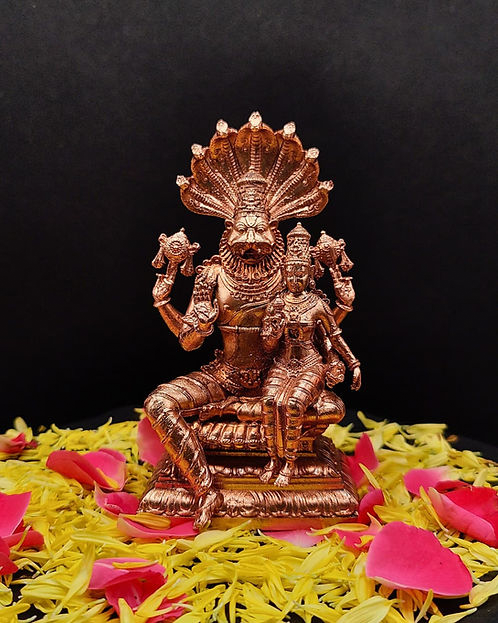
The God Who Chose Peace Over Fury
Lakshmi Narasimha is the saumya, or serene, depiction of Narasimha — the fourth avatar of Vishnu — shown seated with Goddess Lakshmi resting beside him or on his lap. Of the many iconographic forms in which Narasimha is worshipped, this is the one where his fearsome, world-shaking energy has visibly softened into calm, protective grace.
One God, Two Storms: Rage and Its Aftermath
Hindu tradition worships Narasimha in several forms, ranging from Ugra Narasimha — ferocious, mid-slaughter, teeth bared — to this gentler Lakshmi Narasimha. The two are not contradictions but companions: one shows divine anger in defense of dharma, the other shows what becomes of that anger once its purpose is fulfilled. Devotees often say that to understand Lakshmi Narasimha fully, one must first understand the fire he was before he became still.
The Goddess Who Walked Toward Danger
Most depictions of Vishnu show Lakshmi seated beside him in quiet partnership. Here, her role is different — she is not merely a consort in glory, but a consort in crisis, approaching a god still trembling with rage no one else dared face. It is a rare mythological image: the goddess of fortune stepping toward danger, not away from it, to bring her husband back to himself.
Power and Grace: The Philosophy Behind the Form
When Two Forces Complete Each Other
In this form, Narasimha represents Shakta — raw, unbound power — while Lakshmi represents Shakti, the grace that gives that power direction and meaning. Neither is complete without the other: power without grace turns destructive even after its purpose ends, and grace without power has nothing to temper. Lakshmi Narasimha shows the moment these two finally meet in balance.
Even Righteous Anger Must Learn to Stop
Philosophically, this form teaches that righteous anger has its place — but also its limit. Divine justice, once served, must give way to peace, or it curdles into something harmful even to the one who dispensed it. Lakshmi Narasimha is often invoked precisely for this reason: to remind devotees that strength is only complete when it knows how to stand down.
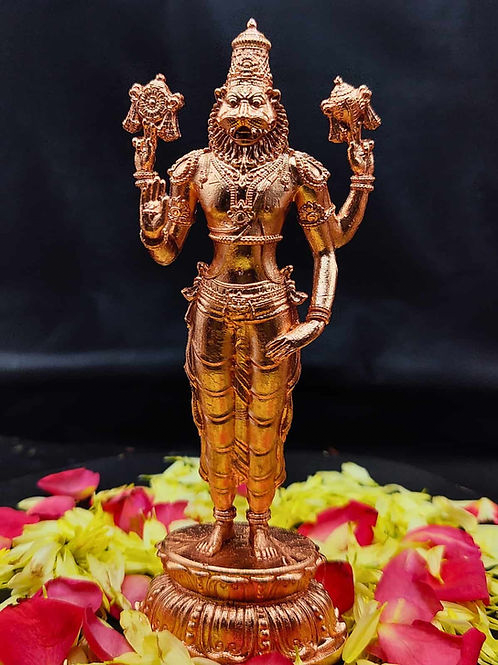
The Legend That Shook Heaven and Earth
A Boon Written Without a Single Loophole — Until There Was One
The asura king Hiranyakashipu had won a boon so carefully worded that death seemed impossible — not by man or beast, not by day or night, not indoors or outdoors, not on earth or in sky. Emboldened, he persecuted the devotees of Vishnu across his kingdom, certain no force in creation could touch him.
A Son's Faith That Refused to Break
Among the persecuted was Hiranyakashipu's own son, Prahlada, whose devotion to Vishnu never wavered despite poison, fire and repeated attempts on his life. When his father demanded to know where Vishnu could be found, Prahlada answered that Vishnu was everywhere — even, he said, within the very pillar beside them.
The Pillar That Tore the Sky Open
Enraged, Hiranyakashipu struck the pillar — and it split open at dusk, neither day nor night, to reveal Narasimha: half-man, half-lion, fulfilling every clause of the boon by existing entirely outside its terms. Narasimha dragged the demon to a threshold, laid him across his lap, and killed him with his claws as twilight fell.
The Touch That Finally Calmed a God
Even after Hiranyakashipu fell, Narasimha's rage did not subside — his roar is said to have shaken the heavens, and no god or sage dared approach him. It was Goddess Lakshmi who finally drew near, offering herself in devotion rather than fear, and it was her presence alone that eased Narasimha back into peace. This is the exact moment Lakshmi Narasimha idols are made to capture — power finally, gently, at rest.
Where This Story Still Lives Today
This legend didn't stay in scripture — it took root across sacred hills and riverbanks, each temple holding its own piece of the tale. The Ahobilam temple complex in Andhra Pradesh, believed to be the very spot where the pillar split open and Narasimha emerged, remains the epicenter of his worship, home to the Nava Narasimha — nine distinct forms spread across its hills, with the Lakshmi Narasimha Swamy Temple at Lower Ahobilam dedicated specifically to this peaceful, consort-seated form.
Further north, the hilltop shrine at Yadadri draws pilgrims to a Narasimha said to have appeared before the sage Yadava Maharshi after years of penance, while the Panakala Lakshmi Narasimha Swamy Temple at Mangalagiri is famed for its idol that is offered jaggery water believed to be consumed by the deity himself. At Antarvedi, where the Vasishta Godavari meets the Bay of Bengal, and at Dharmapuri on the banks of the Godavari itself, Lakshmi Narasimha is worshipped as a guardian who rose to protect his devotees — each site a living chapter of the same story: fury answering a devotee's call, then finding peace in Lakshmi's presence.
Why Devotees Turn to Him
A Protector Who Doesn't Need to Frighten You
Because his fury has already been spent and calmed, Lakshmi Narasimha is approached as a protector who defends without needing to frighten those he protects.
Strength That Knows When to Rest
He is invoked by those seeking to master their own anger or intensity — a reminder that strength is meant to serve, then settle, not consume.
Grace That Brings Abundance Home
With Goddess Lakshmi seated beside him, the idol is closely associated with wealth, abundance and family stability.
The Fury That Became a Love Story
The image of a fierce god soothed by devoted love makes this form especially meaningful for couples and families seeking peace within the home.
Four Faces of One Lion, and Only One That Rests
Ugra Narasimha is worshipped mid-battle, frozen in the act of destruction; Yoga Narasimha is shown in silent meditation, having withdrawn entirely from the world; Gandaberunda Narasimha appears as a two-headed being of overwhelming, almost cosmic power. Lakshmi Narasimha stands apart from all three — not withdrawn, not mid-fury, but present and at peace, power made approachable through love rather than distance.
Let This Peace Guard Your Home Too
Many households choose this particular form of Narasimha precisely because it holds both halves of the story at once — the protector and the protected-turned-peaceful. Traditionally placed in the pooja room or a family altar, it is regarded as a guardian who has already proven what he will do for those he loves, and now simply watches over them. The Lakshmi Narasimha Idol at IdolBronze reflects this duality in its detailing, rendering Narasimha's regal strength alongside Lakshmi's gentle, stabilizing presence — a fitting piece for daily worship or as a meaningful gift marking a new home or milestone.
Conclusion
Lakshmi Narasimha's story is not simply about a demon defeated — it is about what comes after victory, when power must learn stillness. That is why this form continues to be worshipped not just for protection, but for the peace that follows it.
Comments
Log in or sign up to join the conversation.