


The one thing a retired person has to do that most of us ignore in our younger years is have a firm plan in place for market corrections.
Most of us do not have the time to recover from a big loss.
And from my perspective, the markets so far in 2015 have been showing all the signs of another rough period in our future:
- Stocks dropped 1,000 points from their record high and were down 800 points in July alone.
- The market is riddled with the “topped-out jitters” and has been for months.
- The bond market is being hit by threats of higher rates, a liquidity crunch and tumbling commodity prices.
- Oil analysts are split between $35 and $75 a barrel on their short-term projections for crude – a wide spread that’s driving the oil markets crazy.
- Morgan Stanley is telling us cheap oil, which is usually good for the economy, is actually hurting it. The drop in the number of drilling rigs is starting to add up in the negative column.
- Add in the chaos in the Middle East, Greece and the EU, as well as China’s weakness, and you have a pretty good argument for a bad – or at least uncertain – near term.
Remember, uncertainty drives markets down as much as bad news ever has.
All of these rough spots tell the contrarian in me that it’s time to take another look at gold.
A Tough Time for Gold
The yellow stone is touted as the “safe harbor” and is supposed to shine during bad times, like an economic crisis, a war, a period of inflation or a drop in the market. But despite the accumulating factors that normally drive gold up, it has been stubbornly sitting at almost $900 an ounce below its high.
That’s a 47% disparity. No one wants it.
A recent report shows that only 10% of investors are bullish on gold and, according to our sources, investors are short 16 million ounces of gold. The long-term average going back to 1995 is just 3.9 million ounces.
In my 30 years in the market, I’ve learned that whenever everyone is as negative and as dead-set against something as they are against gold right now, it is time to take another look.
Digging Deeper
One reason the selling trend in gold will reverse is the belief of many analysts that the dollar will not hold its current peak.
As the dollar weakens, gold rallies.
The dollar will drop in value because the Fed doesn’t like a strong dollar. It makes our exports more expensive and imports cheaper. And it cuts into the profits earned outside the U.S. by U.S. companies.
Another reason I’m anticipating gold’s rebound is that China will recover.
The huge 15-year boom in commodities, gold included, was driven in large part by China’s amazing expansion. The growth was so great that China intentionally slowed it back in 2011 and didn’t try to restart growth until last year.
Gold also has a season. India’s gold consumption, for example, spikes in the fourth quarter because of increased buying for religious purposes. Increased buying combined with the current low price could drive a bigger-than-expected fourth quarter.
Hiding in Plain Sight
Gold also has a way of sneaking up on us for no good reason – especially when no one is looking.
Take a look at the chart below:
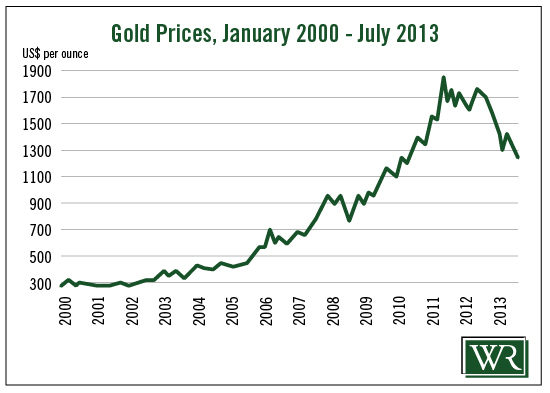
During the cellphone, microchip and Internet booms of the early 2000s, no one was looking at gold. The inflation-adjusted price had dropped all the way to $300, a remarkably low level for one of the hottest money periods in our history.
At $300 an ounce, I’d say it was even farther from people’s minds then than it is today.
The market environment in the early 2000s was very similar to today’s. When no one was watching, gold delivered one of its biggest runs ever.
And it made absolutely no sense.
The surging inflation rate of the late ‘70s and early ‘80s drove gold to record levels. However, in the 2000s, inflation was quite tame.
There weren’t any financial crises either. Bush inherited a recession in 2000, but nothing close to what we saw in 2008.
Until the crash in 2008, the stock market was booming.
Historically, none of these factors have put upward pressure on gold prices. In fact, none of the usual pressures that drive gold up were present until the 2008 collapse.
But it caught fire anyway, and no one but dedicated gold bugs expected it or were even there to see its run.
The Deadly Wild Card
One factor pointing to an imminent gold run – which no rational investor can ignore – is the Fed’s experiment of printing $4 trillion to save us from the crash in 2008.
To date, virtually all of that cash is still sitting on member banks’ books. And no one – and I mean no one – has a clue how this will unfold when that cash finally hits the streets.
We know the printing presses have not stimulated the economy. The market continues to sputter along, bouncing off the bottom.
All of that cash is still out there and is looking for an excuse to catch fire. And when it does, inflation could go crazy. This could make the late ‘70s look tame.
Inflation is the single worst enemy of investors, especially retired persons who have no way of replacing the losses it creates. And despite all the early indicators, once again virtually everyone is ignoring the single best defense of inflation: gold.
Whether it’s seller exhaustion, an improving Asia, out-of-control money printing, or just its history of running when everyone is looking elsewhere, you have to admit: It looks like a good time to start paying attention to history’s favorite “pet rock.”
Good investing,
Steve


Comments
Log in or sign up to join the conversation.