

The Republic of the Congo is one of the most resource-rich countries in the world. However, like many African nations, the country continues to be undeveloped due, at least in part, to a civil war that took place in the late 1990s. It has enjoyed a relatively stable, if controversial, government since then, however (do not confuse the Republic of the Congo with the similarly named Democratic Republic of the Congo, which has been in a Civil War since 1996).
On May 1, 2014, Russian media service RT reported that Denis Sassou Nguesso, President of the Republic of the Congo, announced plans to develop his country’s natural resources in conjunction with Russia. These natural resources include petroleum, gold, iron, phosphorus, and base metals. Particularly interesting, however, are some of the other statements that the African leader made.
For the past several decades, two of the leading sources of development financing have been the World Bank and International Monetary Fund. Many individuals in the Western countries, however, fail to appreciate that many citizens and political leaders in emerging economics see both of these organizations as imperialistic organizations. In 1980, the Overseas Development Institute, an independent think tank on international development and humanitarian issues, discussed some of the reasons for this attitude:
- Developed countries are seen to have a more dominant role over less developed countries primarily due to the Western bias towards a capitalist form of the world economy with professional staff being Western trained and believing in the efficacy of market-oriented policies.
- The International Monetary Fund works on the incorrect assumption that all payment disequilibria are caused domestically.
- The effects of IMF policy are anti-developmental. In effect, the deflationary effects of IMF programs cause the receiving economy to contract.
- The policy conditions of the organizations’ programs result in a transfer of wealth from less developed countries to more developed ones.This is essentially the way empires have operated throughout history, with wealth essentially being transferred from the conquered regions back to the conquering power.
- Several IMF policies lack a clear economic rationale.
While all of these criticisms play a role in the unfavorable attitudes towards these organizations among developing countries, the third and fourth points are the most important. Evidence of this can be found by looking at the South American nation of Argentina. This nation, which had been considered a model recipient of IMF assistance due to its compliance with the organization’s requirements, experienced a catastrophic economic collapse in 2001. Many in Argentina and elsewhere believe, rightly or wrongly, that the IMF’s requirements for aid were at fault in this, leading to widespread hatred of the organization among South American nations. Further evidence of this dislike towards the organization can be found in the fact that President Nguesso “encouraged” the development of an alternative.
This alternative is the New Development Bank, colloquially known as the “BRICS Bank.” This organization was officially formed by the BRICS nations (Brazil, Russia, India, China, and South Africa) in July 2014 for the purpose of assisting other developing nations. The organization was formed after extensive discussion among all the founding nations and infused with $100 billion in currency swap agreements.
The mineral wealth of the Republic of the Congo make it a prime candidate to turn into one of the next emerging economies, which are poised to grow at a rate substantially higher than any developed economy (the current turmoil in China notwithstanding). This makes the nation one that investors may want to keep an eye on going forward. However, at present the nation lacks the needed infrastructure to be able to exploit this tremendous opportunity. This is where the New Development Bank and, in particular, the nations of both Russia and China come into the equation.
As most of you reading this are already no doubt aware, the nation of China greatly expanded its national infrastructure during the strong economic boom that it experienced over the past few decades. According to consulting firm McKinsey & Co., since 1992, China has spent 8.5% of its GDP on infrastructure, a rate that far exceeds that of any other nation.
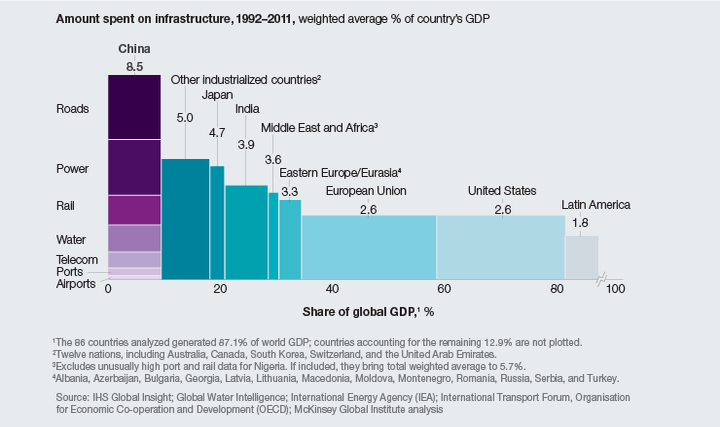
Source: McKinsey & Co.
This has resulted in the Chinese gaining extensive knowledge about developing a nation’s infrastructure from the ground up as well as given the country several large infrastructure companies including Cheung Kong Holdings (CHEUF), China Communications Construction Company Group (CCCGF), and China National Building Material Company.
Admittedly, President Nguesso specifically stated that his country needs Russian assistance in developing its infrastructure. Russia also has large and technically skilled infrastructure companies that may assist in this process including RusHydro (RSHYY) and Mosmetrostroy. However, given the tight alliance that China and Russia have developed over the past few years, one that has only grown stronger due to the sanctions placed on Russia by several Western nations, and the Chinese interest in building up Africa’s infrastructure, it seems likely that Chinese firms will be involved as well.
As already mentioned, the Republic of the Congo is one of the most resource-rich nations in the world. This is something that applies to Russia as well. However, while the African nation still needs to develop its resources, Russia has been exploiting its own for decades. This has given Russia several large companies that have both the financial resources and knowledge to assist in developing the resources of the Republic of the Congo. These firms include Norilsk Nickel (NILSY), AK Alrosa, United Company Rusal, and Polus Gold International (PLZLY). All of these companies along with several others will likely be involved in developing the African nation’s mining industry.
It seems less likely that American or European firms will be able exploit the opportunity to assist in developing the Republic of the Congo. This is due to the attitudes that the Congolese President expresses. He specifically refers to the Western powers as “colonists” and speaks quite warily of them. Given this attitude, it is rather unlikely that he would allow companies from Western nations in.
It is important to note that this opportunity is still in the very early stages at this point. As such, it is uncertain how the development of the Republic of the Congo will proceed or exactly which companies will be positioned to take advantage of this emerging opportunity. It is also uncertain how the geopolitical relations between Russia and the Western powers will play out. Thus, it is too premature to make any changes to an investment portfolio because of this but at the same time, it is recommended that one keep an eye on it in order to take advantage of the opportunity when the time is right.

Comments
Log in or sign up to join the conversation.