

We have had a great run in real estate worldwide. Some markets, such as the one in Australia, have risen almost every year for 30 years.
But with global interest rates rising, and a recession just over the horizon, you have to ask if it is time to sit down when the music stops playing.
The next crash could be severe, and global in nature.
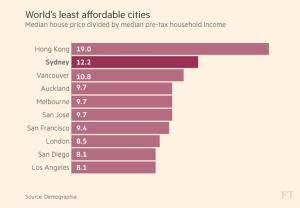
In the table below, Sydney is ranked as the second-most expensive market in the world at 12.2 times the local median pre-tax household annual income.
It is far behind Hong Kong, at 19.9 times, and just ahead of Vancouver, Canada, at 10.8 times.
Even Australian banking regulators are concerned about a “Dutch tulip” style mania developing in the Land Down Under.
They are worried that the coming price collapse will pose a major threat to their financial system.
Indeed, a home on Sydney Harbour owned by the Fairfax newspaper family sold for a staggering AUS$75 million, a new record for the country.
Sure, the views are great. But AUS$75 million?
There have been a lot of these real estate booms over the past five decades.
There was the notorious Japanese bubble in 1990. I have been through at least three such booms in California, where real estate brokers can turn into Uber drivers in a heartbeat.
And they always follow the same predictable pattern.
How high is high? Think of an absurd, impossible number, and then double it. That always seems to be a good rule of thumb. Except that Australia is already past that last doubling.
When my Australian friends ask how high prices can go, I tell them to check out prices in Shanghai, China, where apartments go for twice as high for a quarter of the space.
In fact, identifying bubble tops is a fool’s errand. When markets become irrational, the last thing buyers care about is rationality, hard data, or valuations.
In the past, the music always stopped playing for the same reasons.
Central banks fearful of inflation slammed on the brakes and drove interest rates through the roof, as Chairman of the Federal Reserve Paul Volcker did in 1980.
An extraneous shock, such as the 1973 and 1979 oil price spikes, or the 1991 Savings & Loan Crisis, can also let the air out of the balloon.
I remember that during the S&L Crisis, I was ushered in to see a California property and the owner burst into tears when the agent mentioned the price because of the huge personal hit he was taking on his equity.
Except that this time it’s different.
Real estate used to be local. Now it’s global.
You have the same factor pushing up property in prime markets all over the world at the same time: Chinese buying.
For a decade now, buyers from the Middle Kingdom have been bidding up the prices of homes in London, Australia, New York, Vancouver, and elsewhere.
In Napa Valley, CA, the Chinese are snapping up trophy vineyards left and right, paying wildly inflated prices. Prices are up an eye-popping 16.6% year on year.
You can always tell when a property changes hands when the stone lions show up at the front gates.
Their goal is the same everywhere. Get their money out of China before the wheels fall off, be it for economic or political reasons.
The Chinese aren’t looking for retirement homes. They need bolt-holes, places to hide out.
A stepped-up anti-corruption campaign by the Beijing government seems to have accelerated the trend.
The capital flows have been so enormous that the Chinese government has had to liquidate $1 trillion in foreign exchange reserves, a quarter of the total, primarily held in US Treasury bonds, notes, and bills, to support the renminbi.
These gargantuan capital flows have created the same anomalies around the world - that of “ghost neighborhoods” owned for investment purposes only.
On the receiving end, the US government is taking measures to stem money laundering and tax evasion.
The IRS is using the Patriot Act to require proof of ownership for all real estate purchases more than $2 million in New York and San Francisco.
Cayman Islands, British Virgin Islands, and Cook Islands nominee holding companies or LLCs can no longer be used as identity shields.
Without real residents living there, local businesses, such as dry cleaners, coffee shops, and supermarkets, die off for lack of customers.
Take a walk around the Mayfair district of London one of these days and you’ll see what I mean.
Or ride up and down the elevators in the residential towers at New York’s Columbus Circle, where 60% of the apartments are foreign-owned.
I even have one of these at the end of my street here in San Francisco.
The home came on the market for $2.1 million three years ago and sold in a day for $2.3 million. It has been empty ever since.
(By the way, the opposite end of my street displays San Francisco’s other big problem, start-ups moving into cheaper residences to avoid sky-high commercial property rates. There the lights NEVER go out.)
Real estate agents everywhere love the business.
Most of these deals are done for cash only with rushed due diligence. Loan approvals and appraisals, frequent deal killers for domestic buyers, never even enter the picture.
Look at the table below and you’ll see that four of the world’s 10 most expensive cities are in California.
But at least here you have multiple booms going on in technology, health care, alternative energy, and transportation driving earnings, and therefore house prices.
Since the causes of this bubble are largely coming from China, so must the end.
A serious economic slowdown in China would tip the balance. So would trade war with the US.
Tougher controls on capital flows could stem the tide. So would political instability, never far below the surface in China.
Whatever the reason, leveraged owners of luxury real estate anywhere on the planet should always keep one thing in mind: Your fate is totally in the hands of China.

Comments
Log in or sign up to join the conversation.