


In investing, stubbornness is not a virtue; it is often an expensive psychological defect disguised as conviction. Refusing to adapt when market conditions change is like a chess player refusing to acknowledge that the board has changed because he remains emotionally attached to his original strategy. Markets are not static, and neither are the psychological forces driving them. Fear, greed, complacency, panic, optimism, and herd behaviour constantly interact, creating powerful psychological vectors that can push markets in directions that appear irrational to the permanently bearish observer.
The Permabear becomes trapped inside his own narrative. Every rally is dismissed as manipulation, every new high is labelled a bubble, and every temporary decline is celebrated as confirmation that the long-awaited collapse has finally arrived. This is where mass psychology becomes crucial: markets move according to the dominant emotional vector of the crowd, not according to the emotional needs of someone desperately waiting to be proven right. When the crowd’s primary vector remains bullish, fighting that force simply because you believe the world should collapse is not courage; it is intellectual rigidity.
Being a Permabear is therefore akin to having a financial death wish. It is a special combination of stupidity and stubbornness so powerful that even repeated hard slaps from reality fail to alter the underlying belief system. The Permabear does not merely analyse the market; he becomes emotionally married to disaster. He needs the crash to happen because, without it, his worldview begins to collapse.
And that is the real danger. The market does not care about ideology, political beliefs, economic theories, or how many times someone predicted the end of the world. Long-term charts tell the story with brutal clarity: the primary vector of the markets has historically been upward, despite wars, recessions, inflation, political chaos, banking crises, pandemics, and countless predictions of imminent financial Armageddon.
The intelligent investor learns to read the psychological vectors and adapt. The Permabear stands in front of the advancing crowd, screaming that everyone is wrong, while the market continues moving in the opposite direction. Eventually, reality wins, and reality has very little patience for stubborn investors.
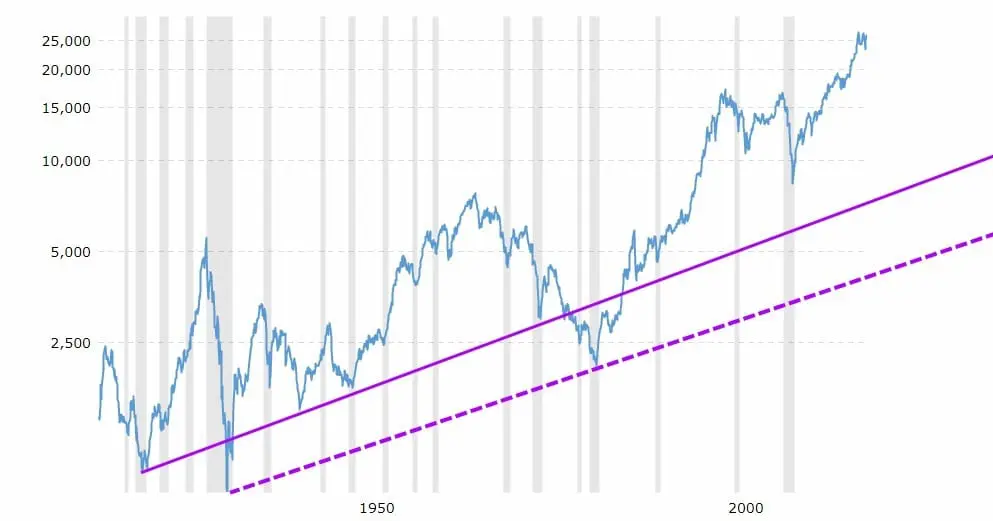
The 100-year Dow Jones chart delivers a brutal lesson to the Permabear: despite wars, recessions, crashes, inflation, pandemics, and endless predictions of financial Armageddon, the market’s primary long-term vector has remained upward. This does not mean markets rise in a straight line, but it does demonstrate the danger of permanently betting against the dominant trend while waiting for the apocalypse.
Successful investing is not about being permanently right; it is about adapting. The Permabear, however, becomes psychologically trapped inside a narrative where every rally is manipulation and every decline signals the beginning of the end. “The market can stay irrational longer than you can stay solvent.” The market does not care about your ideology, ego, or prediction.
Market mastery requires focusing on the forces that actually move prices: mass sentiment, crowd psychology, technical extremes, and the dominant market vectors. When fear reaches an extreme, opportunity often begins to emerge; when euphoria becomes overwhelming, caution becomes necessary. The crowd’s emotional vector matters far more than the endless stream of sensational headlines designed to provoke fear and keep investors emotionally reactive.
As we noted during previous periods of crisis, the market often looks most dangerous precisely when exceptional opportunities are beginning to form. It is easy to invest when everything looks rosy, but that is often when assets are already overpriced. When times appear bleak, the best opportunities can begin to emerge.
The intelligent investor does not sail blindly into every storm, nor does he permanently hide in the harbour waiting for disaster. He studies the psychological currents, measures the dominant vectors, and adapts when conditions change. Fear is profitable primarily for those selling it. For everyone else, it is usually an expensive investment strategy.



Comments
Log in or sign up to join the conversation.