

A security consultant in his late forties came into Dr SNA Clinic on Wimpole Street after months of quietly researching options online. He'd read enough forum threads and clinic websites to know the Priapus Shot existed, but almost nothing about what actually happens during the procedure, or why one clinic might charge considerably more than another for what looks, on the surface, like the same treatment. That gap between marketing copy and clinical reality is common, and it's worth closing before anyone books an appointment for a treatment involving their own blood and a fine needle.
The P-Shot — short for Priapus Shot, named after the Greek god associated with fertility and virility — is a PRP-based (platelet-rich plasma) treatment marketed for men experiencing mild to moderate erectile difficulty, reduced sensitivity, or a general decline in sexual function that hasn't responded well to first-line options. The premise is straightforward in outline: a small blood sample is drawn from the patient, spun in a centrifuge to concentrate the platelets and growth factors, and the resulting plasma is injected into specific areas of the penis. The theory behind it draws on regenerative medicine principles already used elsewhere in aesthetic and orthopaedic practice, where PRP is used to encourage tissue repair and, in some applications, new blood vessel formation.
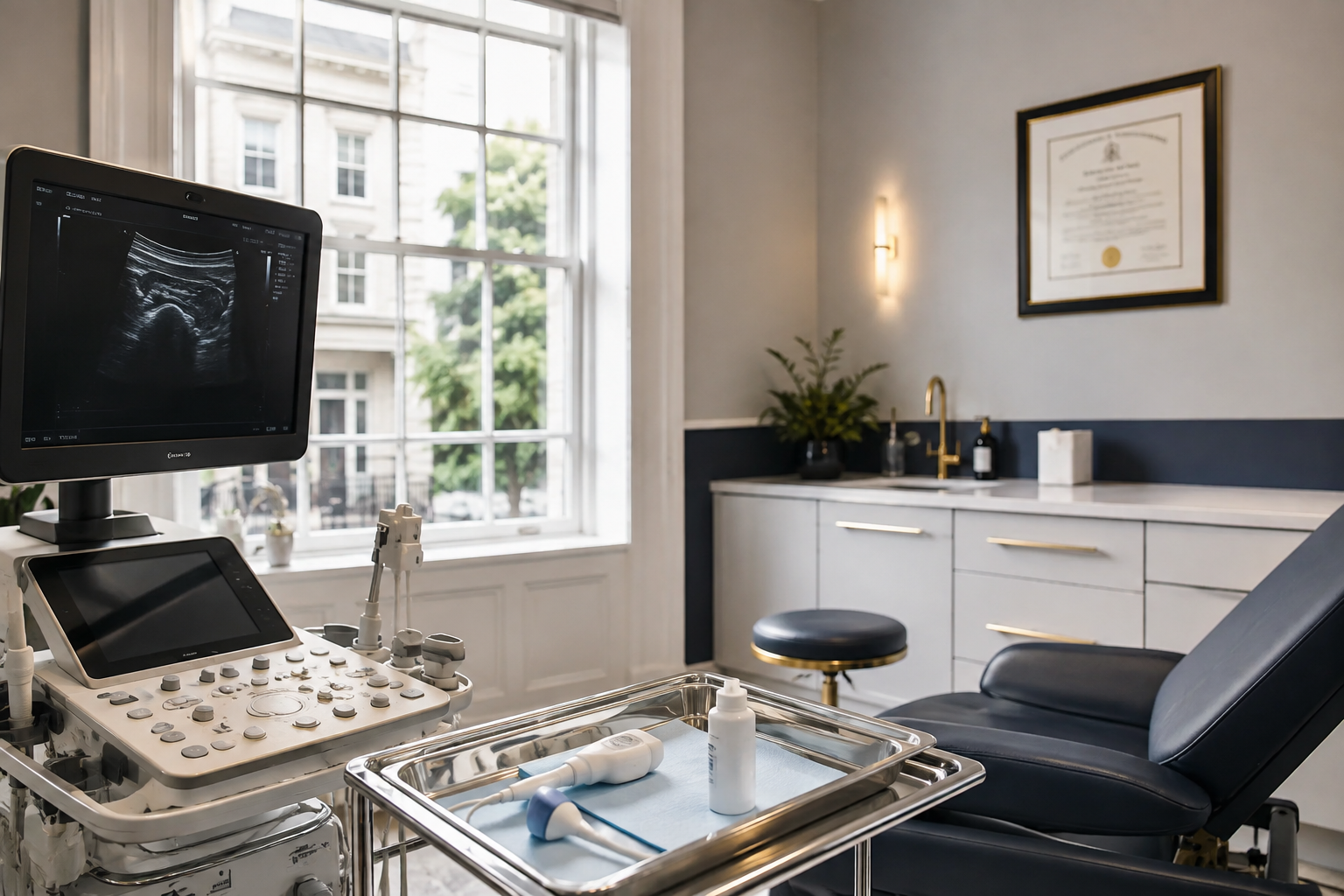
What separates a well-run P-shot treatment from a poorly run one has almost nothing to do with the blood itself and almost everything to do with technique, equipment, and training. This is where the price variation across London clinics starts to make sense. A CE-marked PRP preparation device matters because it governs how consistently the platelets are concentrated and how much of the plasma's regenerative potential survives the spinning process — cheaper, unregulated kits can produce inconsistent yields that undermine the entire premise of the treatment. Ultrasound guidance during injection matters for a more obvious reason: the penis contains blood vessels and nerve structures in close proximity, and a practitioner working without imaging is relying on anatomical memory and feel alone. At Dr SNA Clinic, Dr Syed Nadeem Abbas performs P-Shot treatment using ultrasound guidance, which allows the plasma to be placed with more precision and reduces the guesswork involved in a procedure that has very little margin for error.
Training is the third variable, and it's the hardest one for a prospective patient to verify from a website alone. Dr Abbas holds MRCS from the Royal College of Surgeons of Edinburgh and completed an MSc in Aesthetic Plastic Surgery with Distinction at Queen Mary University London, alongside clinical training at Cambridge, Oxford, and the Royal London Hospital. That background matters less as a credential to be impressed by and more as a practical indicator: a practitioner with surgical and anatomical training is working from a different baseline of understanding than someone who has completed a weekend injectables course. For a procedure involving penile vascular anatomy, that difference is not cosmetic.
It's worth being honest about where the evidence for PRP-based sexual health treatments currently stands, because the field is younger than some marketing suggests. The clinical literature on PRP for erectile dysfunction is still developing, with a number of small studies and case series showing promising results for men with mild to moderate symptoms, but larger randomised controlled trials are still limited compared with established treatments. Bodies such as the European Association of Urology have noted PRP therapies as an area of ongoing research within regenerative approaches to sexual medicine, rather than a first-line, guideline-backed treatment in the way that, say, PDE5 inhibitors are. That doesn't mean the treatment lacks merit — plenty of interventions in modern medicine started in exactly this evidence position — but it does mean a patient should go in with realistic expectations rather than assuming a guaranteed outcome. A practitioner who is candid about this during consultation, rather than promising transformation, is generally the one worth trusting with the needle.
Cost is the question most men ask first and understand least. A P-Shot at Dr SNA Clinic reflects the combined cost of the CE-marked preparation equipment, the consultation and ultrasound-guided injection time with a practitioner trained to surgical standard, and the follow-up care that should accompany any regenerative treatment. Cheaper alternatives elsewhere in London are rarely cheaper because of a different blood-processing method — they are usually cheaper because one or more of those elements has been reduced or removed. For a treatment involving injection into a highly vascular and sensitive area of the body, that's not necessarily where a patient wants to make savings.
The security consultant who came in after months of research asked, reasonably, why he shouldn't just find the lowest price he could and book the first available slot. The honest answer is that he could, and many men do. But the P-Shot isn't a commodity treatment in the way a flu jab is — the outcome depends heavily on who is holding the needle, what equipment they're using to prepare the plasma, and whether they're guiding the injection with imaging or with guesswork. For men considering the treatment in London, the more useful question isn't "what's the cheapest P-Shot price," but "what exactly am I paying for, and does that justify the number." At Dr SNA Clinic on Wimpole Street, that number is built from equipment, training, and imaging — the parts of the treatment that don't show up in a before-and-after photo but determine how safely and effectively the procedure actually goes.
Men considering P-Shot treatment in London, or any PRP-based approach to sexual health, should discuss their specific history and expectations directly with a practitioner during consultation rather than relying on marketing claims from any single clinic, including this one.
Comments
Log in or sign up to join the conversation.