

The dividend outlook of the S&P 500 (Index: SPX) had a mixed outcome for July 2026. Dividends expected to be paid in the now current quarter of 2026-Q3 are slightly lower than what had been anticipated in our June 2026 snapshot, but the farther future showed continued strength as expected dividends increased.
Here is our tally of how the expected future changed in the month from 15 June to 14 July 2026:
2026-Q2: Finalized at $20.72 per share (unchanged).
2026-Q3: Decrease of $0.09 to $21.13 per share
2026-Q4: Increase of $0.05 to $21.45 per share
2027-Q1: Increase of $0.18 to $22.75 per share
2027-Q2: Increase of $0.19 to $21.75 per share
The following chart shows how expectations for the S&P 500's quarterly dividends per share changed in the month from 15 June 2026 to 14 July 2026.
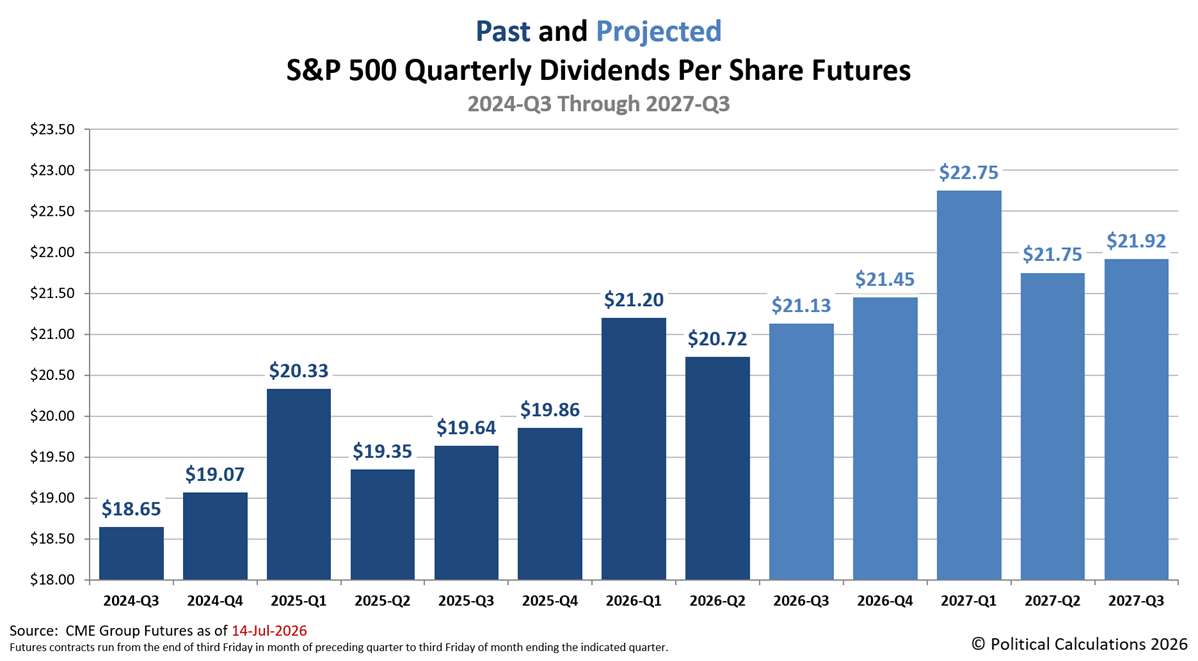
The initial estimate of dividends expected to be paid out to S&P 500 investors for the distant future quarter of 2027-Q3 is $21.92 per share.
More About Dividend Futures
Dividend futures represent the quantified expectations investors have for the future income they will realize from owning shares of stocks, which in turn, affects how investors set current day stock prices. How changes in the outlook for dividends at specific points of time in the future contribute to changes in current day stock prices as represented by the value of the S&P 500 index is described by this math.
Dividend futures for the index indicate the market capitalization-weighted amount of dividends per share for all these dividend-paying stocks that are expected to be paid out over the period covered by each quarter's dividend futures contracts. These contracts start on the day after the preceding quarter's dividend futures contracts expire and end on the third Friday of the month ending the indicated quarter. For example, as determined by dividend futures contracts, the now "current" quarter of 2026-Q3 began on Saturday, 20 June 2026 and will officially end on Friday, 18 September 2026. Since the expectations for this quarter's dividend payouts can change all the way up to that final date, it counts as a future quarter all the way up to its end.
Because dividend futures are tied to options contracts that run on this schedule, that makes these figures different from the quarterly dividends per share figures that are reported by Standard and Poor. S&P reports the amount of dividends per share paid out during regular calendar quarters after the end of each quarter. This term mismatch accounts for the differences in dividends reported by both sources, with the biggest differences between the two typically seen in the first and fourth quarters of each year.
Comments
Log in or sign up to join the conversation.