


There was a line in this week's Striking Price column in Barron's that really stood out.
"A conservative options-selling program can add 6% to 8% to your annual returns."

Maybe columnist Steve Sears is having a conversation I cannot hear, a reference to one of my favorite quotes from the show Deadwood: Hearst says, "I am having a conversation you cannot hear," to Bullock. My initial response is simply that the options market does not give money away.
The column in question was a post-mortem on a Walmart (WMT) options trade that did not work. A few months ago, the column suggested buying a call and selling a put on Walmart. The stock went down, the call expired worthless, and the puts were assigned.
Someone who trades options frequently will have some number of trades that work out well and some that will not. There is no getting away from some losing trades, so the idea becomes having more winning trades than losing trades or somehow having the dollars netted on the winning trades exceed the dollars lost on the losing trades.
I am sure a few market participants can do what is asserted in the quote, adding 600-800 basis points to returns, but taken as a blanket statement, no, I would not bet my money on that.
Perhaps a more accessible outcome could be thought of as redistributing the composition of your return.
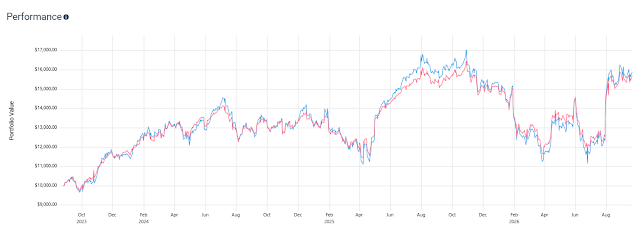
One of those lines is a common stock, and the other line is the corresponding YieldMax. The stock is not as volatile as MicroStrategy (MSTR) or Tesla (TSLA), so the total returns of the two are identical. One is just price appreciation (there is a little bit of a dividend), and the other is all "yield" as the price return is down considerably.
A little less dramatically but not as tight as above, ISPY, which is a tax-efficient derivative income fund versus SPY.
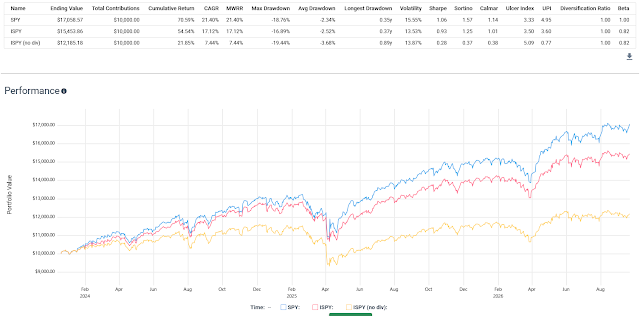
ISPY's return has not kept up with SPY, and it probably won't when markets are going up. In a couple of the drawdowns, ISPY has gone down less, which can happen some of the time but won't happen all of the time. ISPY's return has been about 9.5% in distributions, with the rest in price appreciation. The returns are split into a couple of different sources versus really just one of any consequence from SPY.
The options market does not give money away. The way ISPY redistributes the return will appeal to plenty of investors; derivative income funds have $175 billion in assets. Clearly, people want this sort of appreciation/"yield" combo even if they don't articulate it that way, but they are not getting free money.
Pretend for a second that ISPY can compound at the same 7% on a price-only basis, kicking out 9-10% in ROC (that's the tax efficiency); that is a plenty useful outcome for some people in the benchmark free context we talked about yesterday; some want yield without eroding NAV. The trade-offs of funds like ISPY, or SPYI, or GPIX might not be for you; you might think they are terrible, but there is a reasonable use case in terms of results and investor tolerances without being NAV incinerators like the mystery stock in the first chart.



Comments
Log in or sign up to join the conversation.