

As the cloud of Omicron gathers it is critical to try to understand the impact it will have. As we've all learned over the past two years, there are many kinds of impacts. I want to concentrate on just a few.
Illness
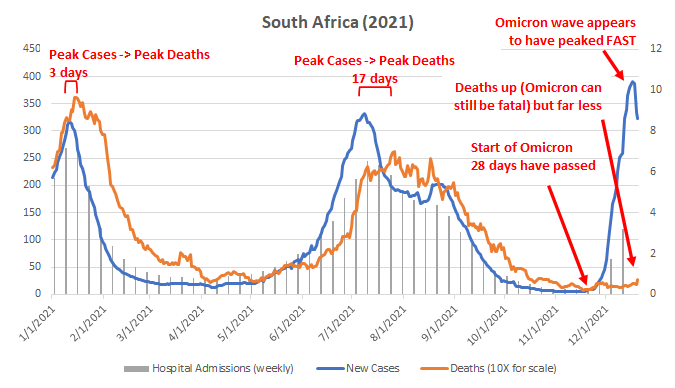
Omicron is incredibly contagious. Initial indications are that it clearly increases hospital admissions. However, it is not clear hospital patient populations rise. In other words, people seem to be getting discharged faster. The symptoms being described are much milder - and are associated with the common cold. Looking at the South African data, admissions have increased - but not as rapidly related to cases as they did in previous rounds.
Death
There is no question at this point that Omicron is less deadly. Not just on a per-case basis, but overall. Death rates in South Africa rose with prior rounds of infection almost immediately following the rise in case loads. Separation in trends was realized (deaths slowed down) relative to cases, but deaths were not that far behind cases. With Omicron there is a rise in deaths, but it is far less substantial. The data in the US and UK is too early to judge, but it appears to be following the same trends.
If Omicron disrupts an existing Delta outbreak, it could actually cut deaths and illness by displacing the more dangerous variant. This could explain the early drops in the US and UK.
.png)
.png)
Economics
As a disease, Omicron moves fast. South Africa appears to have peaked already. The last round in South Africa took 2 months to peak. Omicron has done it in 3 weeks. The post-peak drop off appears to be more vigorous as well - in line with a highly infectious disease very quickly spreading through a population and then running out of carriers. This is important because it suggests we'll have very good and complete data sooner than we would with a slower moving variant. This is important economically.
I believe a consensus will quickly emerge that Omicron is not nearly as deadly as feared. I also believe hospitalizations will be shorter and overall hospitalization numbers will flat line or drop as Delta is displaced. The political classes will want to be seen doing something so we have seen border closures (totally useless in countries with Omicron even if Omicron was bad). We might see lockdowns and other closures. Due to popular pressure, these initiatives will falter a short way into the wave. Politics will determine when. Areas with politics that emphasize collective sacrifice will find initiatives extended. Other areas may have no additional restrictions whatsoever. People will see vast numbers of cases, but many fewer effects, and increasing numbers will demand their governments move forward.
Society
I hope the bifurcation we're seeing will begin to shift. The Great Omicron Panic will wash up against the minor Omicron reality. As the cost of panic continues to ripple through the world population there will be additional emphasis on rebalancing the tradeoffs. The arrival of Pfizer's Plaxovid will also help - as it will enable intervention in the most high-risk cases and further cut down both deaths and opportunity for mutation.
Reducing the cost of panic is critical socially. Societies that are already being bankrupted by a lack of children are being faced with a severe drop in marriage formation. Just to give one example: in Australia, 30% of marriages are between people from different countries. During their extended shutdown, a significant percentage of family formation just stopped. In 2019, 113,815 marriages took place in Australia. In 2020, it was 78,898. Even countries will less severe lockdowns saw this. Many countries do not yet have 2020 data, but Scotland and Northern Ireland saw declines over 50%. Even Israel, which places extreme priority on family, saw a drop of 15%. Long-term these costs will be severe economically and in other respects. The sooner society can remain 'open' despite new variants the healthier it will be.
Conclusion
I believe Omicron will be a blessing. It will provide further immunity to vaccine reluctant and vaccinated people alike. It will do so at a much lower cost than the previous variants. It will probably not spell the end of coronavirus. After all, our immunity to coronaviruses seems to time out and there may be other variants that are not affected by prior Omicron infection. All that said, I think Omicron will provide a respite - perhaps a long enough respite to enable non-vaccine-based interventions like Plaxovid (or even aspirin) to acquire widespread efficacy.
The next few weeks will be hard, but the next few months could be eye-opening and very very positive.



Comments
Log in or sign up to join the conversation.