

Don’t look now fans, but bonds may be back on the list of things to worry about in the stock market. Jeff Gundlach, who has apparently been anointed the new king of the bond market, has suggested that bonds are on the precipice of a bear market and that Ten-year Treasury yields are on course to move “toward 3 percent” this year.
Just over two weeks ago, the yield on the U.S. Gov’t 10-Year closed at the low of the year at 2.137%. The thinking at the time was that inflation indicators were wobbling, the economic outlook was mixed, and the chances of Trump getting anything done in 2017 were falling fast. So, despite all the Fedspeak to the contrary, the markets doubted the Fed’s ability to stay the course. Rates looked to be moving in the opposite direction of the general consensus.
Lest we forget, the yield on the 10-year began 2017 at 2.446% and just about everyone on the planet expected that yield to rise steadily throughout the year. So, when yields dropped to a fresh calendar-year low on June 26, it appeared that the prognosticators of doom and gloom in the bond market had once again failed – in rather spectacular fashion.
However, eight days later, the yield on the 10-year had spiked to 2.396% and looked ready to take out important resistance zones. The move was impressive – and global in scope. And those who don’t spend their days watching the action in markets, were left scratching their heads.
Yield of U.S. Gov’t 10-Year – Daily
(Click on image to enlarge)
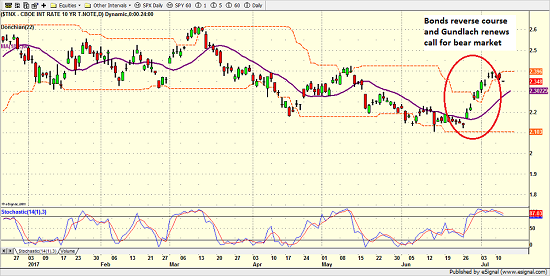
So, what gives? Why did bond yields reverse course in violent fashion? Why did the sentiment flip completely in such a short period of time?
No, Janet Yellen didn’t change her tune. No, the Fed didn’t surprise the markets at their June meeting. And no, the inflation data hadn’t suddenly reversed.
The answer actually has nothing to do with the United States economic data, nor inflation, oil, or even the Fed. Nope, this situation started across the pond – and not where you might think.
It turns out that a weaker than expected bond auction in France caused traders in Europe to sit up and take notice (and do some serious selling). Next, Super Mario started “talking taper” (or so traders thought). And then, the Bank of England chimed in with some unexpectedly hawkish comments.
The Lightbulb Goes Off
This coupled with the fact that Yellen & Co. appear to be bent on raising rates and unwinding their $4 trillion balance sheet (yes, despite growth and inflation expectations being downgraded almost daily) caused traders to realize that the “QE Era” was coming to an end.
After nearly of decade of unprecedented global central bank intervention, it appears that the most of the globe’s central banks (save Japan of course, which apparently plans to print money until the end of time) have decided that it is time to step aside.
Yep, that’s right; almost in unison, central bankers have started talking about pulling back on their stimulative efforts. As in ending QE. As in selling some of the mountain of paper the banks have acquired while trying to keep the global economy afloat. And as in “normalizing rates” and monetary policy.
So, what do traders do when they realize that the biggest buyers of bonds are going to (a) stop buying in bulk and (b) move toward becoming net sellers of bonds? They sell, of course.
Whether the current spike in rates will continue or not is anybody’s guess. Whether or not Mr. Gundlach and all the other prognosticators calling for the start of the big, bad bond bear will be right anytime soon is also in question.
However, for me, the takeaway is that when investors decide to do the same thing at the same time, things can get ugly – in a hurry. So, as I’ve been lamenting for some time now, I do not believe we are seeing the type of low risk environment that the volatility metrics might imply.
No, the bottom line is I think risk is elevated and one should play the game accordingly.
Thought For The Day:
If you have everything under control, you’re not moving fast enough. -Mario Andretti
Current Market Drivers
We strive to identify the driving forces behind the market action on a daily basis. The thinking is that if we can both identify and understand why stocks are doing what they are doing on a short-term basis; we are not likely to be surprised/blind-sided by a big move. Listed below are what we believe to be the driving forces of the current market (Listed in order of importance).
1. The State of the U.S. Economic Growth (Strong enough to justify valuations?)
2. The State of Earnings Growth (Ditto)
3. The State of Trump Administration Policies



Comments
Log in or sign up to join the conversation.