


For years, the inflation debate has revolved around the Federal Reserve.
Mainstream reporters wanted answers to questions like: Did the Fed print too much money? Are interest rates too low? Is consumer demand too strong? Should policymakers keep rates higher for longer? But…
Another kind of inflation is becoming increasingly difficult to ignore.
Across food, fuel, precious metals and industrial commodities, physical constraints are colliding with a world that suddenly wants far more resources.
And that means the result isn’t simply another CPI spike.
We may be entering a structural commodity inflation cycle.
The Commodity Signals Are Broadening
Let’s start with agriculture, and then zoom in on specific prices.
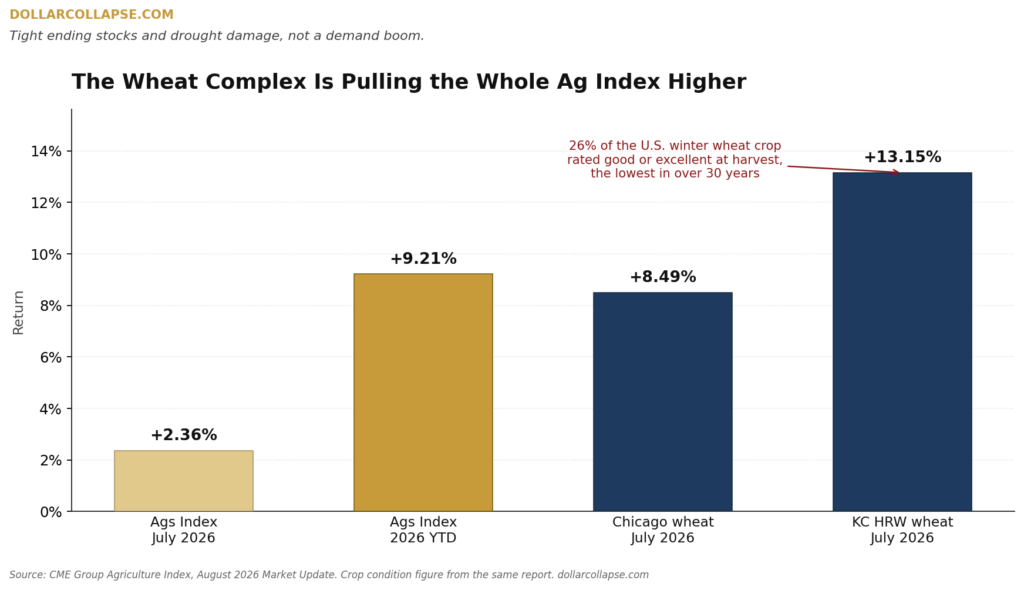
The CME Group Agriculture Index gained 2.36% in July and was up 9.21% for the year through July. Wheat was particularly strong, with Kansas City hard red winter wheat gaining 13.15% during the month and Chicago wheat rising 8.49%. CME said wheat prices were being driven by “tight ending stocks and severe drought damage during the growing season.”
Then there is energy.
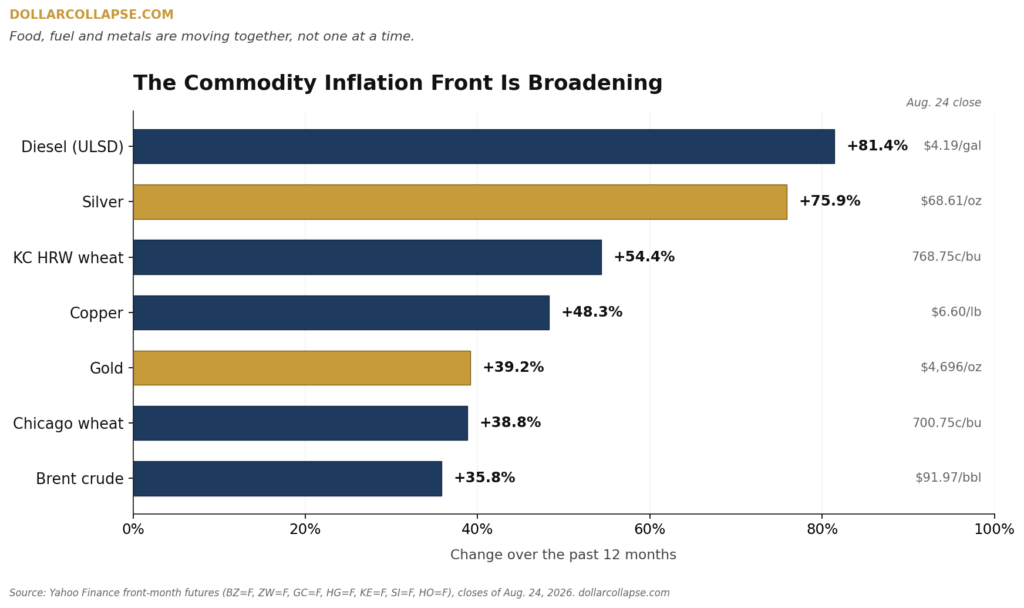
Brent crude was trading around $92 per barrel on August 24 as geopolitical tensions continued to hang over global energy markets. However, crude oil may not even be the most important number. That’s because diesel is flashing a much louder warning.
Reuters reported that the U.S. diesel crack spread, which measures the premium of diesel futures over crude oil, hit an all-time high of $102.20 per barrel.
Here’s why that is important. Reuters described it as “global supply disruptions from the wars in Iran and Ukraine” colliding with peak agricultural fuel demand.
The result has been a lower-than-normal global refinery throughput in July. It was also about 5 million barrels per day lower than a year earlier. Almost all of our industrial base runs on diesel. For example, Trucks, Farmers, Miners, Construction equipment, and Manufacturers use it. As a result, higher diesel prices don’t stay at the gas station.
They move through the supply chain like this:
Diesel rises -> transportation costs rise -> production costs rise -> food and goods prices rise.
Food Is Becoming a Geopolitical Commodity
Agriculture is facing the same combination of physical and geopolitical constraints.
Russia and Ukraine are two of the world’s most important agricultural exporters. Their war is increasingly affecting the infrastructure required to move grain onto global markets. It has become so tense that the Financial Times recently warned that “global food security may be collateral in Ukraine war” as both sides increasingly target agricultural export infrastructure. According to the Financial Times, Russia and Ukraine together account for roughly 27% of global wheat supplies.
Reuters reported on August 24 that attacks on Black Sea infrastructure were disrupting port operations, damaging grain terminals and causing shipment delays or cancellations.
This is where war, weather, energy and agriculture begin feeding into each other.
Farmers need diesel.
Fertilizer production requires enormous amounts of energy.
Crops require favorable weather.
International food markets require functioning ports, railroads and shipping lanes. Each of these is being disrupted simultaneously, which is making the problem much harder to solve.
Then Comes the New Industrial Boom
At the same time supply is becoming more fragile, governments and corporations are pursuing some of the most resource-intensive policies in decades.
So governments want to make sure that their tax-paying businesses and tax-producing workers have everything to execute these policies locally. And protect their resources.
They want larger militaries and ammunition stockpiles.
They want new factories, electrical grids, and transportation infrastructure.
They want energy security.
And now the AI boom requires enormous new data centers, power generation and transmission infrastructure. It all requires physical stuff.
None of this in small amounts: Copper. Steel. Natural gas. Electricity. Diesel. Concrete. Uranium. Silver. Heavy machinery.
The problem is that the world spent decades optimizing supply chains around efficiency and low cost. Now governments are increasingly optimizing around resilience and national security(in a word, protectionism), which requires heavy capital investment in infrastructure at home. For our governments, it may make economies more secure; it probably won’t make them cheaper. Here’s where this is leading…
The Fed Can’t Print Copper
Commodity scarcity creates a serious problem for central banks.
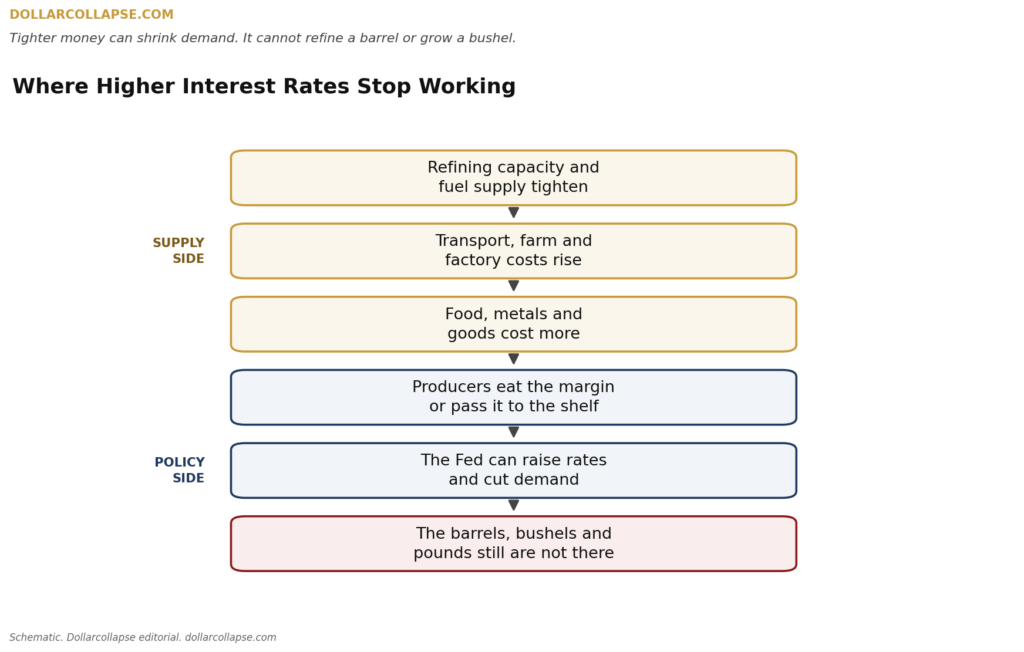
Traditional monetary policy is designed primarily to control demand. When inflation gets too high, the Fed raises interest rates. Credit becomes more expensive. Consumers spend less. Then businesses invest less, resulting in slower economic activity. But higher interest rates cannot grow wheat.
They cannot reopen a blocked shipping route.
They cannot rebuild a destroyed refinery.
They cannot manufacture a transformer or build a transmission line overnight.
Especially, they cannot create more copper.
The Fed can destroy enough demand(raise interest rates) to bring prices down, but doing so when the underlying problem is constrained supply means weakening the economy to compensate for shortages. That becomes a very different inflation problem.
Hard Assets Are Already Sending a Message
Precious metals, gold and silver, are already reflecting some of this uncertainty.
Reuters reported that gold climbed above $4,600 per ounce on August 24 and reached its highest level in more than three months. More interestingly, gold-backed ETFs attracted 46.7 metric tons of inflows during the previous week, worth about $6.4 billion, which was the largest weekly demand in 10 months.
Gold’s rise does not prove a commodity supercycle is underway.
But combine gold with agricultural inflation, strained diesel markets, geopolitical energy disruptions, industrial reshoring and massive infrastructure requirements, and a pattern begins to emerge.
The inflation problem may be changing.
For decades, globalization helped suppress the cost of physical goods. Cheap energy, inexpensive labor, efficient supply chains and abundant industrial capacity created a powerful disinflationary force.
Now many of those forces are reversing.
If that continues, the next inflation cycle won’t simply be about too many dollars chasing too few goods.
It may increasingly be about too many governments, industries and technologies chasing too few resources.
And that is one inflation problem the Federal Reserve cannot easily fix.


Comments
Log in or sign up to join the conversation.