


In the 1960s, computers were so big and expensive that only governments, universities and the largest corporations could afford them.
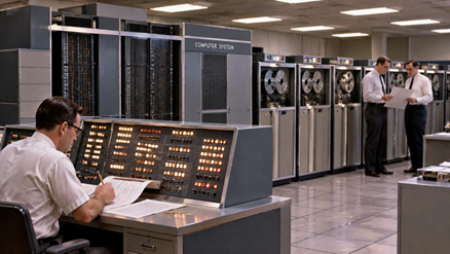
Then came the personal computer. And within a few decades, billions of people had access to computing power that was once reserved for some of the world’s most powerful institutions.
It was one of the most important technological developments of our lifetimes. And it created enormous fortunes for investors who saw it coming.
Today, I believe we’re approaching a similar moment with artificial intelligence.
You see, up until now, the AI boom has largely revolved around a handful of tech giants building massive data centers.
But I’m starting to see evidence that the next wave of AI investment could take us in the opposite direction.
And that could open up an entirely new market for some of America’s smallest technology companies.
The Push for AI Independence
When you ask ChatGPT a question, your request is typically sent over the internet to a data center where powerful computer chips process it and send you back an answer.
I’m not particularly concerned about where my data goes when I ask ChatGPT to help me plan a vacation or recommend a good book.
But consider what happens when a pharmaceutical company wants to use AI to develop a new drug. Or when an aerospace company wants to use it to design a more efficient jet engine.
These companies spend billions of dollars developing products that they don’t want their competitors to know anything about.
And they’re understandably concerned about sending that information outside their own computer networks.
Even the legal protections surrounding that information are being called into question.
Earlier this year, a federal judge ruled that a defendant’s conversations with the AI chatbot Claude weren’t protected by attorney-client privilege.

While companies can use cloud-based AI securely, cases like this help explain why some businesses want more control over their data.
And I’m hearing more about this from some of the biggest names in the AI industry.
In a recent letter to shareholders, Palantir Technologies (Nasdaq: PLTR) CEO Alex Karp wrote: “A global movement is emerging. The revolution for independence and AI sovereignty is now well underway.”
AI sovereignty is essentially the ability to control your own AI systems and the data they use.
For a business, that could mean running AI on its own computers to keep sensitive information within its private network.
And thanks to some recent advances in AI technology, that’s becoming a much more practical option.
You see, there’s a big difference between training an AI model and actually using one.
Training a powerful AI model can require thousands of expensive computer chips working together for months at a time. But once that model has been trained, it can often run on far less powerful equipment.
Using a trained AI model to perform a task is known as inference.
And as you can see in the chart below, spending on AI inference is projected to overtake spending on AI training by 2030.
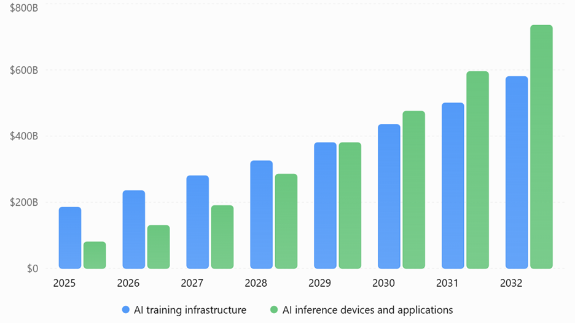
Source: Bloomberg Intelligence, Morgan Stanley Investment Management, August 2025.
Recreated using approximate chart values.
That’s particularly exciting because inference can often take place outside the massive data centers where AI models are trained.
And researchers are getting better at developing smaller AI models that can perform specific tasks extremely well.
A hospital, for example, doesn’t necessarily need an AI model that can write poetry, translate dozens of languages and explain quantum physics. It might simply need one that can analyze medical images or help doctors review patient records.
Running that AI locally could allow the hospital to process sensitive patient information without sending it to an outside company.
There are other advantages, too.
A manufacturer using AI to inspect products as they move down an assembly line needs to identify defects in real time.
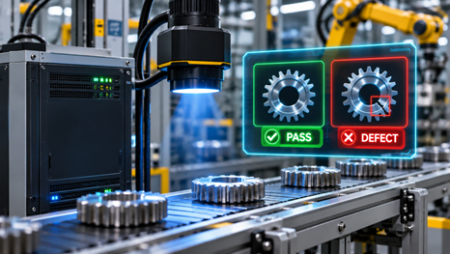
Processing that information locally can reduce delays and allow the system to keep working even if its internet connection goes down.
Then there’s the challenge of building enough data centers to meet the world’s demand for AI.
As I’ve written about before, communities across America are pushing back against data center construction because of concerns about electricity prices, water consumption and the strain these facilities put on local infrastructure.
And even when developers find communities willing to welcome them, getting enough electricity to power these enormous facilities can take years.
So there’s a growing incentive to find ways to bring computing power directly to the businesses that need it.
And the potential market is enormous.
Morgan Stanley estimates that AI could eventually create a $40 trillion market opportunity.
Even a small fraction of that could represent an enormous opportunity for companies supplying businesses with their own AI infrastructure.
Here’s My Take
I still expect the world’s biggest tech companies to spend enormous amounts of money building data centers over the next several years.
But I also believe that we’re going to see a lot more businesses invest in their own AI infrastructure.
And that has exciting implications for investors.
Think back to the personal computer revolution. IBM (IBM) was already a giant in the computer industry when companies like Microsoft (MSFT) and Apple (AAPL) were just getting started.
But the emergence of a whole new market for computers gave these smaller companies an opportunity to become giants in their own right.
I’ve been researching several small technology companies that are developing solutions to help businesses gain greater control over their artificial intelligence.
And on Monday, I’ll show you how a remarkable invention from 20 years ago could help make it possible.



Comments
Log in or sign up to join the conversation.