
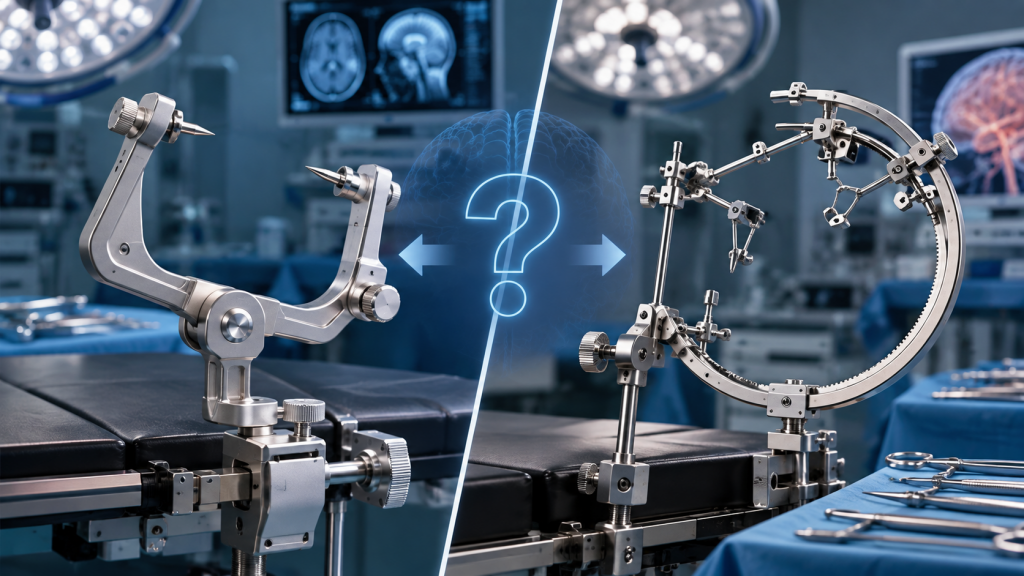
It happens more often than anyone likes to admit.
A hospital orders a head fixation system for its new neuro theatre. The kit lands, the box is opened, the OT technician carries the base unit to the table — and the rods do not seat. Either the rail is the wrong cross-section, or the head-end receptacle holes sit at a different centre distance, or there is no receptacle at all because that particular table was never designed for one.
Now everyone is on the phone. The surgeon wants to know why the list cannot start. Purchase wants to know who signed the order. And the supplier is explaining, reasonably enough, that nobody ever sent them the table model.
All of it avoidable. Here is how.
Three measurements settle almost everything
Before a single quotation is approved, get these three things in writing.
First, the side rail cross-section in millimetres. European DIN rails run roughly 25 mm by 10 mm. American rails are closer to 32 mm by 8 mm. A clamp machined for one will not sit properly on the other, and forcing it is not a solution — the whole point of a head clamp is that it does not move.
Second, whether the table has head-end receptacle holes, and at what spacing. Some tables take a direct-mount base. Others need a rail-mounted base instead. These are different parts, not different settings.
Third, whether the head section of the table is removable. Most cranial work needs it off. If it is fixed, your positioning options shrink immediately.
Send those three answers along with your table make and model at enquiry stage. Any supplier of a neuro OT table attachment who does not ask for them is not paying attention.
The adaptor question, if you already own one
A lot of Indian neuro theatres already have DORO or Mayfield swivel adaptors sitting in a cupboard from an older system.
Worth checking before you order a full kit. If the connect teeth on the new base unit are designed to match those adaptors — and on the Ventek India kit, for example, they are — you may only need to replace the base unit rather than the whole assembly. That is a meaningful saving, and your OT staff keep working with hardware they already know.
Mention the existing adaptor at enquiry. Not after delivery.
What a complete kit should contain
This is the second place procurement goes wrong, and it is quieter than the first.
A head fixation kit is not just the clamp. It should include the head clamp itself, the base unit that mounts to the table, a ball socket adaptor for angle adjustment and locking, a silica horseshoe headrest for pin-free support, and two separate sets of skull pins — adult and paediatric.
That last item gets treated as optional by some suppliers. It should not be. Paediatric fixation needs substantially lower force and its own pin set, and a kit that ships without one is incomplete no matter what the invoice says. The Mayfield neuro attachment from Ventek India ships all seven items in a single carry box, which is a reasonable benchmark to hold other quotations against.
The horseshoe headrest matters for the same reason. Infants and very young children are generally not pinned at all, because the skull is too thin. The headrest is not an accessory in that situation. It is the only option.
Check the locking, not the finish
Every head clamp photographs well. Anodised aluminium, stainless steel, clean machining — they all look the same in a catalogue.
What separates them is what happens in hour five of a case.
Ask about the ball socket adaptor specifically. A poorly machined joint develops creep: it locks fine, holds for an hour, and then drifts a millimetre or two. In a navigation-guided case, that costs you a re-registration. Ask whether the joint faces are precision machined and whether the lock engages in a single action.
Then look at the tightening mechanism on the clamp. A calibrated screw with a visible force setting tells you the manufacturer thought seriously about pin force. A plain thumbscrew, where "tight" means whatever the last technician decided, tells you something else.
Ask about spares on day one
The joints fail first. Not the frame, not the clamp body — the lock handle and the ball socket.
So get the spares list before the purchase order goes out. Ask how long spares will be available for that exact model. Ask whether skull pins can be ordered as a routine consumable line, because they should be replaced rather than resharpened. A fatigued pin is a pin that can slip under load.
A manufacturer that machines in-house can usually answer this directly. Ventek India, which has produced operating theatre equipment from its CDSCO-registered Bawana facility in New Delhi for more than 18 years, sits in that category. A trading house that imports and rebadges generally does not.
One more thing worth doing
If you are buying the operating table and the neuro attachment at the same time, buy them from the same specification review.
Not necessarily the same brand — though it helps — but at least have one person confirm that the table articulation, the light working field and the attachment mounting envelope do not conflict. When three vendors supply three items, that check almost never happens.
And it is a great deal cheaper to do on paper than on the loading dock.
Comments
Log in or sign up to join the conversation.