

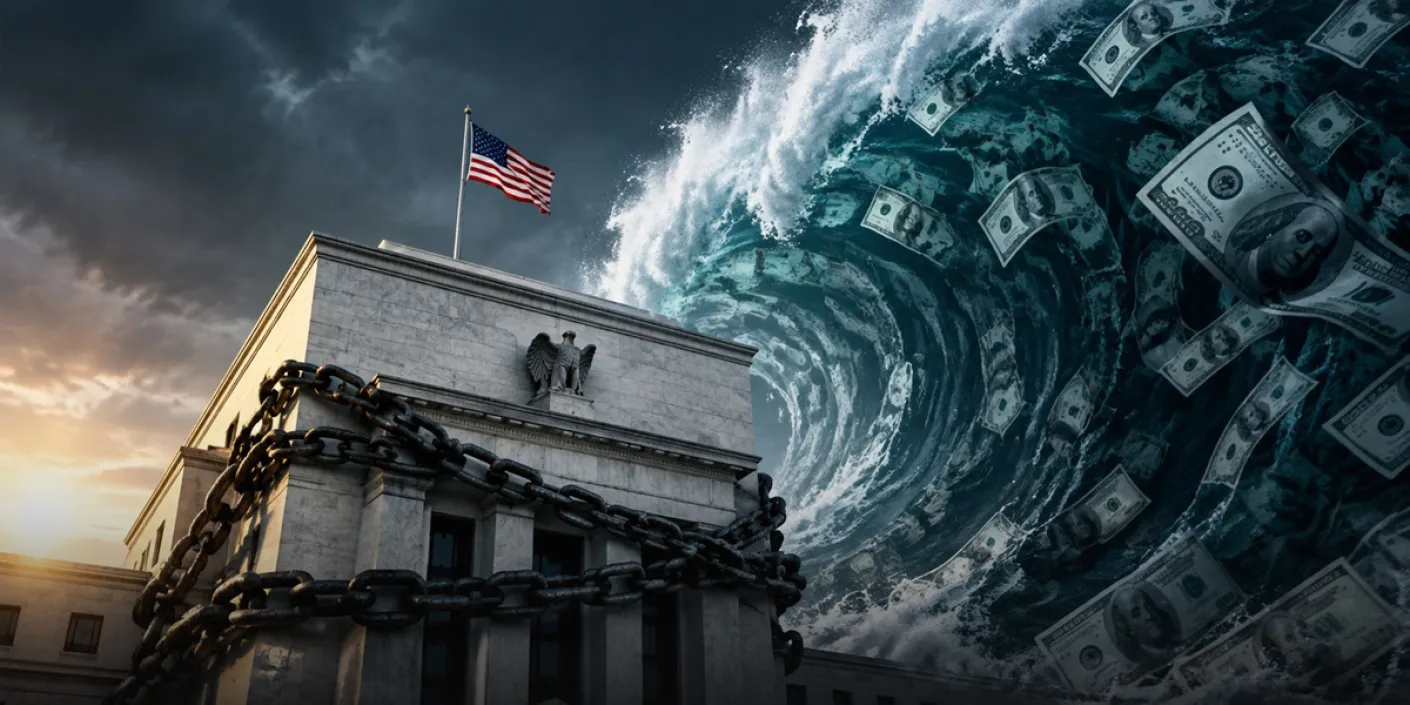
If you want to understand where the markets and economy are headed over the next decade, you must look past the daily headlines and look at the math. And, right now, the math of the United States federal budget is telling a terrifying story. We are sailing directly into a perfect macroeconomic storm, and the warning sirens are sounding the alarm for anyone willing to look at the government’s balance sheet.
We are no longer dealing with future hypotheticals. The consequences of decades of fiscal recklessness—an illusion of prosperity built on cheap credit—are arriving at our doorstep. The mechanics of how this unfolds will dictate the value of your portfolio, your purchasing power, and the broader economy well into the 2030s.
The 2030 Trajectory: A Fiscal Runaway Train
To understand where we are heading, you must look at where we started. At the turn of the millennium, total US public debt sat at roughly $5.6 trillion. It took the nation over two centuries to accumulate that debt. Then came the War on Terror, the 2008 Great Financial Crisis, and the 2020 Pandemic as the national debt went vertical.
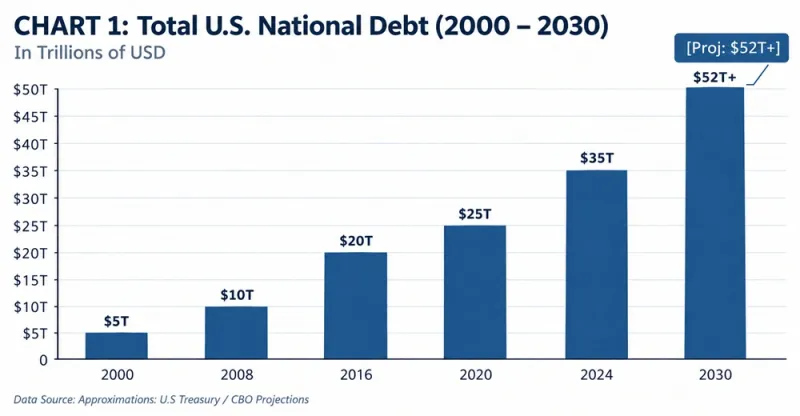
If we continue our current trajectory, the Congressional Budget Office (CBO) projects that the US national debt will soar past the $50 trillion mark by 2030. But, honestly, given the historical tendency for government estimates to be overly optimistic, that number could be much higher. These projections assume no recession for the balance of this decade. We are running multi-trillion-dollar deficits during periods of relative economic expansion. What happens when the next recession hits, tax revenues plummet, and automatic stabilizer spending skyrockets? We are borrowing just to pay the interest on what we’ve already borrowed—the classic, textbook definition of a debt spiral.
What is even more alarming is that, in a mid-term election, candidates from both parties are promising even more spending.
2026 Midterm Fiscal Proposals: Side-by-Side
The core debate in 2026 centers on not just new spending, but on the expiration of the 2017 Tax Cuts and Jobs Act (TCJA) provisions, which along with Medicare expansion and subsidies drastically impacts the federal deficit trajectory.
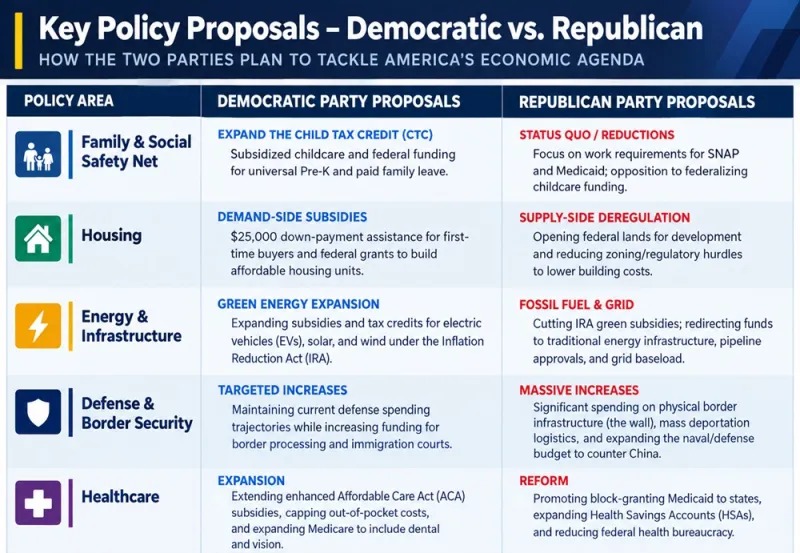
Democrats propose a tax and spend policy whereas Republicans advocate a cut and grow policy. Neither party acknowledges the fiscal debt cliff.
The Interest Expense Crisis: The Hockey Stick
The real crisis isn’t just the total debt; it’s the cost of carrying that debt. For the last 15 years, the Treasury skated freely by the Federal Reserve’s Zero Interest Rate Policy (ZIRP).
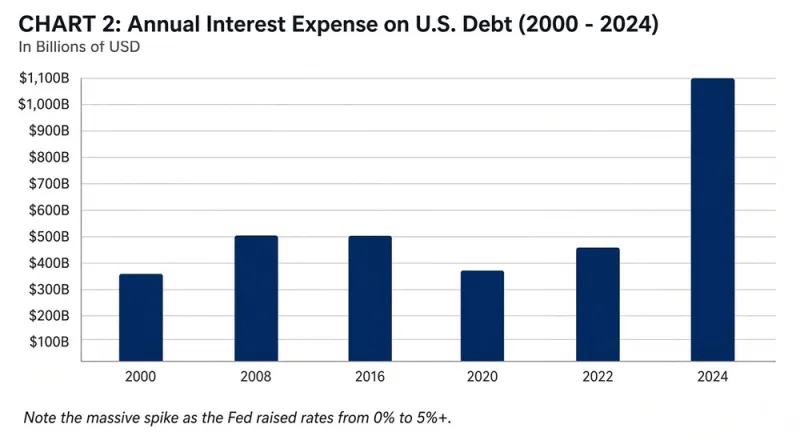
Look at the data from 2008 to 2020 in the chart below. National debt nearly tripled during that time, yet the annual interest expense went down. That was the magic of ZIRP. It allowed the government to gorge on debt without immediately feeling the pain.
But that era is dead and gone.
The Great Rollover: Resetting the National ARM
Here is the structural flaw that is going to break the system: the Treasury funded a massive portion of this debt at the short end of the yield curve. This was done deliberately to keep interest expenses low in the era of ZIRP. As homeowners locked in low 30-year mortgages at the lowest interest rates in history, the Treasury did the opposite. They financed debt at short-term rates where interest rates were the lowest. This is why interest expense fell while the national debt nearly tripled.
When a 1.5% Treasury bill matures today, it has to be reissued at 4.5% or 5%. The problem for the government now is the FED’s ZIRP policies ended as the FED raised interest rates to 5%. Nearly a third of all outstanding US Treasury debt matures in the next 12 to 24 months. Trillions of dollars of this low-yielding debt must be rolled over and reissued at 4.5% or 5%.
Because of this brutal rollover math, annualized interest on the national debt has now surpassed $1 trillion, exceeding national defense spending. Interest payments on the federal debt already absorb roughly one-fifth of federal revenues, and that share is projected to rise in the coming years. This is mathematically unsustainable. You cannot tax your way out of this and, politically, no one has the stomach to cut entitlements to fix it.
Enter "Fiscal Dominance"
This brings us to a crucial concept that investors must understand: Fiscal Dominance.
Back in 1980, Paul Volker could hike interest rates to 20% to crush inflation because the US debt-to-GDP ratio was around 30%. Today, debt-to-GDP is over 120%. The dynamic has flipped. Fiscal dominance occurs when the central bank can no longer fight inflation because keeping interest rates high would literally bankrupt the federal government.
The Inevitability of Debt Monetization
This raises the question; who is going to buy $50 trillion of debt by 2030?
Foreign central banks like China and Japan are actively reducing Treasury holdings.
Commercial banks are saturated and are dealing with their own balance sheet issues.
The investment public simply can’t absorb the level of debt issuance.
When the Treasury holds a bond auction and the traditional buyers don't show up, there is only one entity left: the buyer of last resort, the Federal Reserve.
To prevent a failed auction and a catastrophic spike in interest rates, the Fed will have to step in and buy the debt. They will monetize the deficits by creating currency out of thin air. We saw a preview of this during the pandemic, but the coming wave of monetization will be structural and permanent. It won't be called Quantitative Easing (QE) as a temporary emergency measure; it will be Yield Curve Control (YCC) as a matter of national survival.
The Warsh Dilemma: When the Hawk Meets the Math
This brings us to the man in the hot seat: Federal Reserve Chairman Kevin Warsh. Now, if you follow the mainstream financial media, they’ll tell you Warsh is a hawk. He’s built a reputation as a sound-money guy, a pragmatist who has heavily criticized the Fed's massive balance sheet expansion in the past. He wants to bring back market discipline. Deep down, he probably wants to be the next Paul Volcker.
However, the math simply will not let him.
As mentioned previously, Volcker broke the back of inflation in the early 1980s by jacking interest rates up to 20% when the U.S. debt-to-GDP ratio was sitting around 30%. Today? We are north of 120% and climbing fast. Warsh is stepping into a burning dynamite factory armed with a squirt gun.
Here is the crux of the Warsh dilemma: his ideology demands that he fight inflation and let the free-market price the cost of capital, but Fiscal Dominance demands that he bail out the United States Treasury.
So, when does the hawk finally blink? When does he throw in the towel and begin monetizing this massive debt? He won't do it willingly. He will be forced into it by one of three systemic breaking points in the financial plumbing.
Trigger 1: The Treasury Auction Failure
This is the absolute nightmare scenario for Washington, and it is the most direct trigger for debt monetization. The Treasury is currently issuing a historic avalanche of debt just to fund our multi-trillion-dollar deficits and roll over that maturing short-term paper we talked about.
Warsh will be forced to blink the moment we see a severe "fail" in a major Treasury auction. That means the primary dealers and foreign buyers—the folks who normally buy our debt—simply refuse to take down the supply at the current yields. If the Treasury tries to sell $100 billion in bonds and the buyers demand 6% or 7% to take the risk, bond prices will crash, and yields will gap up violently.
The Fed cannot, and will not, allow the U.S. government to face a failed auction. At that exact second, Warsh will be forced to activate the Fed as the "buyer of last resort," stepping in with freshly printed fiat currency to buy the debt.
Trigger 2: The Financial Plumbing Freezes
The entire U.S. financial system relies on Treasury bonds acting as pristine collateral for overnight lending—what we call the repo market. But when there are too many Treasuries flooding the market and not enough cash on bank balance sheets to absorb them, the plumbing clogs up.
We saw a mini-version of this back in September 2019. If Warsh tries to hold rates high and shrink the Fed's balance sheet, liquidity will rapidly drain from the system. When the overnight repo rate suddenly spikes because banks are choking on Treasury paper and hoarding cash, the credit markets will freeze. Warsh will have to blink immediately, flooding the system with liquidity and monetizing debt just to keep the banking system's lights on.
Trigger 3: The Corporate Maturity Wall
While Warsh might have the stomach to let a few over-leveraged zombie companies go under, he cannot withstand a systemic collapse of the corporate bond market.
Over the next 24 months, trillions in corporate debt must be refinanced at these new, higher rates. If Warsh holds the line, corporate interest expenses will explode. Profit margins will collapse, leading to mass layoffs and a sharp, violent spike in unemployment. The political pressure from Capitol Hill—combined with the Fed's dual mandate to maintain maximum employment—will force him to cut rates and expand the balance sheet to save the corporate credit markets.
The Disguise: How the "Blink" Will Be Sold to the Public
This is important to understand: when Warsh finally does blink and turns the printing presses back on, he will never call it debt monetization. He won't even call it Quantitative Easing (QE).
To protect his hawkish credibility and maintain the illusion of Federal Reserve independence, this bailout will be packaged under highly technical, boring acronyms designed to put the public to sleep. Keep your ears open for these code words:
"Market Functioning Interventions": They will claim they are buying Treasuries not to stimulate the economy or bail out the government, but simply to "ensure smooth market operations."
"Yield Curve Control" (YCC): They will peg the yield on the 10-year Treasury at a specific rate—say, 4.5%—to prevent government borrowing costs from exploding. The Fed will then print whatever amount of currency is required to defend that line in the sand.
"Standing Repo Facilities": Creating permanent backstops where banks can seamlessly swap government debt for Fed cash.
The Bottom Line for Investors
Kevin Warsh’s dilemma is that the Federal Reserve is no longer independent; it is a captive hostage to the Treasury's balance sheet. He can talk tough, and he might hold out a little longer than a dovish chair would, but mathematics always wins.
When the ultimate choice comes down to either (A) allowing a sovereign debt crisis and a deflationary depression, or (B) monetizing the debt and sacrificing the purchasing power of the U.S. dollar, the central bank will always choose B. They will print.
As an investor, you cannot position your portfolio based on what a hawkish Fed Chair wants to do. You have to position yourself for what the unforgiving mathematical reality of Fiscal Dominance will force him to do. That means you need to be looking at hard assets, precious metals, commodities, and high-quality companies with real cash flows that can survive in a world where the currency is continually debased to pay for the sins of the past.
What This Means for Stocks and the Economy
For the economy, this spells a prolonged period of stagflation-sluggish, volatile growth coupled with sticky, persistent inflation. The government’s insatiable demand for capital will crowd out the private sector, suppressing productive investment.
For the stock market, rising interest rates and the fear of uncontrolled debt issuance act as a massive headwind.
Multiple Compression: High rates crush the valuation of long duration growth stocks. You can’t justify paying 40 times earnings when the risk-free rate is commanding 5%. This is already happening with the Nasdaq PE multiple dropping from a peak of 43 in 2024 to a more recent multiple of 32 despite explosive earnings.
Corporate Margin Squeeze: Companies that gorged on cheap debt over the last decade are facing the same “maturity wall” as the government. Refinancing their corporate debt at higher rates will eat directly into their profit margins. We will see a wave of Zombie companies forced into bankruptcy.
Real Return Deficit: While the nominal stock market might eventually rise due to the sheer volume of newly printed fiat currency flooding the system, your real returns (adjusted for inflation) may be far lower.
We are shifting from an era where paper assets and financial engineering ruled, to an era where the cost of capital matters again. As the Fed is eventually forced to monetize the debt to stave off a sovereign default, the currency will be the ultimate release valve.
Investors need to look at this mathematical reality with open eyes. The 2030 debt trajectory guarantees that the next decade will not look like the last. Focusing on hard assets, real cash flows, commodities, and inflation resistant sectors is no longer just a wealth-building strategy; it will become a necessity for financial survival.



Comments
Log in or sign up to join the conversation.