

Yesterday, crude oil prices and risk asset markets were rocked by comments made by Saudi oil minister, Ali al-Naimi, in which he stated that, because no one would adhere to production cuts, discussing such a move would be a “waste of time” and described the prospects of a production freeze as a “joke.” Iran’s oil minister, Bijan Namdar Zanganeh, described the proposed Saudi-Russia production freeze proposal as “ridiculous.” That anyone became optimistic because of production freeze chatter is what is “ridiculous” and a “joke.”
It appears that pundits and money managers who are bullish on oil and believe that all OPEC need do is force U.S. shale producers into bankruptcy are either disingenuous or dull-witted. The former is shameful, but the latter is far worse, particularly for their clients. What is it that these bulls do not understand about the credit markets?
There is a belief (a mistaken belief in my opinion) that all OPEC and Russia have to do is force U.S. shale produces into bankruptcy and they will wrest control of oil prices. As I have written previously, bankruptcy does not automatically spell doom for U.S. shale oil production, it could make production profitable at lower price levels. Remember, an oil driller which seeks Chapter XI protection does not go out of business. However, they typically receive a significant reduction it their corporate debt loads. They also often renegotiate contracts with suppliers, logistics companies, etc. Forcing U.S. oil E&P companies into bankruptcy could result in making them more competitive. Chapter VII filings would result in companies seeking such protection ceasing operations. However, the survivors or new speculators would be able to buy the assets from the bankrupt companies at bargain prices. These assets might include equipment, rigs, wells, land and leases. Chapter VII could (should) result in profitable oil (and gas) production at lower price levels, as well.
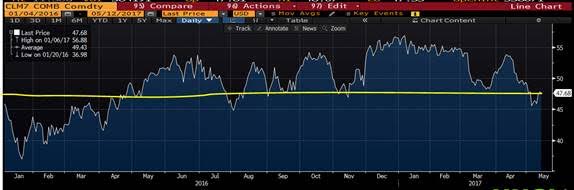
If this scenario is so clear, why do the “markets” seem to miss it? It appears that some speculators underestimated the potential for U.S. production. Some misjudged the ability of U.S. energy producers to increase efficiencies. When energy prices began to decline in the second half of 2014, the analyst community believed that U.S. production would tail-off when WTI dipped below $80. Then it was $70, $60, and $50. Not until WTI approached $40 did we see the nascent signs of production reduction. I was surprised by this as well. However, by the time WTI breached $50, it was clear that we were in a brave new world for domestic energy production. I believe, that the reason many pundits and money managers continue to espouse bullish oil sentiment and hope for OPEC and Russian production cuts is that they have caught falling knives all the way down, possibly including last week.
On the other side of the strategy coin, the Saudis, Qatar and Iran understand that they are unlikely to get enough U.S. production offline to meaningfully boost oil prices. They also understand that by pushing U.S. producers into bankruptcy, the result might be that U.S. producers become even more competitive. Foreign oil producers also have bills to pay. The Saudis have a large social obligation for which to pay. Since reducing production is not guaranteed to lift prices (U.S. production could rise) and could result in lost market share, they are incentivized to keep pumping at record rates.

Comments
Log in or sign up to join the conversation.