


Overview
Global financial markets are currently navigating one of the most complex macroeconomic matrices of 2026. A convergence of persistent geopolitical energy shocks, sweeping Asian foreign exchange volatility, and a pivotal schedule of central bank decisions has set the stage for an extended period of high-stakes market repricing.
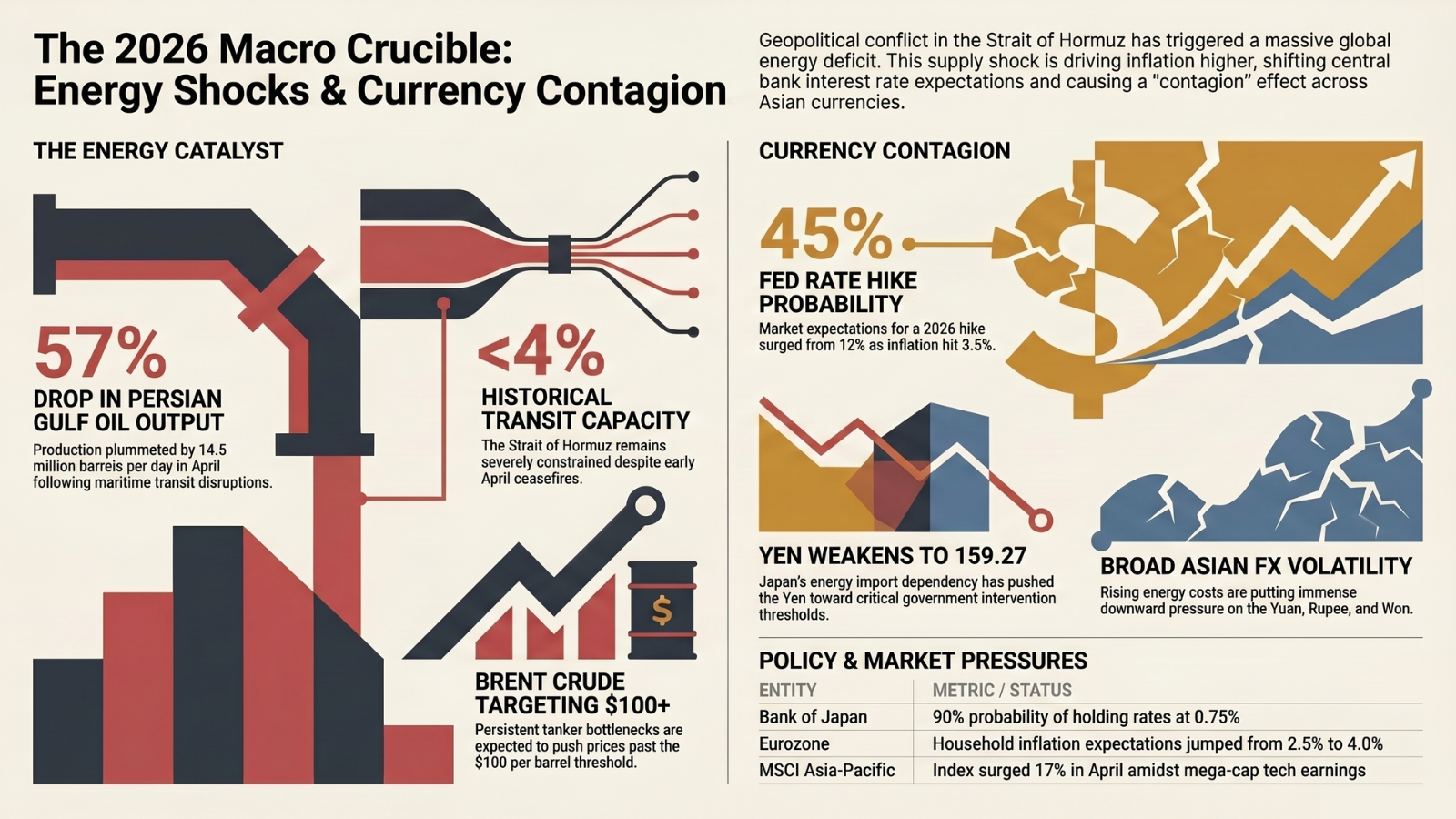
The Energy Catalyst: The Strait of Hormuz Bottleneck
The foundation of the current macroeconomic strain lies in the disrupted global energy supply chains. Following the geopolitical conflicts in late February, maritime transit through the critical Strait of Hormuz remains severely constrained, operating at less than 4% of its historical averages despite early April ceasefires.
The immediate supply shock is tangible in the data:
Production Deficit: Persian Gulf oil output plummeted by an estimated 14.5 million barrels per day in April, representing a staggering 57% decline.
Price Trajectory: With immediate bottlenecks in tanker availability persisting, macroeconomic models suggest that if the blockade continues, Brent crude could firmly breach the $100 per barrel threshold.
While institutions like Goldman Sachs project a gradual recovery of lost capacity upon normalization, the near-term energy squeeze is injecting a substantial geopolitical premium into global inflation metrics.
Currency Contagion: The Broad Asian FX Sell-Off
This energy-driven inflation shock—pushing April estimates to approximately 3.5%—has fundamentally altered interest rate expectations. Market probability for a 2026 Federal Reserve rate hike has surged from a mere 12% to 45%.
The resulting "higher-for-longer" yield environment has triggered massive safe-haven flows into the US Dollar, creating a brutal contagion effect across Asian currencies:
Japanese Yen (JPY): As a major net energy importer, Japan has seen the Yen weaken to 159.27 against the dollar, pushing the currency perilously close to critical government intervention thresholds.
Emerging Markets: The Chinese Yuan (CNH) faces immense downward pressure from rising energy import costs, while the Indian Rupee (INR) and South Korean Won (KRW) are experiencing heightened, broad-based volatility as capital flows toward higher-yielding USD assets.
The 'Super Week' Convergence
Compounding the energy and FX volatility is a highly dense schedule of monetary policy decisions and corporate earnings, testing the resilience of global equities.
Bank of Japan (BOJ): Markets are pricing in a 90% probability that the BOJ will hold its benchmark rate at a multi-decade high of 0.75%. However, forward guidance regarding war-induced inflation will dictate the Yen's next major directional move.
European Central Bank (ECB): Recent consumer surveys have delivered a shock to policymakers, with Eurozone household inflation expectations for the next 12 months jumping from 2.5% to 4.0%. With non-labor input costs spiking to 5.8%, the narrative of a June rate cut is being severely tested.
Mega-Cap Tech Earnings: Amidst this macro turbulence, five of the "Magnificent Seven" (including Microsoft (MSFT), Alphabet (GOOGL), Meta (META), and Amazon (AMZN)) are releasing earnings. These results will directly test the fundamental strength of the AI-driven S&P 500 rally, which recently saw the MSCI Asia-Pacific ex-Japan index surge 17% in April.
SBCFX Strategic
In an environment where central bank policy updates, major corporate earnings, and geopolitical headlines collide, directional speculation carries unprecedented risks.
Market dynamics suggest a necessary pivot toward dynamic hedging strategies. Utilizing cross-asset correlation—such as hedging FX exposure with energy commodities—and maintaining strict algorithmic stop-loss mechanisms are no longer merely defensive tactics, but essential disciplines for capital preservation during this macroeconomic crucible.



Comments
Log in or sign up to join the conversation.