
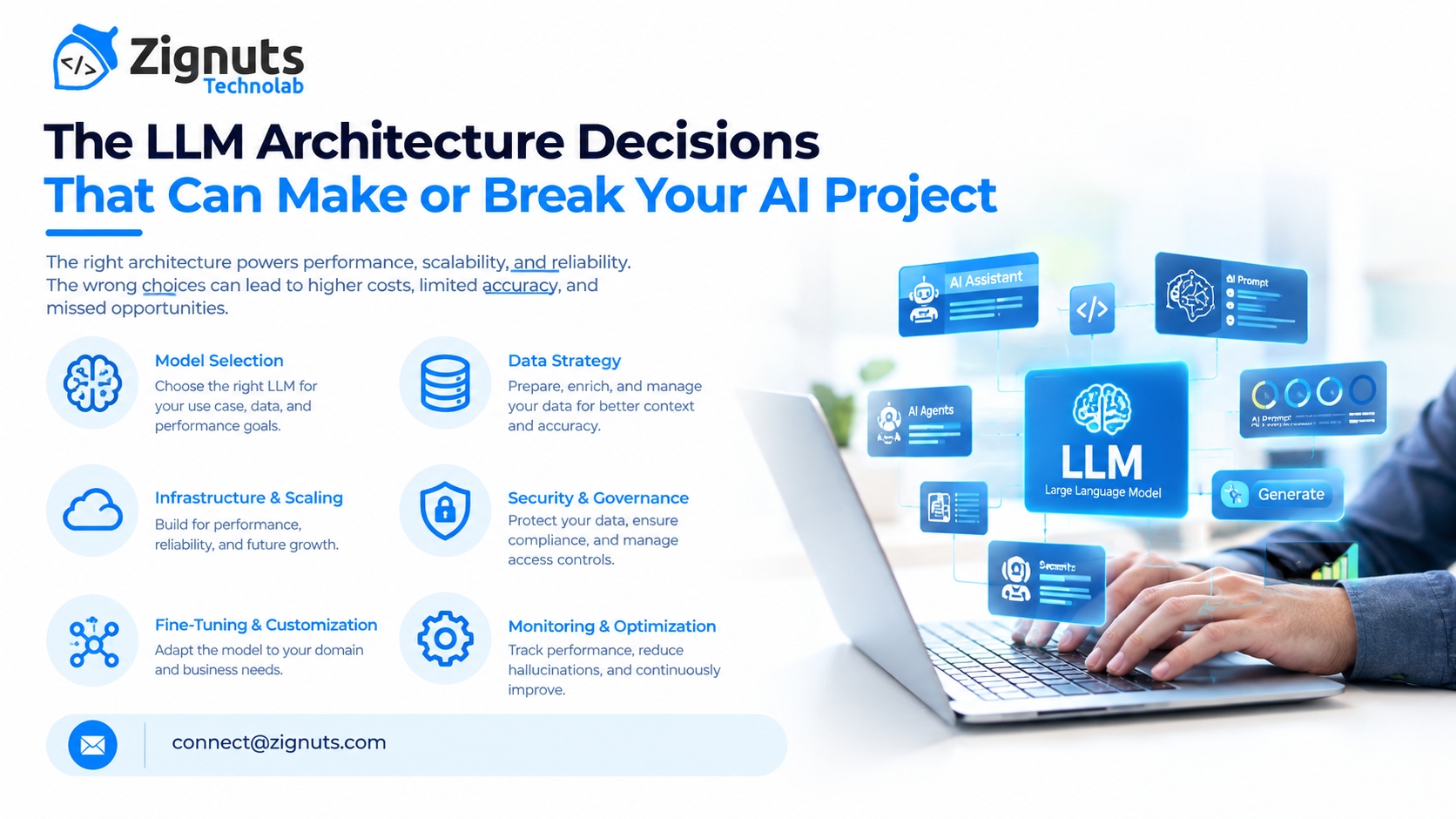
An LLM project can look impressive during a prototype and still struggle when real users, enterprise data, integrations, security requirements, and operational costs enter the picture. The difference often comes down to architecture. Custom LLM Architecture Solutions are not about creating a complicated system for its own sake. They are about designing the right combination of models, data, retrieval, application logic, integrations, security, and monitoring around a specific business requirement.
2027 Business Expectation | Architecture Implication | Executive Recommendation |
|---|---|---|
LLM applications will become more embedded in core workflows | Architecture will need to support reliability beyond simple conversations | Design around business workflows rather than chatbot features |
Organizations will use multiple models and AI components | Model abstraction and modular architecture can become increasingly valuable | Avoid unnecessary dependence on one model or provider |
AI governance will become part of enterprise deployment | Security, monitoring, evaluation, and access controls will need architectural support | Include governance requirements before production deployment |
Architecture Matters More Than the Demo
A prototype usually has a narrow objective.
It might send a prompt to a model, receive an answer, and display the response through a simple interface.
That is useful for validating an idea.
Production systems have much more to handle.
They may need to authenticate users, retrieve enterprise information, enforce permissions, connect with internal systems, manage conversation context, validate outputs, handle failures, track usage, control costs, and maintain consistent performance.
This creates an important distinction:
A successful LLM demonstration proves that something can work. A well-designed architecture determines whether it can keep working as the business grows.
Start With the Business Problem
Architecture decisions should begin with the business workflow rather than the model.
Before selecting a model or framework, define:
What business problem needs to be solved?
Who will use the application?
What information does it need?
What systems must it connect to?
What decisions or actions will it support?
What level of accuracy is required?
What happens when the model is uncertain?
How will success be measured?
A document assistant, customer service application, coding assistant, internal knowledge platform, and workflow automation system may all use LLMs, but their architecture requirements can be very different.
The Core Architecture Layers
An enterprise LLM system generally consists of several interconnected layers.
The model is only one of them.
A practical architecture can be viewed as:
Business Requirements → Data & Retrieval → LLM Layer → Application Logic → Enterprise Integration → Evaluation & Monitoring
Each layer has a specific responsibility.
Business requirements define the expected outcome.
Data and retrieval provide relevant context.
The LLM generates or transforms information.
Application logic controls deterministic business rules.
Enterprise integrations connect the application to operational systems.
Evaluation and monitoring help determine whether the system continues to perform as expected.
The architecture becomes stronger when these responsibilities are clearly separated.
Choosing the Right Model
Model selection is one of the most visible architecture decisions, but it should not dominate the entire design.
A larger model may provide stronger capabilities for some tasks, while a smaller model may be more suitable for applications where latency, cost, or predictable processing matters.
The right choice depends on the workload.
Consider:
Reasoning requirements
Context requirements
Response latency
Output consistency
Supported modalities
Deployment options
Data-handling requirements
Operating cost
Availability
Integration requirements
Teams should evaluate models against representative business tasks rather than relying only on general benchmarks or demonstrations.
When One Model Is Not Enough
A production application does not necessarily need one model for every task.
For example, a system could use one model for complex reasoning and another for lightweight classification, extraction, or routing.
This can create a more flexible architecture when the workload contains tasks with significantly different requirements.
However, multiple models also increase operational complexity.
Each additional model can introduce another provider, API, evaluation process, failure mode, pricing structure, or security consideration.
The goal should therefore be appropriate specialization, not unnecessary complexity.
Data Architecture Is a First-Class Decision
LLMs are only as useful as the information available to the application when a task requires business-specific knowledge.
Enterprise data can exist across:
Databases
PDFs
Knowledge bases
CRM systems
ERP platforms
Cloud storage
Internal applications
APIs
Support systems
Collaboration platforms
Connecting all of these sources directly to an LLM is rarely a good architectural strategy.
Instead, the application needs a controlled data layer that determines what information is available, how it is retrieved, and whether the user has permission to access it.
Data quality also matters.
Outdated, duplicated, contradictory, or poorly structured information can produce unreliable results even when the model itself performs well.
Retrieval Architecture Can Define Answer Quality
Retrieval-augmented generation can help an application provide the model with relevant enterprise information at request time.
But retrieval involves more than adding a vector database.
Teams need to consider:
Document ingestion
Chunking strategy
Metadata
Embeddings
Search methods
Filtering
Re-ranking
Permission checks
Freshness
Source attribution
Retrieval evaluation
For some applications, combining semantic search with keyword or structured filtering can provide a more suitable retrieval process than relying on a single search method.
The architecture should match the type of information the application needs to find.
Keep Business Logic Outside the Model
One of the most important architecture decisions is determining which responsibilities belong to the LLM and which should remain deterministic.
An LLM can interpret a request, summarize information, classify content, or generate a response.
It should not automatically become the source of truth for every business rule.
For example, an organization's eligibility calculation, approval threshold, pricing rule, or access policy can often be implemented through deterministic application logic.
The LLM can help interpret the user's request and gather relevant information, while application code applies the actual rule.
This separation can make systems easier to test, audit, and maintain.
Design Integrations Around Controlled Actions
Enterprise LLM applications often become more useful when they can interact with external systems.
An assistant might retrieve customer information, create a ticket, update a record, or initiate an internal workflow.
But every integration adds architectural responsibility.
The application should define:
Which tools are available
Which users can invoke them
Which parameters are accepted
Which actions require confirmation
What happens if an API fails
How actions are logged
How errors are handled
A model should not receive broad system access simply because an integration is technically possible.
Security Should Shape the Architecture
Security should be built into the architecture rather than added after the system is complete.
Important considerations include:
Authentication
Authorization
Data classification
Encryption
Secrets management
Permission-aware retrieval
Input validation
Output controls
Tool permissions
Audit logging
Data retention
Monitoring
For sensitive applications, the architecture should also consider what information enters prompts, what is sent to external model providers, and what information remains in application logs.
Architecture Choices for Different Business Requirements
Different LLM use cases can require different architectural priorities.
Business Use Case | Architecture Priority | Key Design Consideration |
|---|---|---|
Internal knowledge assistant | Secure retrieval | Connect responses to authorized enterprise information |
Customer service automation | Integration and reliability | Combine LLM responses with customer and workflow systems |
Document intelligence | Data processing | Build reliable ingestion, extraction, and validation |
AI workflow automation | Tool control | Restrict actions and introduce approval for high-impact operations |
Enterprise coding assistant | Security and context | Protect source code while providing relevant development context |
Cost Is an Architecture Concern
LLM costs can be influenced by much more than the model's listed price.
Architecture can affect:
Number of model calls
Prompt size
Retrieved context
Output length
Model selection
Request frequency
Caching
Retry behavior
Parallel processing
Evaluation workloads
A poorly designed retrieval pipeline may send unnecessary context with every request.
An application with excessive model calls can increase operational costs without improving the business outcome.
Cost optimization should therefore begin with architecture.
Teams can use techniques such as caching, model routing, context reduction, batching where appropriate, and deterministic processing for tasks that do not require generative reasoning.
Reliability Requires Failure Planning
LLM applications depend on components that can fail.
A model API may become unavailable.
A retrieval system may return poor results.
An internal API may time out.
A model may produce an unexpected response.
A user may provide an ambiguous request.
Production architecture needs explicit responses to these situations.
Potential mechanisms include:
Timeouts
Retries
Fallback models
Graceful degradation
Structured outputs
Validation
Error handling
Human escalation
Service monitoring
The objective is not to assume that failures will never happen.
It is to ensure that failures do not automatically become business incidents.
Evaluation Should Be Part of the Architecture
Traditional software testing alone is not enough for many LLM applications.
Model outputs can vary, and quality depends on context.
An evaluation strategy can measure dimensions such as:
Factual accuracy
Relevance
Instruction following
Retrieval quality
Output format
Safety
Tool-use correctness
Business-rule compliance
Representative test cases should be created from actual or carefully constructed business scenarios.
The same evaluation process can then be used when changing models, prompts, retrieval systems, or application components.
Avoid Building a Monolith Around One Provider
An architecture that depends heavily on one model provider can create future constraints.
This does not mean every application needs a fully provider-independent architecture.
Abstraction can introduce its own complexity.
Instead, businesses should identify which components are likely to change and separate them where practical.
For example, application logic, retrieval, evaluation, and business rules can often remain relatively independent from the underlying model.
This makes future experimentation easier without requiring the entire application to be redesigned.
Executive Questions Before Architecture Approval
Before investing heavily in an LLM architecture, decision-makers should ask:
What business outcome does the architecture support?
If the architecture cannot be connected to a measurable business objective, its complexity may be difficult to justify.
Which components actually need an LLM?
Not every step of an AI workflow requires generative intelligence.
What data will the application access?
Identify sources, ownership, sensitivity, quality, freshness, and permission requirements.
What happens when the model is wrong?
Define validation, fallback, escalation, and human review mechanisms.
What can the AI system change?
Separate recommendations from actions and establish appropriate authorization.
How will costs scale?
Model calls, context size, user volume, retrieval, storage, and monitoring should be considered before production.
Can the architecture evolve?
Evaluate how easily the application can accommodate new models, data sources, users, integrations, and business requirements.
A Practical Architecture Implementation Roadmap
Step 1: Define the business workflow
Map the current process and identify where an LLM can provide measurable value.
Step 2: Identify data requirements
Determine which internal and external information the application needs.
Step 3: Establish security boundaries
Define identities, permissions, sensitive data controls, and system access.
Step 4: Select the model strategy
Evaluate one or more models against representative business tasks.
Step 5: Design the data and retrieval layer
Build controlled ingestion, indexing, retrieval, filtering, and authorization mechanisms.
Step 6: Separate deterministic logic
Keep calculations, permissions, business rules, and critical validations outside the model where appropriate.
Step 7: Design integrations
Connect only the enterprise systems required for the workflow and restrict available actions.
Step 8: Build evaluation into development
Create repeatable tests before changing prompts, models, retrieval methods, or application logic.
Step 9: Establish monitoring
Track quality, latency, failures, usage, security events, and cost.
Step 10: Scale deliberately
Expand users, workflows, and integrations only after the architecture demonstrates reliable performance under realistic conditions.
Common Architecture Mistakes
Several decisions can create avoidable problems later.
Starting with the model: A strong model does not compensate for an unclear business requirement.
Connecting too much data: More information does not automatically create better answers.
Giving excessive permissions: AI applications should operate within clearly defined boundaries.
Putting business rules inside prompts: Critical rules are generally easier to control when implemented deterministically.
Ignoring evaluation: Without repeatable evaluation, teams can struggle to determine whether an architectural change improved the application.
Optimizing cost too late: Architecture choices can influence operating costs from the beginning.
Building unnecessary complexity: Custom architecture should solve real requirements rather than introduce components simply because they are available.
Measuring Whether the Architecture Works
Architecture success should ultimately be connected to application and business performance.
Useful measures can include:
Task completion rate
Response quality
Retrieval accuracy
Error frequency
Latency
Model usage
Cost per workflow
User adoption
Human escalation rate
Integration failures
Security events
System availability
The exact metrics should reflect the business use case.
For example, an internal knowledge assistant may emphasize retrieval quality and employee task completion, while an AI workflow system may place greater emphasis on action accuracy, integration reliability, and controlled execution.
The Architecture Should Support Change
LLM technology will continue to evolve, but businesses should avoid designing systems that depend on predicting exactly which model or framework will dominate in the future.
A more practical objective is adaptability.
A well-structured architecture should make it possible to evaluate a new model, replace a retrieval component, add another data source, or modify a workflow without rebuilding every layer.
This is where modularity becomes valuable.
The architecture should be stable enough for production while remaining flexible enough to evolve.
Conclusion
The most consequential LLM architecture decisions are rarely about selecting the most impressive model.
They are about deciding where intelligence belongs, how enterprise data reaches the application, which rules remain deterministic, what actions the system can perform, how security is enforced, how quality is evaluated, and how the entire solution will behave as usage grows.
Custom LLM Architecture Solutions should therefore be built around the organization's actual workflow rather than around a model's capabilities.
A strong architecture creates clear boundaries between data, models, business logic, integrations, security, and monitoring. It also gives the business room to change those components without rebuilding the entire system.
For executives and technology leaders, the practical objective is simple: build an LLM architecture that solves today's business problem while leaving enough flexibility to support tomorrow's requirements.
FAQs
1. What is custom LLM architecture?
Custom LLM architecture is a system design tailored to a specific business use case, combining models with data, retrieval, application logic, integrations, security, evaluation, and monitoring.
2. Does every enterprise LLM application need a custom architecture?
Not necessarily. The level of customization should depend on business requirements, data sensitivity, integrations, scale, reliability expectations, and governance needs.
3. Should business logic be handled by an LLM?
LLMs can interpret requests and generate useful outputs, but critical calculations, permissions, and deterministic business rules are often better handled by application logic.
4. How does RAG affect LLM architecture?
RAG adds a retrieval layer that supplies relevant information to the model. Its design needs to account for indexing, retrieval quality, permissions, data freshness, and evaluation.
5. How can businesses control LLM operating costs?
Architecture can reduce unnecessary model calls and context through model selection, routing, caching, efficient retrieval, context management, and deterministic processing where appropriate.
6. What makes an LLM architecture scalable?
Scalability depends on factors such as modular components, reliable integrations, efficient data access, monitoring, capacity planning, cost controls, and the ability to adapt individual components without redesigning the entire system.
7. When should architecture planning begin in an LLM project?
Architecture planning should begin once the business problem and requirements are clear, before sensitive data, production integrations, or high-impact workflows are connected to the model.
Comments
Log in or sign up to join the conversation.