

The latest spike in US inflation is frightening. But, with fingers crossed, it will pass. Convincing the American public of this is another matter.
“Back in July the White House’s Council of Economic Advisers posted a thoughtful article to its blog titled, “Historical Parallels to Today’s Inflationary Episode.” The article looked at six surges in inflation since World War II and argued persuasively that current events don’t look anything like the 1970s. Instead, the closest parallel to 2021’s inflation is the first of these surges, the price spike from 1946 to 1948.” (Paul Krugman, NYT, November 12, 2021)
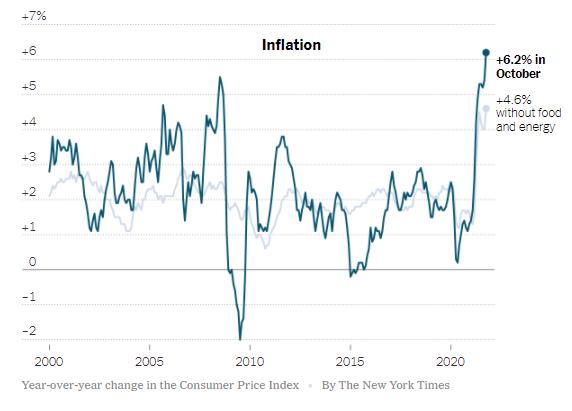
Over the past twelve months, the US consumer price index (CPI) rose 6.2%, which was the fastest twelve-month increase in over thirty years.
It hardly seemed to matter to Americans that the twelve-month surge in the CPI was reduced to 4.6% in October when food and fuel prices were removed from the calculation.
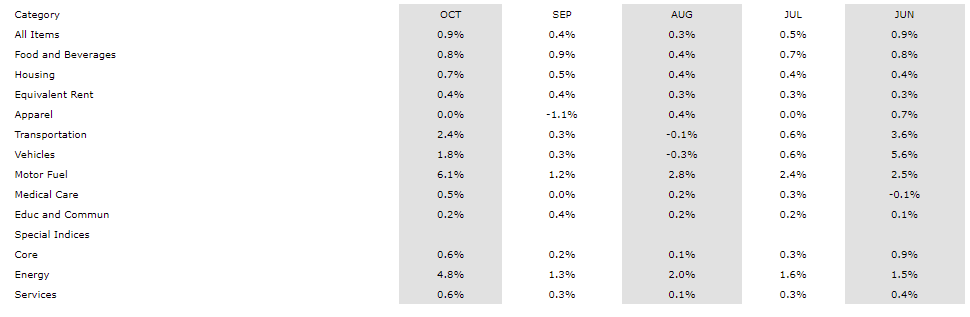
The latest pattern of monthly increases in the CPI has also been alarming. The CPI increased 0.9% in October, 0.4% in September, and 0.3% in July and in August. In other words, the October monthly increase represented more than a 10% annualized rate of inflation.
Indeed, it seems as if that everything that could go wrong on the inflation front coalesced last month. Last month’s huge price increase included rising fuel costs, numerous product price increases, and even housing rents increased. The prices of clothes, lawnmowers, and car parts surged as supply chain disruptions resulted in fuel shortages and raised transportation costs.
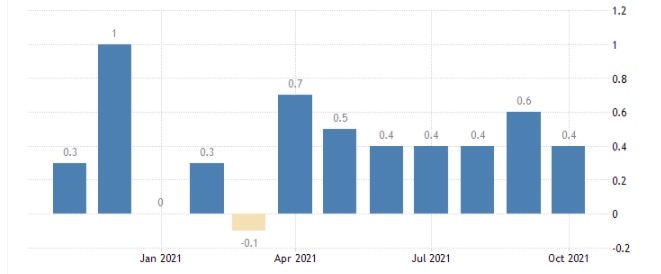
Ironically, as one of the accompanying charts also reveals, on a month-to-month basis inflation appeared to be cooling in the three months leading up to the October price surge.
The latest spike in inflation is very troubling for policymakers since it seems to imply that the adjustment to a more normal inflation rate (something below 3%) could take as long as another 9 months or even longer. In other words, we could face another year of high and volatile inflation numbers.
Nonetheless, Paul Krugman is still quite right when he points out that the source of this inflation wave has little to do with past inflation experiences and has most in common with the inflation experience following the end of World War 11.
I also completely agree that the circumstances this time around are not at all similar to the 1970s stagflation environment.
The problem is that we have little experience with understanding how long it will take for the supply blockages and the labor shortages to clear up as the economy recovers out of the pandemic recession.
For that matter, we also don’t know how long it will take until the Covid pandemic, which has spread around the entire globe, will truly be over.
Currently, a critical impediment to a return to normalcy are the supply chain disruptions which have not only caused fuel shortages but have also sharply increased transport costs. We are simultaneously experiencing the unusual coincidence of clogged ports together with a shortage of truckers and hospitality workers.
Finally, even though money wages have started to increase as the economy moves away from the recession, wages haven’t kept up with higher prices.
That is, over the past 12 months, average hourly earnings in the US increased by 4.9% compared to a 6.2% increase in the consumer price index. As well, in October, hourly earnings rose 0.4% compared to a 0.9% increase in prices.
In other words, the real purchasing power of average American consumers has been declining as the American economy recovers from the recession.
All of this is clearly challenging to the consensus government view that the inflation surge is temporary.
Average Hourly Earnings, Monthly Changes
Monthly Changes In The US CPI
(Click on image to enlarge)


Comments
Log in or sign up to join the conversation.