
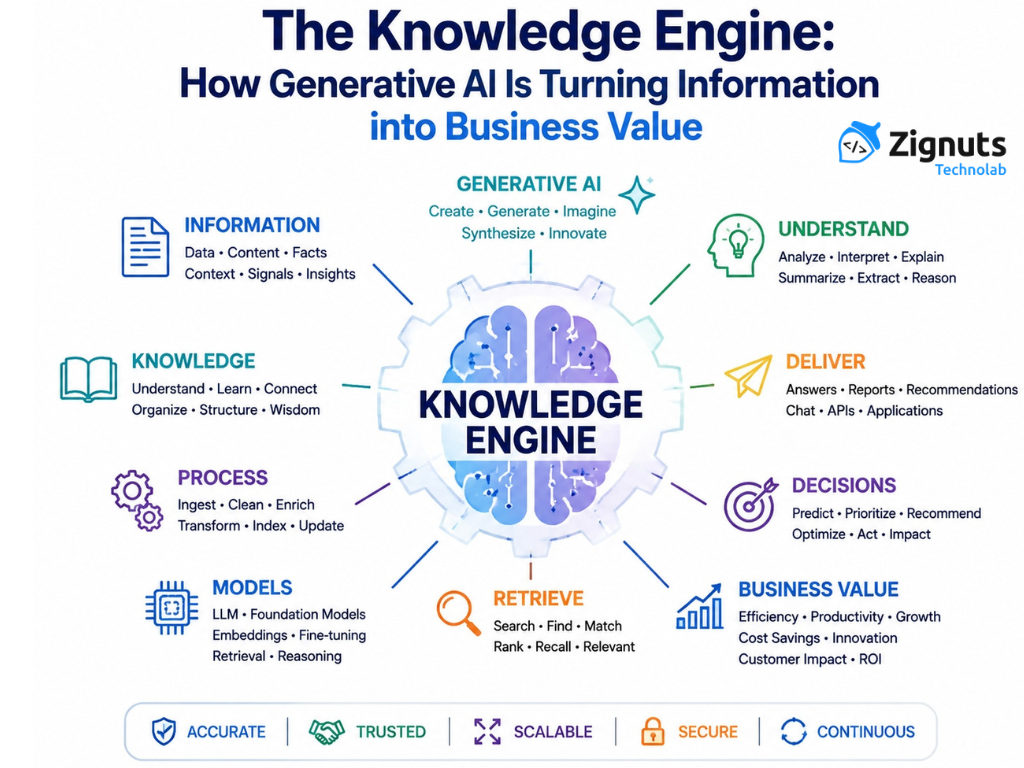
For the past few decades, corporate IT budgets have focused heavily on accumulation. We bought endless server racks, expanded cloud instances, and built gigantic data warehouses.
The strategy worked perfectly for collecting files, but it created an unintended consequence: the data swamp. Hidden inside thousands of unread PDFs, dusty presentation slide decks, and isolated database clusters sits the true core intellect of an organization. Yet, most companies cannot access this knowledge at the moment it is needed most.
When public generative systems first arrived, corporate interest skyrocketed. Everyone instantly saw the potential of conversational tools.
However, early implementations quickly hit a hard operational wall. Simply giving staff access to an open-web writing assistant did not solve deep internal problems. It could write an email or generate a blog post, but it couldn't tell a project lead why a specific software release stalled three quarters ago.
+------------------------+      +------------------------+
|    Legacy Pipeline     |      |     Modern Engine      |
+------------------------+      +------------------------+
| Data Warehousing       |      | Context Synthesis      |
|          ↓             |      |          ↓             |
| Storage Accumulation   |      | Real-Time Execution    |
|          ↓             |      |          ↓             |
| Silent Value           |      | Active Value           |
+------------------------+      +------------------------+
We are now living in a more practical phase of corporate computing. The conversation has completely shifted from public experimentation to deep architectural design. By taking the power of language models and connecting them securely to protected internal environments, generative AI for enterprises is transforming from a novelty writing partner into a core financial engine. This transformation is completely redefining how teams locate information, manage infrastructure, and execute complex business goals.
The Hidden Asset: The True Value of Institutional Knowledge
The fundamental problem holding back modern productivity is not a lack of internal communication. It is a lack of fluid context retrieval. As remote teams and modern project tools expanded, corporate intelligence became scattered across countless software platforms.
The Expense of Lost Context
When an organization cannot easily locate its past research or documentation, it incurs a significant financial penalty. Engineers write software components that a sister team completed six months prior. Operations teams run outdated procedures because updated instructions are buried deep within an unindexed chat history. This lack of access turns highly paid knowledge workers into digital archeologists.
Moving Past Simple Indexing
Traditional internal search systems rely entirely on keyword indexing. If you do not know the exact title or specific phrases inside a file, it remains completely invisible to the retrieval tool. To build a modern knowledge engine, the underlying software must shift toward semantic processing, where the platform reads and understands the context behind user requests.
The Mechanics of the Value Transformation Pipeline
To transform text files into financial value, systems must do more than simply generate conversational text. They must convert human intent into precise system coordinates.
The Power of Vector Processing Spaces
When internal documents are passed into modern ingestion engines, they are broken into smaller chunks and processed through embedding models. This step converts language concepts into multi-dimensional numerical coordinates called vector embeddings.
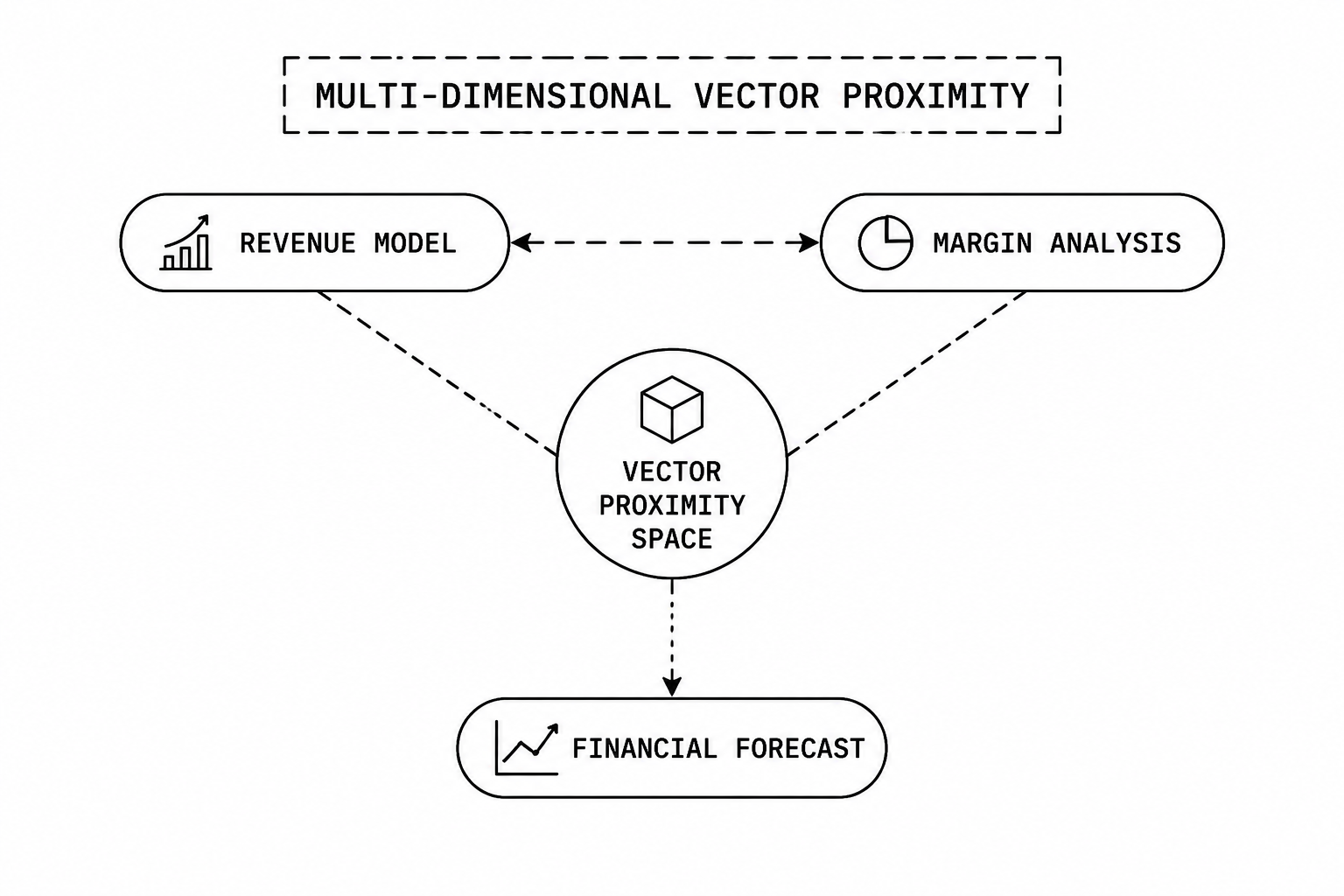
In this mathematical vector space, related concepts naturally sit together. The system understands that a document talking about a financial forecast belongs near a file analyzing revenue margins, even if the individual pages use completely different jargon. This proximity allows AI assistants to grasp exactly what an employee is hunting for, bypassing the limitations of rigid keyword lookups.
Real-Time Structural Synthesis
Once the correct informational blocks are identified, language models perform their most valuable task: text synthesis. Instead of forcing an analyst to open fifteen different internal links, the language layer processes the text, compares conflicting details, and builds a singular summary that directly resolves the user's specific operational question.
The Structural Blueprint: Connecting LLMs to Private Data Safely
To safely deploy an enterprise generative AI strategy, you cannot rely on public foundation models that memorize text during broad training runs. Enterprise data changes too rapidly, and private intellectual property must never be exposed to public networks.
The Core Framework of Advanced RAG
The gold standard for institutional deployment is an architecture called Retrieval-Augmented Generation, or RAG. This framework completely separates the processing logic of the language model from the storage layer containing your company files.
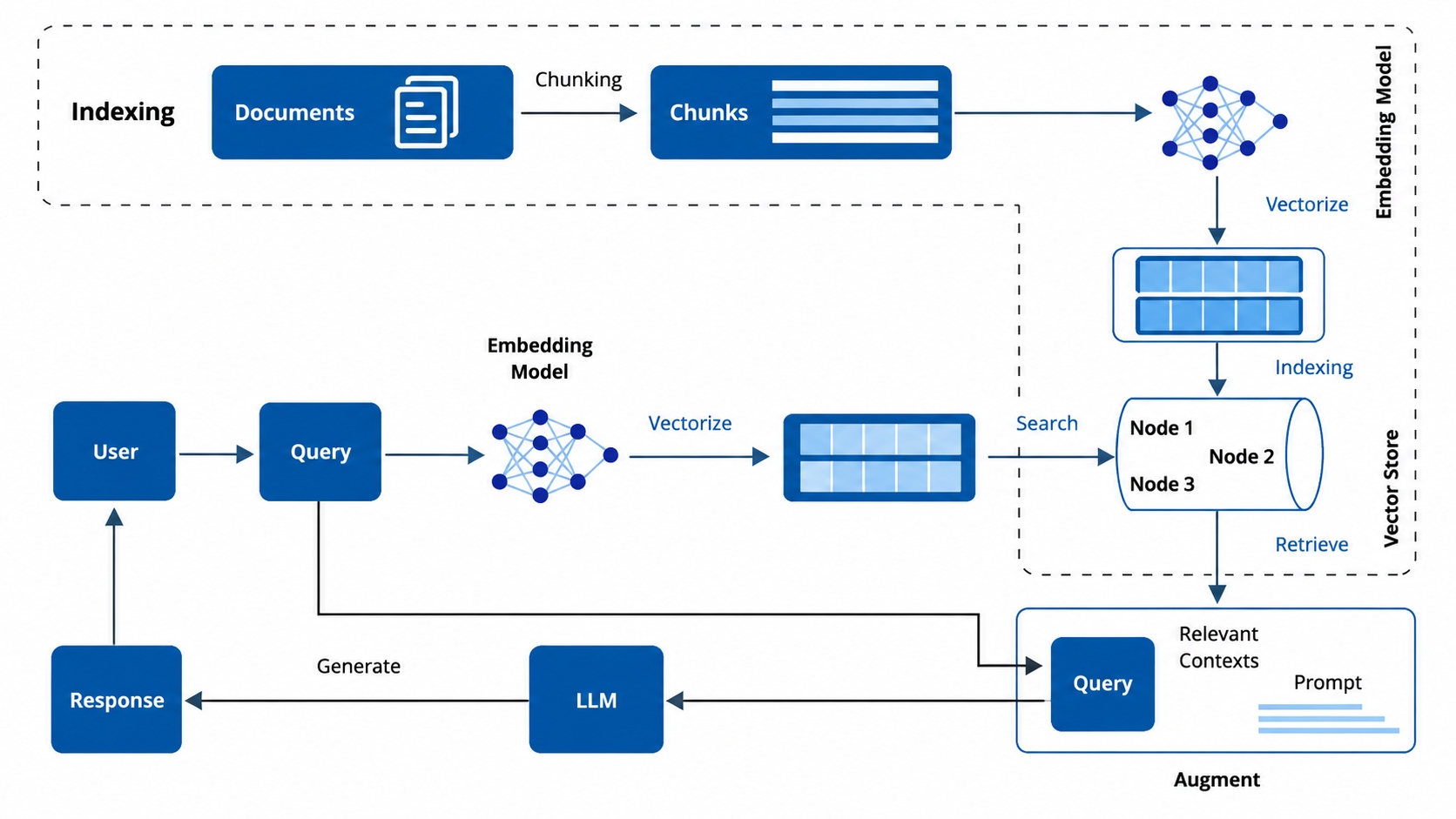
As illustrated in the diagram, documents are initially parsed and broken down via text chunking, vectorized by an embedding model, and indexed securely into a vector store across multiple nodes. When a user inputs a query, the search cluster vectors that question, matches it against the indexed store to retrieve relevant contexts, and appends the raw text snippets directly to the prompt. The LLM then ingests this enriched prompt to generate a verified response, ensuring it functions strictly like a student taking a closed-system, open-book examination.
Grounding the Inference Layer
Because the language model is forced to craft its answer using only the explicit paragraphs provided by the real-time vector search, the risk of factual hallucinations drops to near zero. Furthermore, this workflow lets developers place clear, audit-ready source citations directly alongside the generated text blocks, allowing employees to double-check source files in a single click.
Practical Use Cases
Connecting intelligent language pipelines to operational data channels drives immediate, measurable results across critical enterprise sectors.
Accelerated R&D and Product Development
In highly technical manufacturing fields, engineers spend considerable time parsing past diagnostic histories, design blueprints, and safety frameworks.
The Execution: A process engineer inputs a query: "What structural testing anomalies did we discover when using composite materials under high stress conditions?" The system parses historical project logs, pulls up lab results from three years prior, and delivers a complete summary of historical failure modes alongside relevant material specifications. This prevents repeating past design mistakes, saving significant development capital.
Legal Operations and Contract Management
Corporate legal teams routinely navigate hundreds of multi-million dollar master service agreements, looking for hidden financial risks or conflicting liability terms.
The Execution: A procurement lead asks the system: "Identify any active contracts in our shipping division that lack a formal force majeure clause for logistics delays." The system reads the contract index, evaluates the text, and returns a direct list of contracts requiring human evaluation within seconds.
Benefits and Challenges
Building a context-rich operational system yields immense competitive speed advantages, but it requires addressing tough technical realities.
Key Benefits
Measurement Category | Traditional Repository Setup | Generative Knowledge Engine |
Search Performance | Returns endless lists of unranked file links. | Delivers a clean, synthesized answer block instantly. |
Data Accessibility | Keeps files locked inside department silos. | Connects distinct data silos into one portal. |
Operational Velocity | Teams spend hours manually reviewing files. | Tasks are accelerated via intelligent workflow layers. |
Knowledge Transfer | Specialist knowledge leaves when workers resign. | Core expert insights remain indexed inside the platform. |
Significant Challenges
Access Control and Identity Governance: If the retrieval framework isn't carefully designed, an unauthorized employee could use a simple prompt to access sensitive executive payroll files or future merger strategies.
Text Contamination and Redundancy: If your internal wikis are filled with outdated or contradictory information, the system will occasionally pull up out-of-date answers.
API Infrastructure Overhead: Sustaining continuous vector storage indices and paying for model execution costs requires proactive budgeting and platform optimization.
The Engineering Playbook: Best Practices for Technical Deployment
Building an enterprise platform requires a deliberate focus on data safety, processing efficiency, and clear metrics tracking.
Implement Dynamic Filtering inside Vector Access Layers
Never let an AI model look at information that the user does not have permissions to read on their own. When documents are processed, append your standard user access control lists directly to the text vector metadata. When a query runs, ensure the vector store blocks restricted information before the language layer ever builds the prompt.
Optimize Text Chunk Strategies for Real-World Accuracy
Do not push massive documents into vector models without preprocessing. Slice your data into distinct blocks of roughly 300 words each, and maintain a 15% text overlap between successive chunks. This setup keeps the system from cutting vital context in half at the edges of text blocks.
+================================================================+
|                 Master Enterprise Document                     |
+-------------------------+-------------+------------------------+
| Component               | Word Range  | Description            |
+-------------------------+-------------+------------------------+
| Segment A               | 1 – 300     | Initial Framework      |
| Context Guard           | 255 – 300   | Overlap Zone           |
| Segment B               | 255 – 555   | Secondary Steps        |
+-------------------------+-------------+------------------------+
Build a Standard Human-in-the-Loop Validation Suite
Create a golden testing dataset consisting of one hundred standard, complex customer and internal queries paired with verified answers written by domain experts. Run this suite automatically every time you adjust your embedding steps, tune your retrieval variables, or update your language models to catch accuracy drops early.
Future Trends in Enterprise Intelligence
The corporate software world is moving rapidly toward connected, adaptive systems that anticipate human needs.
The Rise of Multi-Agent Cooperative Networks
Future corporate systems will move past passive search towards active, multi-agent task execution. A logistics assistant will coordinate with an inventory assistant and an accounting model to track down shipping errors, process correct invoices, and send alerts to supervisors completely autonomously.
Deep Cross-Format Systems
Corporate knowledge lives in more than plain text. It sits in workflow diagrams, recording archives, design schematics, and code repos. The next wave of infrastructure will link text and visual materials within the same mathematical space, letting an engineer upload a photo of an equipment failure and instantly receive the right repair documentation.
Four Integration Failures to Proactively Avoid
Using Model Fine-Tuning for Fact Memorization: Fine-tuning is excellent for training a model to use a specific tone or format, but it is an unreliable way to teach it internal facts. Use a clean retrieval framework to feed fresh facts to your model instead.
Hiding Source References: If an assistant gives an answer without showing exactly where the data came from, users will distrust the output. Always include clear links back to your primary source documents.
Failing to Monitor User Analytics: Many teams build expensive architectures without analyzing what questions their staff actually ask. Monitor search patterns to find out exactly where your company's documentation needs updates.
Ignoring Network Boundaries: Launching systems without checking data isolation zones can lead to data leaks. Ensure your AI processing infrastructure remains completely locked inside your private network boundaries.
FAQs
How does generative AI for enterprises differ from public tools?
Public tools run on open consumer networks and answer queries using general historical web data. Secure enterprise tools operate strictly inside private corporate perimeters, referencing secure company files to answer operational questions safely.
How does RAG architecture protect internal data privacy?
Retrieval-Augmented Generation processes information within your private storage cloud. The documents are matched locally and sent to isolated model endpoints, ensuring your intellectual property is never exposed to public systems.
Can these systems connect directly to legacy database frameworks?
Yes. Modern semantic frameworks use modular software connectors to link with cloud storage platforms, communication channels, internal wikis, and customer relationship management systems, providing a singular secure access point.
What are the main requirements for deploying business automation using AI?
Successful deployment requires cleanly structured internal documentation, robust vector storage indices, precise user access management, and an evaluation system to continuously monitor response accuracy.
Final Strategic Conclusion
The era of treating corporate documentation as static, forgotten text blocks is over. By using language models as smart coordination layers rather than simple text generators, forward-thinking enterprises are building dynamic, highly accessible knowledge networks.
Deploying comprehensive LLM integration strategies using secure architectures lets companies turn chaotic data silos into real financial value. Success requires strict attention to data access, careful text processing, and deep data hygiene. The reward is an agile, intelligent company where teams find facts instantly, project context is never lost, and workers have the exact answers they need to move forward in seconds.
Comments
Log in or sign up to join the conversation.