

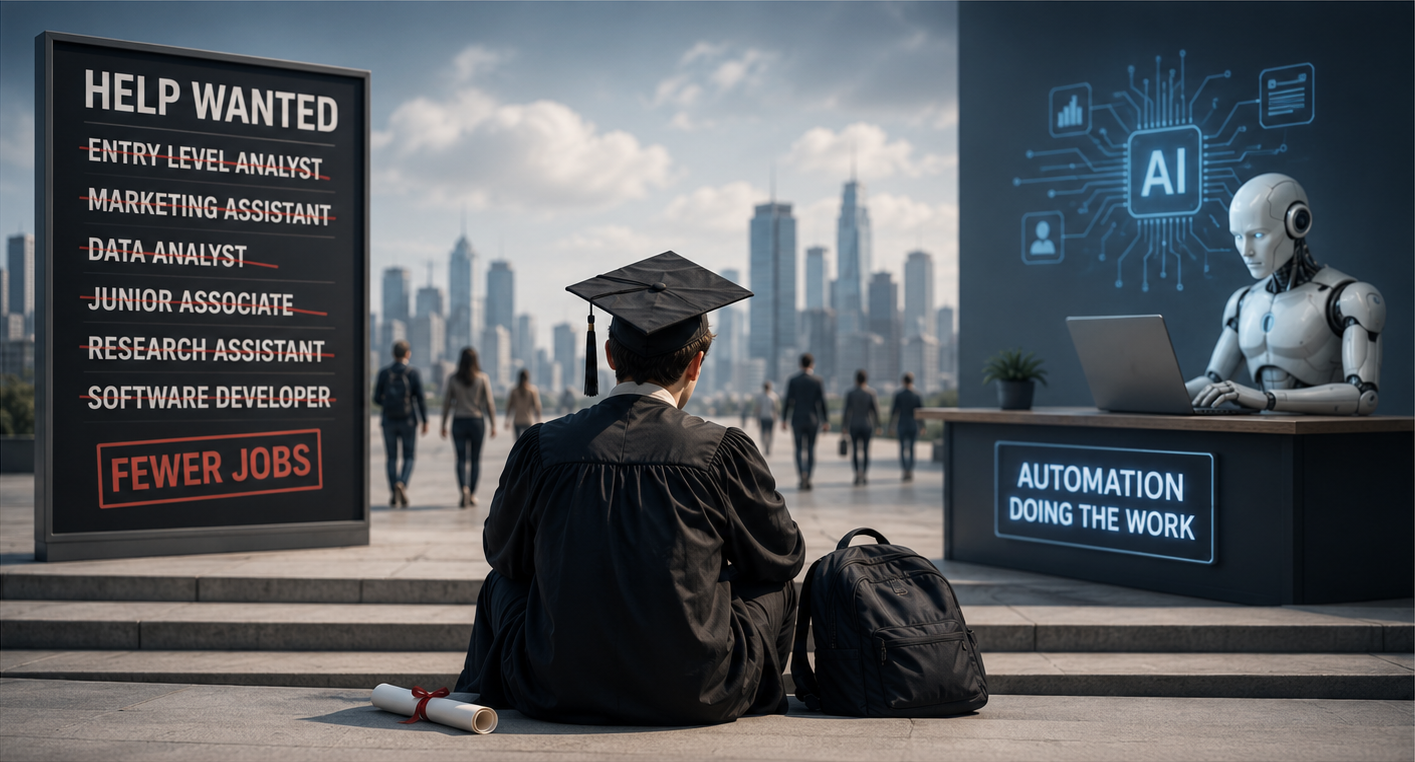
When I talk with college students, and even high school students, a number of them have a profound sense that it is tremendously hard to find a job coming out of college. The level fear seems to me exaggerated, but some underlying shifts in the young-adult labor market seem quite real.
Here’s a figure from the Federal Reserve Bank of New York showing unemployment rates for recent college graduates and other comparison groups. The light blue line shows the unemployment rate for recent college graduates age 22-27. If you look back through the 1990s and early 2000s, you see that the unemployment rate for this group is typically below the black line, which shows the overall unemployment rate. Also, the unemployment rate for recent college graduates is below the line for all young adult workers age 22-27, but above the ilne for all college graduates (of all ages).
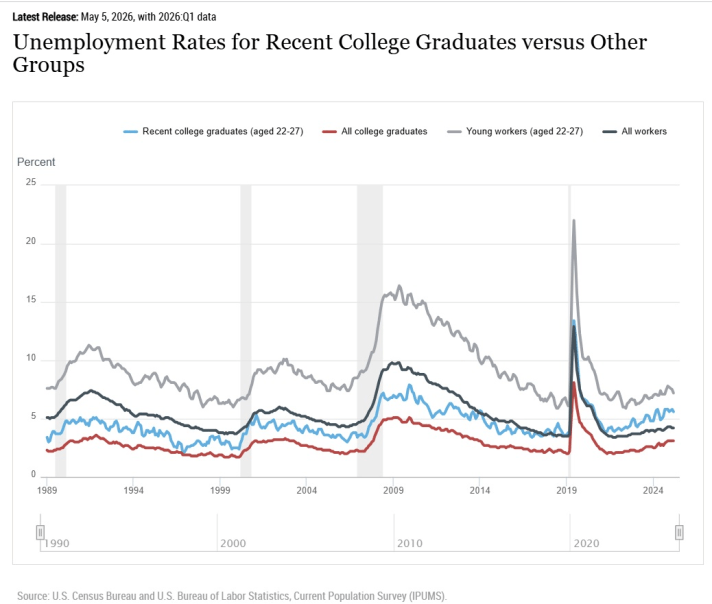
But these patterns are shifting. Even before the pandemic unemployment spike, the unemployment rate for college graduates age 22-27 was about the same as the overall unemployment rate; since the pandemic, it’s higher than the unemployment rate. It’s still true that the age 22-27 college graduates have a lower unemployment rate than for that age group as a whole, but the gap is shrinking. Also, the gap between the unemployment rate for age 22-27 college graduates vs. college graduates of all ages seems to be getting wider.
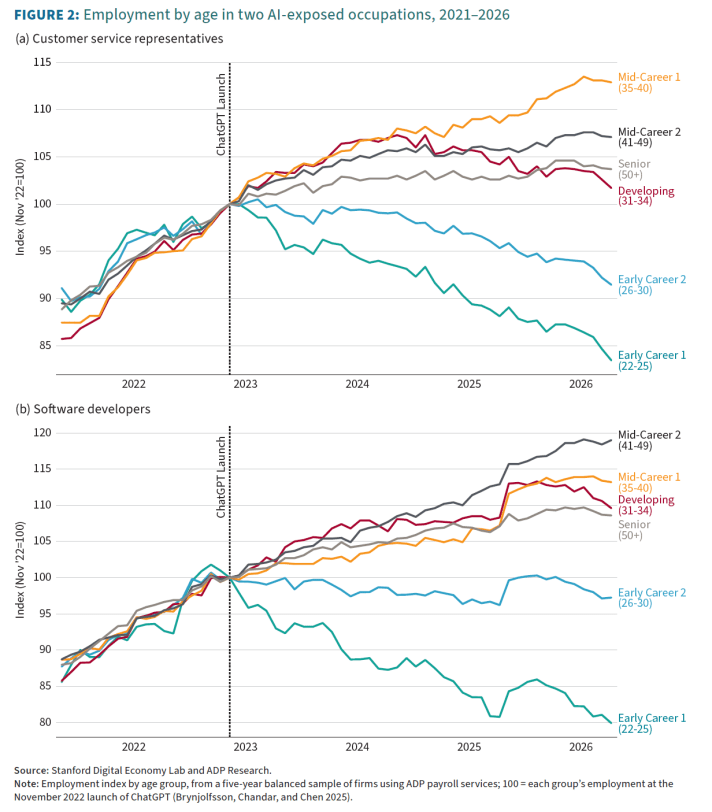
This figure does not show a job apocalypse for recent college graduates. The unemployment rate for the group is still just a little over 5%. But it’s a change. As another sign of the change, consider some figures on total jobs available in a couple of occupations. This is from “What is really happening to jobs? Separating AI hype from reality,” by Neale Mahoney, Erika McEntarfer, and Karsen Wahal (Stanford Institute for Economic Policy Research, Policy Brief, July 2026).
The top figure shows customer service jobs and the bottom figure shows software developer jobs for different age groups. At the launch of ChatGPT in late 2022, the employment level for all age groups is set to an index number of 100, so that the figure shows the change in jobs before and after that date. Before the launch of ChatGPT, the number of jobs for different age groups climbed pretty much in unison. After ChatGPT, the number of jobs for older workers either continued to rise or levelled out, while the jobs for younger workers under the age of 30 dropped off. Again, it’s a change.
There seem to be three broad hypotheses for the shift in employment prospects for recent college graduates. One is the emergence of new AI tools, which may be able to perform a share of the work that was previously done by recent college graduates. Second, the years after the pandemic also involved a dramatic shift to work-from-home arrangements, and the lack of in-person connectivity may have made some firms less confident that they could provide useful and remote oversight for young and inexperienced workers. Third, recent college graduates are the ones who went through high school and/or college years during the pandemic and its aftermath, which may have led to lower-than-typical acquisition of learning and social skills in a way that hinders their job prospects. Of course, all three of these can be true to some extent.
I have also heard comments that even among the recent college graduates who find jobs, many feel as if the job is not using all their skills, but I don’t know how to evaluate this concern. Yes, there are anecdotes about young college-graduate ride-share drivers. But lots of college graduates for a long time now have ended up taking jobs as junior office workers who take minutes of meetings, pass along messages, setting up Zoom meetings, and doing the first draft of Powerpoint presentations. I don’t know of systematic data on whether the issue of underemployment is better or worse.
I offered some previous thoughts on entry-level jobs for young adults here, focused on data about shifts from unemployment to employment for young adults with different education levels.



Comments
Log in or sign up to join the conversation.