

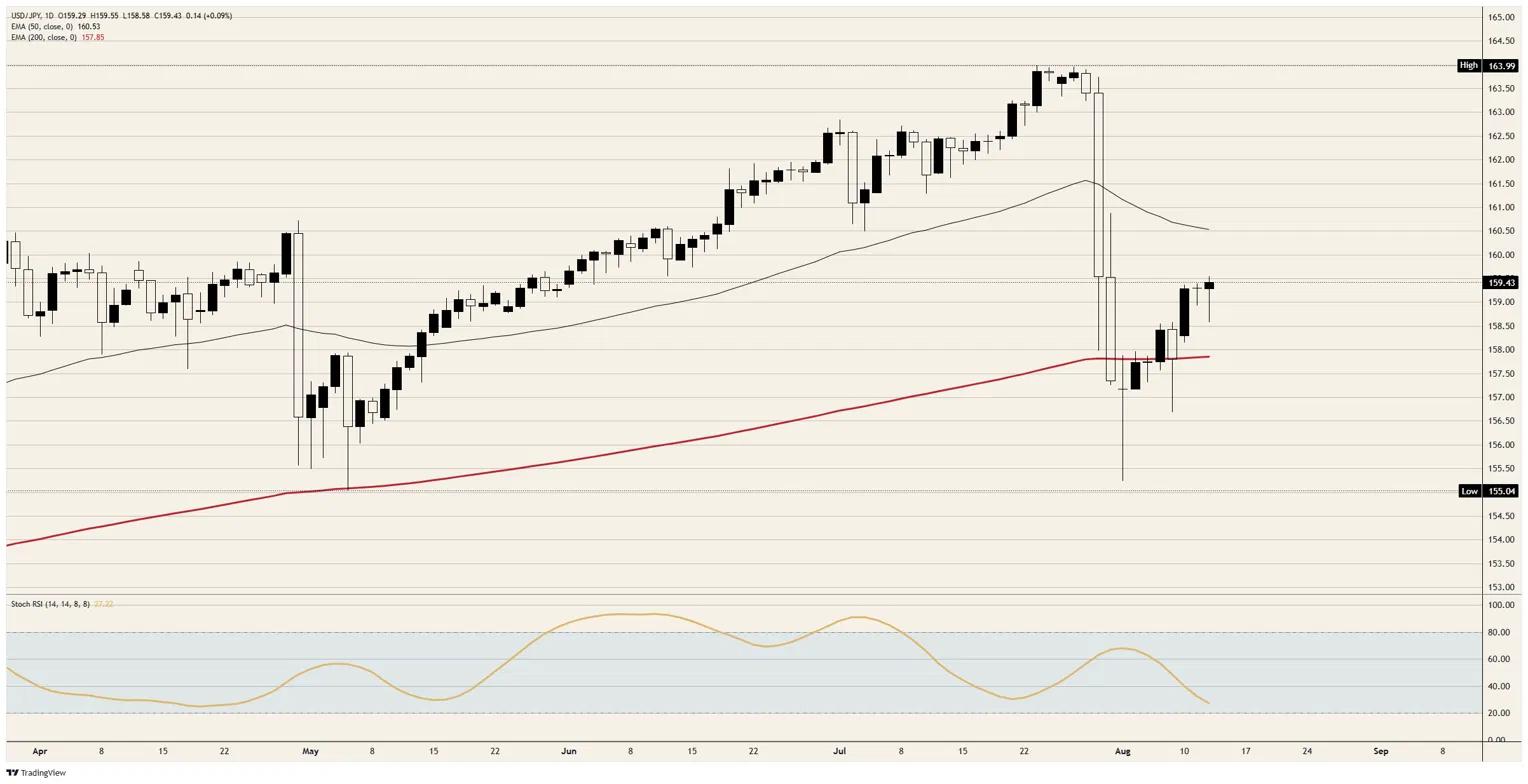
The Dollar has spent Wednesday grinding higher against the Yen with no headline to carry it, trading near 159.50 after a low just beneath 158.60 and a gain of under a tenth of a percent. Close to two Yen have been added in four sessions, none of them on news, which is what a currency looks like when it is being bought for the interest it pays.
Where price now sits is the whole point. The largest currency operation ever recorded took this exchange rate from just under 164.00 to a spike low a shade above the 155.00 handle in the first days of August. Roughly half that ground has been given back in the eight sessions since, and the 200-day Exponential Moving Average (EMA) near 158.00 now sits beneath price rather than above it.
What fourteen trillion Yen actually bought
Japan's Ministry of Finance spent a reported 8.45 trillion Yen in a single day, the largest one-session operation on record, then followed it with roughly 5.3 trillion more. The American Treasury joined the second leg, the first joint Yen-buying action by the two governments since 1998, and the New York Federal Reserve executed it by selling euros rather than Dollars.
Both governments have since pledged to repeat it, publicly and in writing, which is a change of doctrine rather than a change of tactic. The pledge is now the asset, and deterrence only works until somebody tests it. A market that has taken back four Yen without being punished for it is running that test one session at a time.
A softer Federal Reserve did not sell the Dollar
American inflation for July matched consensus on every measure at 12:30 GMT, with the headline Consumer Price Index (CPI) at 0.1% MoM and 3.4% YoY and the core rate at 0.2% and 2.5%, both annual readings a tenth beneath June. Futures cut the odds on a September increase toward the low forties, down from a coin flip on Tuesday and three quarters at the end of July.
An exchange rate driven by the rate gap should have fallen on that. It rose instead, because the gap being traded is the one that exists rather than the one being forecast. The Federal Reserve holds a 3.50% to 3.75% band against a Bank of Japan at 1.00%, so 275 basis points get paid every day the price does not move, and no meeting this year carries a cut.
Japan's own prices make the case Tokyo will not
The release that matters lands at 23:50 GMT tonight, and it is Japanese. July producer prices carry a 0.6% MoM consensus after 0.4%, with the annual rate seen accelerating to 7.4% from 7.1%. Corporate goods inflation above 7% belongs to a central bank in the middle of a tightening cycle, not one that raised its policy rate to 1.00% in June and stopped.
The Bank of Japan held in July on an eight-to-one vote, the dissent arguing for 1.25%, and the discussion around it pointed to upside price risks and a pace of increases faster than markets expect. The International Monetary Fund (IMF) puts the neutral nominal rate for Japan somewhere between 1.1% and 2.2%, which leaves current policy beneath the floor of its own neutral band. Fourteen trillion Yen treated a symptom of that.
What lands before Friday
The American calendar runs the next two days. Producer prices at 12:30 GMT Thursday carry a 0.2% MoM consensus after -0.3%, with the core annual rate seen at 4.2% from 4.7%, alongside jobless claims at 202K from 199K and two regional Federal Reserve presidents speaking either side of the release. Retail sales follow Friday at 0.1% MoM, with preliminary August consumer sentiment at 54.5 from 55.2.
Japanese flow data fills the gaps around it. Machine tool orders print Thursday at 06:00 GMT against a prior reading above 52% YoY, with foreign bond investment at 23:50. Commitments figures published Friday at 19:30 GMT last showed speculators net short 45.5K Yen contracts even after the operation, so the position that made this trade crowded has never actually been unwound.
Levels and bias
Resistance: The 160.00 handle is the line that matters, the level authorities defended, and the one a fresh operation would aim at. Just above it the declining 50-day EMA near 160.50 doubles the barrier, with the late-July peak just under 164.00 far beyond.
Support: 159.00 is the first shelf, then the 200-day EMA near 158.00, reclaimed last week and rising. Beneath that, the early-August spike low just above the 155.00 handle is the level Tokyo has already proved it will pay for.
Bias: Higher toward the 160.00 handle while the 200-day EMA near 158.00 holds, with a daily Stoch RSI near 27 and turning up off the bottom of its range, leaving plenty of room for the move. Sell into 160.00 to 160.50 rather than through it, because that band puts a declining 50-day EMA and a proven intervention trigger on top of each other. Invalidation is a daily close beneath 158.00.
USD/JPY daily chart


Comments
Log in or sign up to join the conversation.