


I’ve been wanting to write about my investment philosophy for some time. It’s a bit of both investing and trading. I am a market technician after all, so I tend to follow trends and intermarket analysis – the study of relationships among the major financial markets like commodities, stocks, bonds, and currencies. There is nothing inherently wrong with trading and I want to speak to that point right away.
Trading can be an effective way to capitalize on shorter-term market trends, manage risk, take advantage of tactical opportunities, or participate in situations where the investment horizon is measured in weeks or months rather than years. There are times when I approach certain positions in exactly that fashion.
But that is not the primary way I think about managing wealth.
The majority of my investment process is built around a different mindset: ownership.
When I purchase shares of a company, I generally want to own a business that I believe can become more valuable over time. I want to understand how that company makes money, what gives it an advantage over its competitors (Morningstar calls these "moats"), how its earnings and cash flow may grow, how management allocates capital, and what I am paying for that future potential.
My objective is not simply to own whatever stocks are performing best today. I want to build a portfolio of businesses that we can be proud to own today and that I believe we will still be glad we owned three and five years from now.
That distinction is important because trading and investing place emphasis on different things.
A shorter-term trader may be primarily focused on price, momentum, catalysts and market behavior. An investor places greater weight on the long-term economics of the underlying business. Neither approach is inherently right or wrong. They simply require different disciplines, different time horizons and, often, different temperaments.
My focus is predominantly on the latter.
I believe one of the most powerful ways to build wealth is to own productive businesses, allow their earnings and cash flows time to grow, reinvest income when appropriate, manage valuation and risk along the way, and avoid unnecessarily interrupting the compounding process.
That is what I call Investor Mentality.
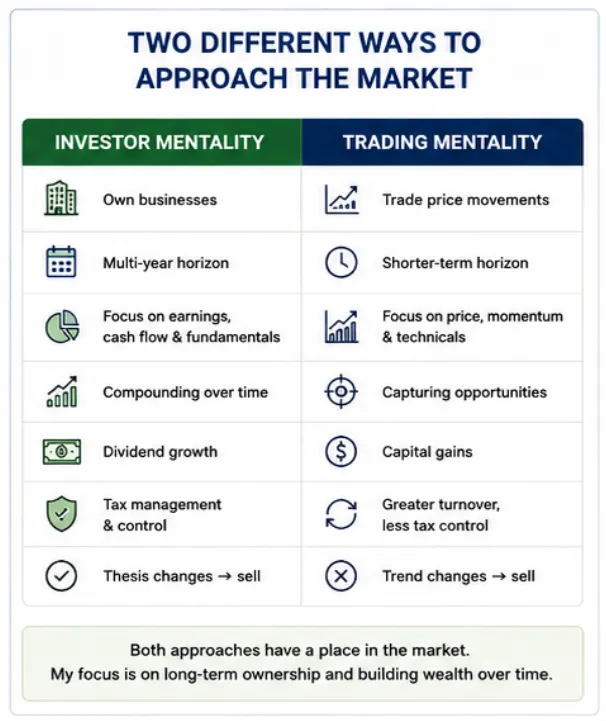
Source: Ryan Puplava, created with AI-assisted design. For illustrative purposes only.
It doesn't mean ignoring market prices. It doesn't mean holding every investment forever. And it certainly doesn't mean refusing to sell when the fundamentals change.
It means starting with a different question.
Instead of continually asking, “What stock should I own next?”, the investor is more interested in understanding whether the businesses already owned are continuing to create value.
If they are, time can become one of the investor's greatest advantages.
A Stock Is an Ownership Interest in a Business
One of the easiest mistakes investors make is forgetting what a stock actually represents.
It isn't just a ticker symbol moving across a screen.
When we buy a stock, we are purchasing an ownership interest in a real business. That business has employees, customers, products, intellectual property, competitors, revenues, expenses, assets and liabilities. Most importantly, it has an ability—or inability—to generate increasing amounts of earnings and cash flow over time.
That is where the investment process begins.
We study whether revenues and earnings are growing, margins are strengthening, free cash flow is improving, competitive advantages are expanding, and management is allocating capital intelligently.
We also continually compare what the business is accomplishing with what investors are currently willing to pay for it.
The stock price matters. But it is only one piece of the analysis.
Price and Value Are Not Always the Same Thing
Imagine owning a private company whose revenues increased, profits expanded, cash flow strengthened and competitive position improved.
Now imagine someone offered to buy that company from you for 10% less than they offered six months earlier.
Would that lower offer automatically mean your business had become less valuable?
Probably not.
You would evaluate what was actually happening inside the company before deciding whether the offer made sense.
Public markets make that more difficult psychologically because investors receive a new price for their ownership interest every second of every trading day.
That constant pricing mechanism is useful, but it can also create the illusion that market price and business value are always the same thing.
They aren't.
Over shorter periods, stock prices can be heavily influenced by interest rates, investor positioning, economic data, sentiment, liquidity, geopolitical events, sector rotations and changes in expectations.
Over longer periods, however, the ability of a company to grow earnings and free cash flow becomes increasingly important.
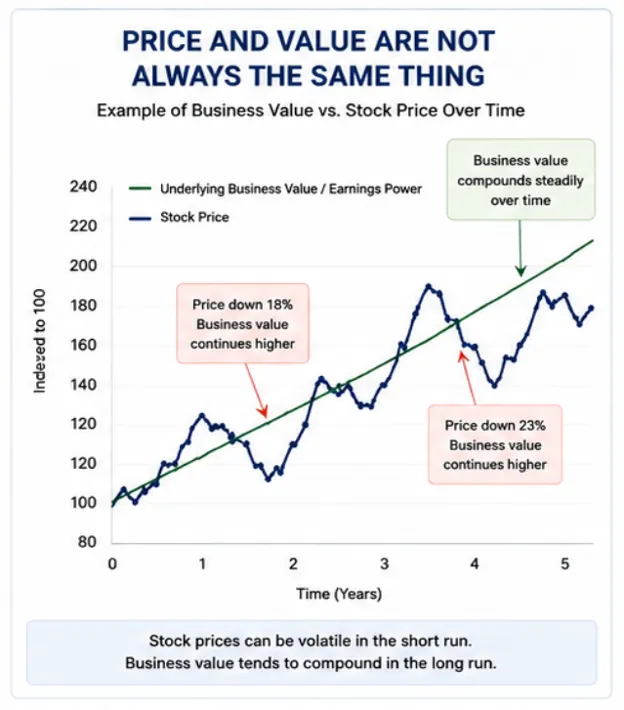
Source: Ryan Puplava, created with AI-assisted design. For illustrative purposes only.
That is why a stock can decline while the underlying company continues to become more valuable. Conversely, a stock can rise substantially even while the fundamentals beneath it begin to deteriorate.
An investor needs to know the difference.
Patience Has to Be Earned
Long-term investing does not mean buying a stock and refusing to change your mind.
Patience only makes sense when the evidence continues to support the investment thesis.
We continually evaluate the health of the business, the durability of its competitive position, the outlook for earnings and cash flow, the valuation of the stock, and whether the prospective return still adequately compensates us for the risks involved.
If a stock price declines while the company continues executing, earnings continue growing and the long-term thesis strengthens, that may create an opportunity.
If the stock declines because the business is deteriorating, competitive advantages are disappearing or the assumptions behind the original investment are proving incorrect, the response should be very different.
Patience with a strengthening business is investing. Remaining patient with a deteriorating thesis can become stubbornness.
Knowing the difference is one of the most important disciplines in portfolio management.
The Trading Mentality
The trading mentality tends to operate from the opposite direction.
Instead of focusing on what a business could produce over the next several years, attention gravitates toward whatever is performing best today.
Artificial intelligence becomes popular, so money rushes toward AI.
Small caps begin outperforming, so investors rotate into small caps.
Biotechnology breaks out, commodities rally, cryptocurrencies surge or another new technology captures the public's attention, and suddenly investors feel they have to participate.
The portfolio gradually becomes a collection of yesterday's best-performing ideas.
Frequently, the investor knows surprisingly little about what they actually own.
The business model, competitive environment, balance sheet, cash flow, valuation and long-term opportunity become secondary to one powerful observation: The price is going up.
Eventually the price stops going up. The same investor who bought because everyone wanted the investment may then sell because everyone wants out.
This is one reason performance chasing can be so destructive. It encourages investors to repeatedly buy optimism after prices have already risen and sell pessimism after prices have already fallen.
Investing requires a different temperament.
Charts Are Valuable—But They Are Not the Investment Thesis
As a Chartered Market Technician, I spend considerable time analyzing price trends, market breadth, momentum, relative strength, support and resistance, and intermarket relationships.
I believe technical analysis is extremely valuable.
Charts can tell us a great deal about investor psychology, risk and market behavior. They can help identify when enthusiasm has become excessive, when selling pressure may be exhausting itself, when an investment is losing relative strength, or when price action is beginning to contradict our fundamental assumptions.
But technical analysis should support the investment process rather than replace it.
If I am going to own a company for several years, I want to understand how that company earns money, the advantages it has over competitors, how management is allocating capital, what its future earnings power could look like and what valuation we are paying for that opportunity.
The chart is an important input.
It is not the entire investment thesis.
Building a Portfolio for the Next Five Years
This leads to another important distinction between investing and trading.
When constructing a portfolio, I don't expect every company we own to outperform at exactly the same time.
A thoughtfully constructed portfolio can contain several different types of businesses performing different roles.
Some companies may be established compounders capable of consistently growing earnings and cash flow.
Others may be faster-growing companies participating in long-duration secular trends.
Some may provide income and stability.
Others may temporarily be out of favor even though their underlying fundamentals remain healthy.
Still others may be turnaround situations where improving fundamentals have not yet been fully recognized by investors.
Leadership will rotate.
There will always be another stock somewhere that performed better over the last three months.
That doesn't mean we should sell a fundamentally sound company every time something else begins outperforming it.
Instead, every investment should have a purpose. We should understand why we own it, what we expect the business to accomplish, and what developments would cause us to reconsider our position.
The objective isn't to create the portfolio that would have performed best during the previous year.
It is to build a portfolio we believe we'll be glad we owned three and five years from now.
The Compounding Power of Growing Dividends
There is another benefit to long-term ownership that can be easy to overlook when investors focus primarily on changes in stock prices: the compounding power of dividends.
Some of the best businesses don't simply pay dividends. They have a history of increasing those dividends as their earnings and cash flows grow.
That can create an increasingly valuable stream of income for a long-term shareholder.
My father has always described this in a way I think investors can immediately understand: “when a company increases its dividend, it is like giving the shareholder a pay raise.”
If a company pays $2.00 per share in dividends today and steadily increases that payment over the years, the investor's income can continue rising without having to sell shares or continually move money from one company to another.
That rising income can be particularly valuable during retirement.
Inflation causes the cost of groceries, utilities, insurance, healthcare and nearly everything else to rise over time. A fixed stream of income gradually loses purchasing power. A portfolio containing companies capable of increasing their dividends can provide an income stream with the potential to grow alongside—or in some cases faster than—those rising costs.
The benefit can become even more powerful when dividends are reinvested.
Those dividends purchase additional shares. Those additional shares can generate additional dividends. If the company subsequently raises its dividend again, the investor may benefit from both a larger number of shares and a higher dividend per share.
That is compounding at work.
It doesn't happen overnight.
It develops over years, and if you sell your stocks every year, dividend compounding can’t take place.
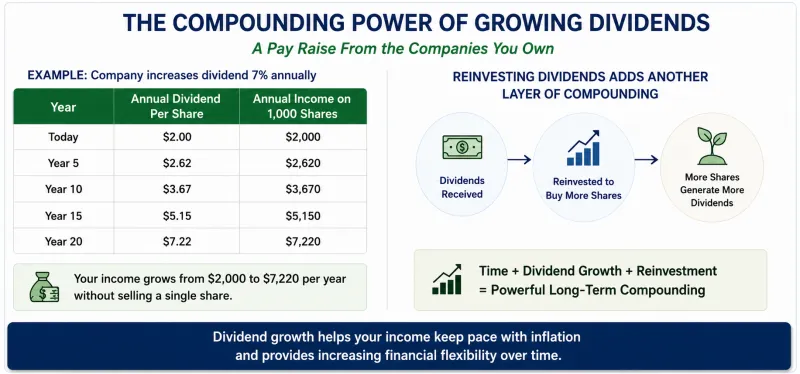
Source: Ryan Puplava, created with AI-assisted design. For illustrative purposes only.
This is another area where an investment mentality can have an advantage over continually trading in and out of positions. Frequent turnover can interrupt the process before the full benefits of growing earnings, increasing dividends and reinvestment have an opportunity to accumulate.
Of course, a dividend by itself does not make a company a good investment. We still need to evaluate the health of the business, the sustainability of the dividend, the company's balance sheet, its growth prospects and the valuation we are paying.
But when a high-quality business can grow its earnings, increase its dividend and reinvest capital productively year after year, time becomes an increasingly powerful partner for the shareholder.
The objective isn't simply to collect income today.
It is to own businesses with the potential to provide more income tomorrow than they provide today.
Performance Matters, but It Is the Outcome of the Process
Performance absolutely matters.
Growing wealth is one of the primary reasons we invest.
But performance is ultimately an outcome of the investment process.
I cannot control what investors will be willing to pay for a company tomorrow.
What I can control is the discipline used to select businesses, the valuation we're willing to pay, portfolio diversification, position sizing, risk management and the decision to trim or sell when circumstances change.
The same principle applies when markets become volatile.
Short-term underperformance doesn't automatically invalidate a sound investment thesis. Likewise, strong recent performance doesn't automatically make an investment attractive.
A professional investment process requires looking beneath the stock price and understanding what is actually occurring inside the business.
If the companies we own continue executing, generating cash, expanding their competitive advantages and increasing their long-term earnings power, time can become one of our greatest advantages.
Direct Ownership Can Also Improve Tax Control
For investors with taxable assets, there is another advantage to thinking like an owner: tax decisions can become part of the portfolio-management process.
Traditional mutual funds pool investors together. When the fund manager sells appreciated securities, the fund can distribute realized capital gains to shareholders. Investors may therefore receive a taxable capital-gain distribution even though they personally made no decision to sell the underlying investment.
Direct ownership of individual securities in a separately managed account (SMA) provides considerably greater control over when gains and losses are realized.
Individual holdings and individual tax lots can be evaluated as part of the broader financial plan.
A highly appreciated position can potentially continue compounding rather than being sold unnecessarily.
Losses may be harvested when appropriate to offset gains elsewhere.
Specific tax lots can be selected when reducing a position.
Portfolio changes can be coordinated with a client's income, charitable giving, realized gains and broader tax situation.
Sometimes the most valuable tax decision is simply not creating a taxable event unnecessarily.
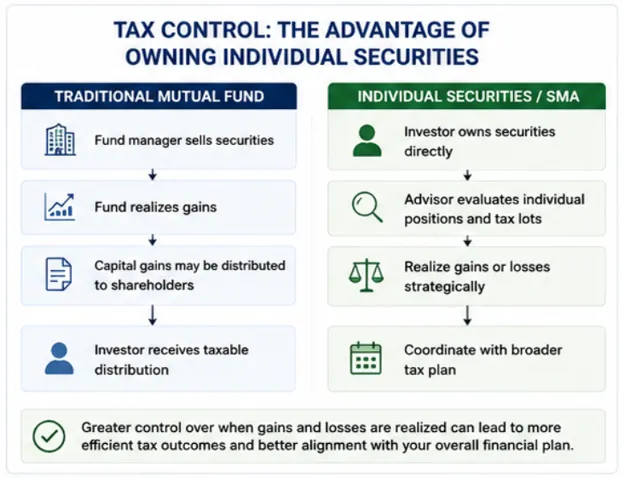
Source: Ryan Puplava, created with AI-assisted design. For illustrative purposes only.
This doesn't mean an individually managed portfolio will always result in lower taxes. ETFs can also be highly tax efficient, and investment decisions should never be driven exclusively by tax considerations.
The advantage is control.
Rather than simply receiving whatever taxable distributions a pooled investment generates, direct ownership allows investment management and tax planning to work together.
For investors with meaningful taxable assets, that flexibility can become increasingly valuable as wealth grows.
Compounding Requires Time
Perhaps the hardest part of investing is psychological.
Markets reward activity with excitement.
Successful investing frequently rewards patience.
There will always be another company whose stock is rising faster than something in your portfolio.
There will always be another theme receiving more attention.
There will always be someone explaining why the newest investment opportunity cannot be missed.
But enduring wealth is rarely created by continually chasing whatever is most exciting.
It is created by allocating capital intelligently, owning productive assets, allowing successful businesses time to compound, managing risk when circumstances change and avoiding unnecessary mistakes along the way.
That is the Investor Mentality.
We aren't trying to assemble the portfolio that would have performed best yesterday.
We're trying to own businesses capable of creating significantly more economic value tomorrow.
That requires understanding what we own.
It requires paying attention to valuation.
It requires patience when the fundamentals support patience.
It requires discipline when the evidence tells us something has changed.
It requires managing risk and taxes alongside return.
And above all, it requires remembering something that is easy to forget when markets are moving quickly:
We aren't buying tickers. We're becoming owners of businesses.
For investors who share that mentality, the goal isn't to jump from one opportunity to another in search of the next hot trade.
The goal is to build, manage and continually refine a portfolio of businesses capable of compounding wealth over many years—and to have the discipline to give that process time to work.



Comments
Log in or sign up to join the conversation.