


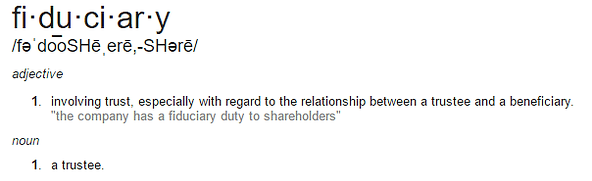
You may recall a few months ago I gave my two-cents on a segment from Last Week Tonight with John Oliver that discussed the importance of using a fiduciary for a financial adviser - regardless if they are advising your company's 401(k) or your own brokerage account. My intention is not to frighten anyone into a panic by writing this piece, but for some of you, the impact will be more profound that you thought.
It's important to highlight, that you as an employee of any company have a legal right to inquire and receive regular information regarding the money you transfer to a 401(k) or any retirement savings firm. However, very few regularly inquire, either because they just don't care, they never think about it, they're trying not to think about it, or they have completely put their trust into their employer to make the best decisions on their behalf - all of these are incorrect ways of thinking.
If you are not being provided information on a regular basis, something is very wrong. If you are being provided information on a regular basis, glance at it every now and then.
The point is, you have the right to know and understand: SO ASK! There is no harm in asking.
I bring this up in particular because I wanted at address a very scary situation that happened to a friend of mine who recently left the same firm that I wasted 2 years of my life. In case you need a reminder, it's THIS ONE. I will show you two very different scenarios and both show why you should never trust your employer's retirement plan, UNLESS they can prove to you that they operate on a fiduciary basis.
My Experience:
When I was eligible to receive benefits from this employer, I decided to designate somewhere between 1%-4% of my pre-tax income to their retirement plan. My initial document to sign had a Morgan Stanley header, gave a brief description of the plan, the funds offered, and said this particular office was located in Jacksonville, Florida.
Okay, cool.
Each month and with each quarterly bonus, I saw X amount of money going into my 401(k) plan. The company did not offer to match, so I knew that saving was bound to be a struggle. However, I was not informed of where my money was being invested (what funds, if they were high risk or not), but I assumed they were being taken care of simply based on who our CEO was.
After I resigned, I wanted nothing more to do with this employer, so I requested that my 401(k) be rolled over into my Rollover IRA with Charles Schwab (which I keep as a deposit place for all of my old retirement plans). I thought I would be speaking with Morgan Stanley in Jacksonville, Florida. Instead, I was connected with some random woman for a firm I had never heard of, located in some sketchy suburb of Atlanta, Georgia. Huh? Who the heck were these people?
My entire retirement plan - after 2 years - was worth exactly $863.86. Wow. In less than 4 years at my prior employer, who also had a matching plan, I saved over $40,000. Why was this difference so enormous? Well, as it turns out, my money was never invested at all. After some basic calculations, I figured out that this was the exact value of the cash I had set aside. No investing at all. And the money wasn't even held at a bank - it was held in some woman's garage in the-middle-of-nowhere, Georgia. I was livid, but I took my money and left, knowing that everything about this company was a lie anyway.
My Friend's Experience:
I don't need to tell you the story again, but for my friend the scenario was much worse. She was employed by the company for 13 years and allocated a much bigger percentage of her pay to her 401(k). When she went to roll over her money after resigning, this money manager in the middle of Georgia put her on hold for nearly an hour only to tell her that her account had less than $1,000 saved.
There was no 401(k) plan at all with this employer. Instead, our contributions were being sent to a pool each month that only the company's CFO had access to, and she tapped into whenever she felt like it. The money just sat in there, and was never invested. Now, for someone like me who can easily do the math, she knew that the calculation had to make some kind of sense to me, otherwise I would take some serious action. With my friend, she made the (wrong) assumption that they wouldn't be able to take legal action against them. Big mistake. I'm glad that my friend is planning to take this case to court, but it's even more sad that it has to be done in the first place.
The lesson? Don't make the same mistake and assume that everything is okay with your employer. Doesn't matter if you work in a small town or right on Wall Street like us:
1) DO YOUR RESEARCH
2) ASK QUESTIONS
and
3) REGULARLY CHECK WHAT IS HAPPENING WITH YOUR MONEY
If you are being road-blocked from trying to get this information, 1) take your money into your account and 2) look for a new job...like, yesterday.


Comments
Log in or sign up to join the conversation.