

A little over a year ago, following a sustained downturn in most of the long leading indicators, I went on "recession watch" with an epicenter of Q4 2019 through Q1 2020. More recently, in my long-term forecasts, based on the exact same metrics, I have indicated that *left to its own devices,* the economy is likely to improve in the second half of this year.
Even though my base case has been slowdown vs. recession, I have never retracted the "recession watch." This is partly because the data used to indicate recessions has come in weak, if mainly positive, and partly because there have been enough extraneous factors (i.e., the economy has not been left to its own devices) that might take the economy down.
Coronavirus presents a unique forecasting issue. That's what I'll address here.
The bond market believes weakness is likely to turn into recession
Let's start with the state of the coincident indicators. Below are industrial production, real retail sales, real manufacturing and trade sales, and real personal income less transfers, all of which have been normed to 100 as of last August:
(Click on image to enlarge)
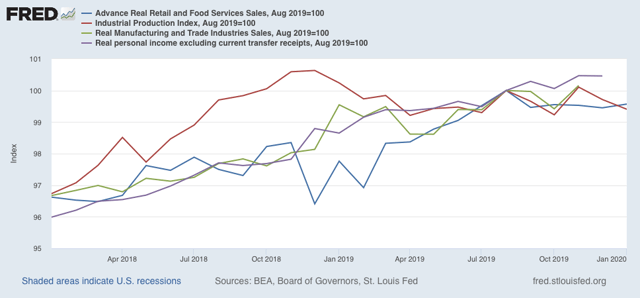
Neither production nor sales have improved at all since then, and income is up only +0.5%. Essentially, we have three of the four coincident indicators of recession flat or nearly so for the 5 months of data since. Only payrolls (not shown) are up significantly. This doesn't look like recession, but it is a slowdown nearly to a stall.
Now, let's consider the impact of coronavirus. The two crucial things we *don't* know are: (1) what percentage of the population is likely to get infected; and (2) what percentage of those infected will have no or such mild symptoms as not to seek medical help. If the first of these percentages is low and the second high, then coronavirus might not cause any more deaths than a typical flu season, i.e., about 100,000 deaths per year in the US. On the other hand, if both percentages are reversed, then we could have a serious health threat approaching that of the Spanish Flu of a century ago, which killed about 2% of the entire world population over a several year period.
Beyond that, even if the situation proves closer to the former alternative (i.e., about as lethal as a typical flu season), a temporary panic can still disrupt the economy.
In the past week, I have been asked where the impact is most likely to show up in the data. The simple fact is, the news is going to lead the data. For example, this morning, there is news of a hotel quarantine on Tenerife, an island belonging to Spain, as well as the first confirmed cases in Austria and Hungary.
As to coronavirus, I have no more expertise on this than you or anyone else, but it certainly seems likely that, at some point in the next 30 days or so, we are likely to read similar stories of an outbreak appearing to take hold in one or more cities of the US. If that happens, the news is almost certainly going to result in panic. You won't need data reports to tell you that it will have a negative effect on the economy.
That being said, since the issue in the past few months has been whether the shallow industrial downturn will or won't spread to the consumer, the first places I would expect it to show up in the data are those involving personal interactions, and that means (1) mortgage applications; (2) temporary staffing; and (3) weekly chain store sales reports. As of last week, there have been no meaningful changes in any of the three.
In the meantime, the message of the bond market is that the slowdown is likely to turn into a recession. As I write this, the 2 and 3 year bond maturities are roughly 0.4% lower than the Fed funds rate, an inversion meaning the bond market expects at least 2 more quarter point reductions in interest rates by the Fed in the near future.
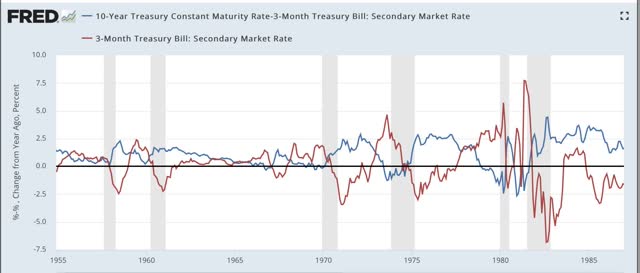
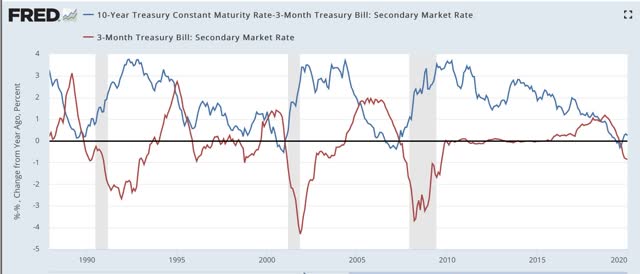
Further, the 3-month to 10-year spread has inverted again, as shown in blue below, together with the YoY change in 3-month rates (red). I include the latter because there is some question as to whether lower rates overall are a "bullish flattener".
Here is 1955 through 1987:
(Click on image to enlarge)
And, here is 1988 to the present:
(Click on image to enlarge)
Finally, here is a close-up on the past 5 years:
(Click on image to enlarge)
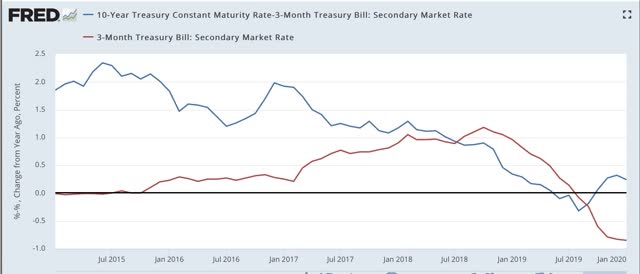
During the inflationary period of the 1950s through the 1970s, the yield curve inverted even as short rates continued to rise. In all three recessions since the early 1980s, however, three-month rates have been lower YoY starting between 2 and 8 months before the onset of the recession, even as the yield curve inversion ended. The exact same scenario occurred last August, i.e., 6 months ago.
In short, there is no reason to treat the recent re-inversions as a "bullish flattener". A recession starting by mid-year is entirely consistent with this scenario.
And that is how I read the bond market: what had been looking like a borderline slowdown now looks to the bond market like a recession.
Conclusion: No "recession warning" but an acknowledgment of reality
So, here is my quandary: do I upgrade from "recession watch" to "recession warning" based on the bond market and the information about coronavirus?
I have decided not to. Because if I do, I am allowing a subjective judgment about the likely impact of coronavirus, however reasonable it seems, to override my discipline, which is that of rigorously obeying the data. I will remain on "recession watch" because the data has been weak, and we are still in the window forecast by the long leading indicators 12 to 18 months ago for the onset of a recession. I will not upgrade to "recession warning" unless and until I see it in the data.
At the same time, we can acknowledge that the coronavirus is exactly the kind of extraneous event that can blindside the data and turn weakness into a downturn very quickly.


Comments
Log in or sign up to join the conversation.