
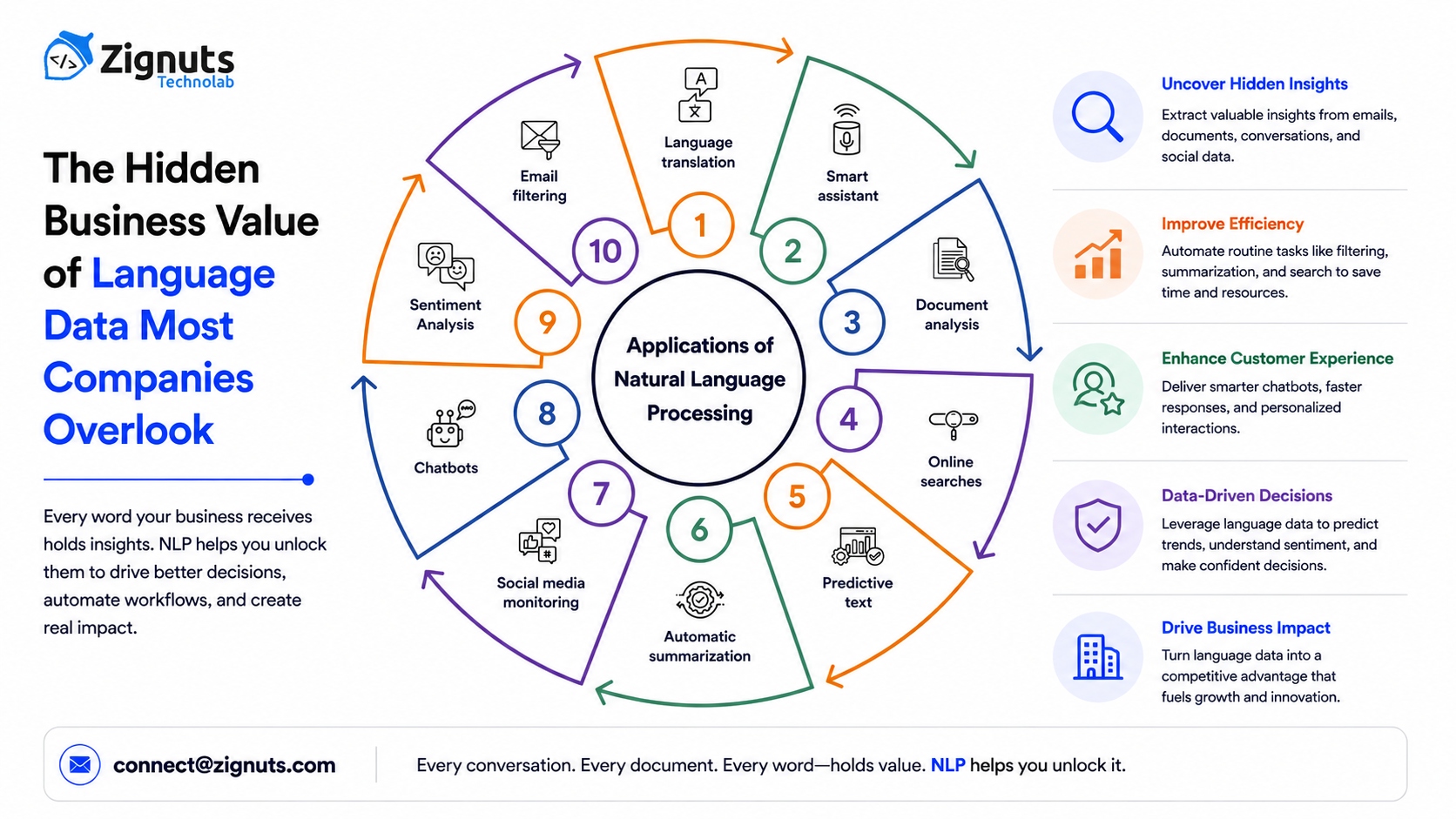
A company can have years of customer emails, support tickets, product reviews, sales conversations, contracts, and internal documents, yet still make important decisions without fully using the information inside them. The issue is rarely a shortage of data. It is the difficulty of extracting consistent meaning from unstructured language at scale. NLP Development Services can help organizations turn that overlooked language data into searchable knowledge, operational insights, and decision support without requiring employees to manually examine every piece of text.
2027 Insight | Business Impact | What Leaders Should Do |
|---|---|---|
Language data becomes a more visible component of business intelligence | Companies can combine structured metrics with insights from conversations and documents | Identify important decisions that currently rely on manually reviewed language |
NLP becomes more deeply connected to enterprise workflows | Insights can move directly from text analysis into business processes | Prioritize integrations that connect language insights with existing systems |
Domain context becomes increasingly important | Generic language processing may be insufficient for specialized business terminology | Evaluate NLP solutions with representative company data |
Governance requirements expand with adoption | More language processing can increase privacy, security, and accountability concerns | Establish data access, retention, monitoring, and human oversight policies |
The hidden value of language data is that it often explains the "why" behind business metrics. A dashboard may show that customer churn has increased. Customer conversations may reveal that customers are frustrated with onboarding. Sales data may show slower conversions, while sales conversations reveal a recurring pricing objection. Operational reports may show delays, while employee messages explain where the process is breaking down.
That additional context can make business intelligence more actionable.
Why Language Data Is Different From Traditional Business Data
Structured data is designed to fit predefined fields.
A transaction may contain a customer ID, amount, product, and date. These fields can be aggregated and displayed in dashboards.
Language is much less predictable.
A customer can describe the same problem in dozens of different ways. One person may say a product is "difficult to use." Another may call it "confusing." A third may say they "cannot figure out how to get started."
The underlying issue may be similar even though the words differ.
NLP helps organizations analyze language based on meaning, context, patterns, and business-defined categories rather than relying only on exact keyword matches.
The Business Cost of Ignoring Unstructured Information
When language data is difficult to analyze, organizations often compensate with manual processes.
Employees read documents individually. Managers review samples of customer feedback. Analysts manually categorize comments. Support leaders examine selected tickets. Product teams collect feedback from different channels and attempt to consolidate it.
Sampling can be useful, but it can also hide patterns.
A recurring issue buried in a small percentage of messages may never receive attention if nobody has a practical way to detect it across the full dataset.
NLP can help organizations analyze larger volumes consistently.
The objective is not to eliminate human analysis. It is to make human analysis more focused.
Where Hidden Language Value Can Appear
Customer Feedback
Customer feedback is one of the richest sources of business intelligence.
Reviews, surveys, support messages, and open-ended comments can reveal:
Recurring product problems
Customer expectations
Feature requests
Service frustrations
Purchasing concerns
Positive experiences
Emerging themes
NLP can organize this information into themes that teams can investigate.
A product manager does not necessarily need to read every comment. They need a reliable way to understand what customers are repeatedly saying and access the underlying examples when deeper investigation is required.
Sales Conversations
Sales teams often record valuable information in emails, calls, meeting notes, and proposals.
NLP can help identify recurring objections, requirements, competitor mentions, and purchasing concerns.
This can reveal patterns that individual account reviews might miss.
For example, if multiple prospects independently raise concerns about implementation complexity, that signal could influence sales messaging, product documentation, onboarding, or product development.
Support Operations
Support teams can use NLP to classify and prioritize customer requests.
A system can identify the type of request, summarize previous interactions, detect recurring themes, and support routing.
This can reduce repetitive manual work while giving managers better visibility into service issues.
Internal Knowledge
Internal language data can also be valuable.
Policies, procedures, technical documentation, project notes, and reports can contain information employees need to perform their jobs.
Semantic search and language-based retrieval can help employees find relevant information without manually navigating multiple repositories.
From Language Data to Business Action
Language Sources → Data Preparation → NLP Analysis → Business Insight → Operational Action
The workflow begins by identifying approved language sources.
The data is then prepared for processing. Depending on the use case, NLP may classify content, identify entities, detect topics, summarize documents, analyze sentiment, or retrieve relevant information.
The output becomes valuable when it influences an action.
A customer complaint might trigger escalation. A recurring product issue might reach a product team. A contract containing a relevant clause might be routed for review. A sales objection might inform enablement content.
Without that final connection, NLP can become another reporting layer instead of a business capability.
Financial Opportunities
The financial value of NLP can come from several directions.
Reducing Manual Effort
Organizations can reduce repetitive work involved in reading, classifying, searching, and summarizing text.
Improving Customer Retention
Better visibility into recurring customer problems may help teams identify issues earlier and respond more effectively.
Supporting Revenue Growth
Analysis of sales conversations can reveal objections, customer requirements, and opportunities for improving sales processes.
Improving Resource Allocation
Language analysis can help organizations identify which problems occur most often, allowing leaders to focus resources on areas with stronger evidence of demand or operational friction.
Executives should avoid assuming that these benefits will appear automatically. Each opportunity needs a measurable business case.
Second Table: Language Data Opportunities by Function
Business Function | NLP Opportunity | Potential Business Outcome |
|---|---|---|
Customer service | Intent, sentiment, and topic analysis | Better routing and customer issue visibility |
Sales | Conversation analysis | Improved understanding of objections and requirements |
Product | Feedback clustering | More informed product prioritization |
Operations | Document and message analysis | Reduced manual information processing |
HR | Internal document and feedback analysis | Faster access to organizational information |
Legal | Document search and information extraction | Faster review and discovery support |
The Role of Context
Language analysis becomes more useful when the system understands business context.
A phrase such as "renewal risk" may have a very different meaning depending on the organization.
A SaaS company may associate it with subscription churn. An insurance business may use the term differently. A professional services company may apply it to client contracts.
This is why businesses should evaluate NLP using real examples from their own operations.
Generic demonstrations can show technical capability, but they cannot prove that a solution will understand the company's specific language.
Security and Privacy
Language data can be sensitive.
Customer messages may contain personal information. Sales conversations can contain confidential commercial details. Internal documents may include proprietary information.
Businesses should establish clear controls for:
Data access
Data processing
Storage
Retention
User permissions
Monitoring
Sensitive information handling
Human review
Data minimization should also be considered. A system should not automatically receive access to every available source simply because that data exists.
Integration Determines Whether Insights Get Used
A common mistake is to treat NLP as a separate analytics application.
Suppose an NLP system identifies a high-priority customer complaint. If the result remains inside a dashboard that the service team rarely checks, the insight may never influence the customer experience.
Integration can connect NLP outputs to systems where employees already work.
Examples include:
CRM platforms
Customer support systems
Document repositories
Workflow platforms
Knowledge bases
Internal applications
The more naturally the insight enters an existing workflow, the more likely it is to create practical value.
Build Versus Buy
Businesses should not assume that extracting value from language requires building everything internally.
Existing NLP platforms can support many common requirements.
A customized solution may be more appropriate when the company has specialized terminology, unique classification requirements, proprietary workflows, complex data sources, or strict governance needs.
A hybrid approach can also be effective.
The decision should consider total cost, integration requirements, security, scalability, maintenance, and long-term control.
Executive Decision-Making
Before investing, executives should ask:
Where is valuable language data currently being ignored?
Identify the documents, conversations, or feedback sources that employees cannot realistically analyze at scale.
Which business decision could improve with better language intelligence?
Focus on decisions rather than technology features.
What is the baseline?
Measure current processing time, manual effort, response performance, or decision quality.
What data can be used?
Confirm access, ownership, privacy, retention, and security requirements.
What level of accuracy is required?
A recommendation system may tolerate different error levels from a compliance workflow.
Where should humans remain responsible?
Define review points for sensitive or high-impact decisions.
Can the solution scale?
Consider data volume, users, integrations, operating costs, and monitoring.
Practical Implementation Plan
Step 1: Inventory language sources
Identify customer conversations, documents, feedback, support data, sales communications, and internal knowledge.
Step 2: Prioritize one use case
Choose the source where language processing creates measurable business friction.
Step 3: Define the outcome
Decide what improvement matters and establish a baseline.
Step 4: Assess data quality
Review completeness, consistency, terminology, labeling, and privacy requirements.
Step 5: Select the technical approach
Compare existing tools, language models, customized solutions, and development options.
Step 6: Run a pilot
Use representative data and test realistic scenarios.
Step 7: Connect insights to workflows
Make sure the results reach the people or systems responsible for taking action.
Step 8: Measure and scale
Compare results against the baseline and expand only when the business case is clear.
Risks and Challenges
NLP can misunderstand ambiguous language, especially when context is incomplete.
Data quality can also affect results. Inconsistent terminology, poor labels, duplicated content, or outdated documents can reduce reliability.
Privacy and security require careful attention when processing customer or employee communications.
There is also a risk of over-automation. Some decisions require professional judgment, particularly when financial, legal, regulatory, or customer consequences are significant.
Finally, language evolves. Products change, customer vocabulary changes, and organizational terminology changes. NLP systems therefore require monitoring and periodic evaluation.
What Leaders Should Look For
The strongest opportunity is often not the most visible NLP application.
A company may initially consider a customer chatbot because it is easy to understand. Yet the greater business value could come from analyzing support conversations, extracting insights from contracts, or making internal knowledge easier to access.
Leaders should therefore map where language creates friction across the organization.
Ask where employees spend too much time reading.
Ask where important information is frequently missed.
Ask where customers repeatedly explain the same problem.
Ask where decisions depend on information that exists primarily in text.
Those areas may reveal stronger opportunities than a conventional chatbot project.
Conclusion
Language data is often one of the least understood business assets because it does not fit neatly into traditional dashboards.
Yet customer conversations, documents, feedback, sales communications, and internal knowledge can contain valuable explanations behind the numbers executives already monitor.
NLP Development Services can help organizations make that information searchable, measurable, and actionable.
The practical path is not to process every piece of text simply because technology makes it possible. Instead, leaders should identify where language is creating decision friction, select a focused use case, establish measurable outcomes, protect sensitive information, and connect insights directly to business workflows.
The companies that unlock value from language will not necessarily be those with the largest datasets. They will be those that know which conversations matter, what signals to look for, and how to turn those signals into action.
FAQs
1. What is the business value of NLP?
NLP can help businesses extract information from unstructured language, reduce manual processing, improve search, understand customer feedback, support decision-making, and identify recurring patterns across large text collections.
2. What types of language data can businesses analyze?
Businesses may analyze customer messages, reviews, support tickets, surveys, contracts, sales conversations, documents, reports, and internal knowledge, subject to appropriate permissions and security controls.
3. Can NLP help improve customer experience?
Yes. NLP can help identify customer intent, recurring complaints, sentiment, and common topics, giving customer-facing teams better information for prioritization and response.
4. Is NLP useful outside customer service?
Absolutely. NLP can support sales intelligence, product feedback analysis, document processing, internal knowledge search, operations, compliance support, and other language-heavy workflows.
5. Does a business need custom NLP?
Not always. Existing platforms may be sufficient for common use cases. Custom development becomes more relevant when a company has specialized terminology, proprietary workflows, complex integrations, or unique data requirements.
6. What are the main risks of analyzing language data?
Important risks include inaccurate interpretation, poor data quality, privacy exposure, security issues, integration complexity, excessive automation, and lack of human oversight.
7. How should executives start an NLP project?
Start with one business problem involving significant language-related effort. Establish a baseline, assess the data, define measurable outcomes, select an appropriate solution, run a controlled pilot, and scale based on evidence.
Comments
Log in or sign up to join the conversation.