

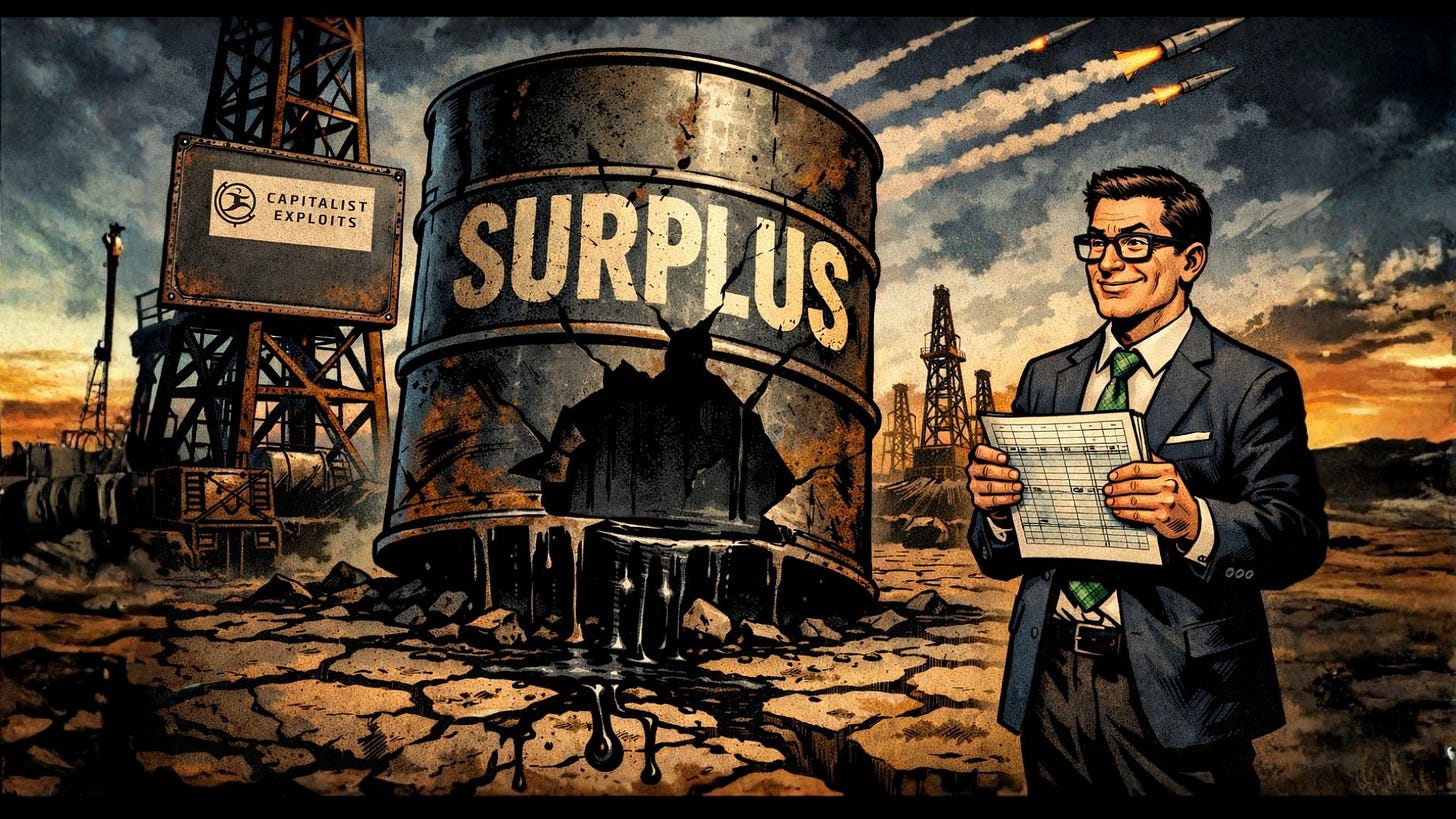
As I write this, the US and Israel have struck Iran. Brent crude closed on Friday around $72. Markets don’t open until Sunday evening.
I suspect Monday morning will be interesting.
But here’s the thing. The Iran strike isn’t the story I want to tell today...not primarily, anyway. It’s the punchline to a story that’s been building for two years. A story about the most aggressively misrepresented market in modern finance. A story about how the world convinced itself that oil was drowning in supply...while the data said something else entirely.
Let’s start there. Then we’ll come back to Iran.
The Surplus That Wasn’t
For the better part of eighteen months, the consensus view on oil has been simple: glut. The IEA said it. Goldman Sachs said it. Bloomberg ran the headlines. Oil is oversupplied. Prices must fall. Producers are toast.
Except the surplus doesn’t actually exist. And I don’t mean that in a vague, contrarian-for-the-sake-of-it way. I mean it in a very specific, accountable, show-your-work way.
Dr. Anas Alhajji...former chief economist at NGP Energy Capital Management, a man who’s been navigating these markets for decades...has been almost alone in pointing this out. And he’s been right. Here’s what the consensus got wrong, specifically.
Error one: the Strategic Petroleum Reserve. US crude production has been rising since early 2025. That part is true. But the US government purchased and locked away more oil in the SPR than all of those production increases combined. That oil is not available to the market. It doesn’t flow to refineries. It doesn’t show up at the pump. It’s locked in salt caverns in Louisiana. When you count it as a surplus, you’re counting something that functionally does not exist in the commercial supply chain. In other words, someone built their bearish model on a spreadsheet error.
Error two: China. Since mid-2025, Chinese inventories built by over 100 million barrels, reaching record highs. The IEA and others counted this as a global surplus. But ask a different question: why is China simultaneously stockpiling oil, natural gas, coal, and building out battery storage at enormous expense? None of those things make sense as commercial decisions. The economics don’t support it. What makes sense...and what the evidence points to clearly...is that China is preparing for either sanctions or war. Every energy item is being treated as a strategic reserve. When you understand that, you stop counting Chinese strategic petroleum stockpiles as commercial supply, just as you wouldn’t count America’s SPR in your balance sheet of available crude. Strip China out, and what remains is largely inventory replenishment from genuinely low levels, not a surplus at all.
Error three: demand forecasting. At the start of 2025, the IEA projected US oil demand would grow by 60,000 barrels per day. The actual number, when revised late in the year, came in at 170,000 barrels per day...and even that was below the actual figure. So the agency that publishes the bearish outlook, and which the financial press treats as gospel, was off on US demand alone by a factor of nearly three. That manufactured demand shortfall fed directly into the manufactured surplus. Shulbit in, shulbit out.
And then, just to top it all off: Kazakhstan. In late 2024 and into 2025, roughly 700,000 to 800,000 barrels per day went offline from the CPC terminal when it was attacked...supposedly by Ukrainian drones, which makes absolutely no sense if you think about it for thirty seconds. Kazakhstan is not Ukraine’s enemy. The primary loser was Chevron (CVX). The sequence of events mirrors what happened in Venezuela, where Chevron was also the main target. Someone was playing hardball. The oil disappeared from the market anyway. Add Brazil’s export declines, and Iraq burning oil domestically after Iranian gas supplies were cut. At peak, the world lost over two million barrels per day in a matter of weeks.
A surplus with no legs. That’s the phrase. And yet the narrative has dominated the tape.


Comments
Log in or sign up to join the conversation.