

“The global upswing in economic activity is strengthening, with global growth projected to rise to 3.6 percent in 2017 and 3.7 percent in 2018. Broad-based upward revisions in the euro area, Japan, emerging Asia, emerging Europe, and Russia more than offset downward revisions for the United States and the United Kingdom. But the recovery is not complete: while the baseline outlook is strengthening, growth remains weak in many countries, and inflation is below target in most advanced economies." (IMF, World Economic Outlook, October 2017)
The acceleration in the global economic growth rate which began in the second half of 2016 has continued into 2017. Consumer and business confidence has grown steadily, global trade is exhibiting stronger momentum, and fiscal retrenchment is over in most advanced countries. At this juncture the global upswing has spread to all the advanced economies.
In other words, the advanced economies in 2017 and 2018 could well post their strongest growth performances in this decade.
While the economic recovery among the G7 economies has been rather similar in many ways, many of the emerging market economies are still struggling. Nonetheless, economic activity in China remains unusually robust, and growth is returning in Russia and Brazil, which faced deep recessions over the last three years.
India’s government recently received a boost from Moody’s, which raised its sovereign bond rating for the first time in 14 years. However, India’s economy has been decelerating for nearly a year because of poorly implemented tax reform and demonetization measures. India’s economy is once again growing slower than China’s.
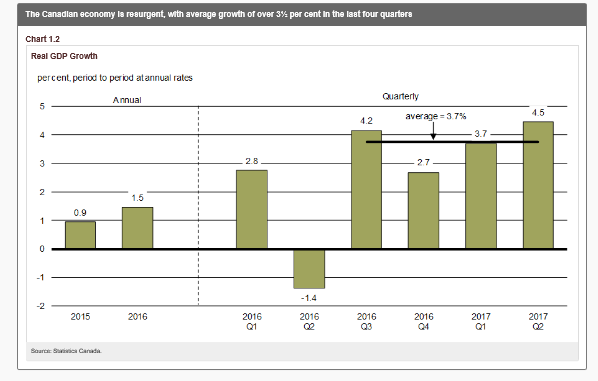
Canada’s relatively strong economic growth performance this year (3.1% estimated growth) is taking place in tandem with the other advanced economies. Indeed, all G7 economies are expanding faster than their estimated trend growth rates.
The current American expansion is the third-longest since World War II and the 3% annual GDP growth rate reported for Q3 is well above the country’s estimated potential growth rate. However, in view of the political shenanigans in Washington, most forecasting organizations have scaled back the size of the expected economic boost from the Trump tax cuts and infrastructure spending programs.
Nonetheless, the U.S. job market has continued to tighten, with the unemployment rate dropping to a 16-year low of 4.1% in October 2017. Moreover, the labour force participation rate has been rising modestly in the tightening job market. The Federal Reserve has already raised interest rates twice this year and has started to gradually reduce the size of its balance sheet.
There still are some common problems facing the advanced economies. At the forefront of these is the fact that virtually everywhere wages continue to be depressed despite stronger economic growth and improvements in the labour markets.
As well, the inflation rate in the advanced countries remains puzzlingly low despite stronger job markets.
Indeed, in the U.S. long-term bond yields have recently declined (i.e. the flattening of the yield curve) even though the Fed has made it abundantly clear that further interest rate hikes are coming.
This suggests that the financial markets are skeptical about the durability of the global economic recovery and the markets are certainly skeptical about inflation moving up to Fed’s 2% target range.
(Click on image to enlarge)
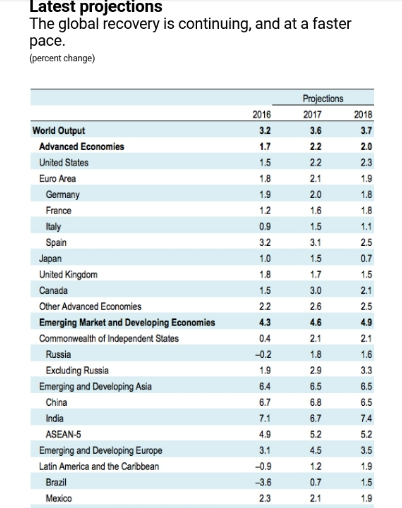
(IMF, World Economic Outlook, October 2017)
The Major World Economies At A Glance: 2016-2018
|
1-Yr%* |
Latest* |
2016 |
2017f |
2018f |
|
|
U.S. |
2.3 |
3.0 Q3 |
1.5 |
2.3 |
2.7 |
|
Japan |
1.7 |
1.4 Q3 |
1.0 |
1.5 |
1.1 |
|
Canada |
3.7 |
4.5 Q2 |
1.5 |
3.1 |
2.5 |
|
Germ. |
2.1 |
2.5 Q2 |
1.9 |
2.0 |
1.7 |
|
India |
5.7 |
4.1 Q2 |
7.1 |
6.7 |
7.1 |
|
China |
6.8 |
7.0 Q3 |
6.7 |
6.7 |
6.5 |
|
U.K. |
1.5 |
1.6 Q3 |
1.8 |
1.5 |
1.2 |
|
Euro 19 |
2.5 |
2.5 Q3 |
1.8 |
2.0 |
1.8 |
|
World |
3.2 |
3.6 |
3.7 |
||
* 12 months and annual % in quarter
Canada’s Economy Has Rebounded Strongly In The Last Twelve Months
(Click on image to enlarge)


Comments
Log in or sign up to join the conversation.