

AstraZeneca (AZN) Shock Drags FTSE Lower as Iran Escalation Keeps Risk Appetite Fragile
London extended Wednesday’s losses on Thursday, with the FTSE 100 drifting lower as healthcare, energy and consumer goods weighed on the index. The downside was limited by strong gains in banks, miners and selected technology-linked names, but the broader tone remained cautious as investors tracked another escalation in the Middle East and its implications for oil, inflation and Bank of England policy. The geopolitical backdrop stayed tense. The U.S. military reportedly struck Iranian targets for a second straight day, with airstrikes hitting about 90 targets across Iran, while Tehran targeted Gulf states. President Donald Trump said the flare-up would “end very quickly", leaving markets to judge whether this is a short tactical escalation designed to force negotiations or the start of a more durable re-escalation.
Oil remained elevated but did not break decisively higher. Brent crude was around $78.37 a barrel, up 0.45% on the day, having recovered after earlier declines from higher levels. That left the market in a difficult position: energy risk is clearly back, but oil has not yet moved far enough to force a full repricing of inflation, rates and earnings. The biggest single-stock drag was AstraZeneca, which tumbled nearly 10% after the company said its nerve-disease drug Wainua failed to meet its target in a late-stage trial to reduce cardiovascular-related deaths. Given AstraZeneca’s heavy weighting in the FTSE 100, the stock’s fall alone was enough to put significant pressure on the benchmark.
The read-across hit parts of healthcare as well. GSK (GSK) fell about 1.1%, and Hikma Pharmaceuticals slipped 0.7%. The sector’s weakness mattered because healthcare is usually one of the FTSE’s defensive anchors. When a heavyweight such as AstraZeneca sells off sharply, the index loses a major stabiliser at exactly the moment investors are already cautious on geopolitics and rates. Consumer and defensive names also weighed. BAE Systems, British American Tobacco, Coca-Cola Europacific Partners, Unilever, Diageo, BP (BP), Croda, Smith & Nephew, Babcock, Reckitt, Compass and Aviva (AV) lost between 1% and 2%. The fall in staples and beverages suggested investors were not simply selling cyclicals; they were reducing exposure across expensive defensives and global quality names after recent strength.
Energy was weaker despite firmer crude, with BP among the decliners. That was notable after the sector had led Tuesday’s gains when Shell (SHEL) raised its gas production outlook, and oil prices jumped on Hormuz concerns. Thursday’s move showed that higher oil is no longer being treated as an unambiguous positive for London. If crude rises because of supply disruption and geopolitical risk, it can support revenues for oil majors, but it can also damage demand, lift inflation expectations and tighten financial conditions. Miners moved the other way. Glencore, Antofagasta and Anglo American gained between 3.1% and 3.7%, while Endeavour Mining, Fresnillo and Rio Tinto (RIO) rose between 1.8% and 2.3%. The sector’s strength helped cushion the index and suggested investors were willing to own globally exposed cyclicals where valuations and commodity sensitivity looked attractive.
Banks were also strong. Standard Chartered climbed 2.7%, while HSBC, Barclays, NatWest (NWG) and Lloyds all moved notably higher. The sector benefited from a combination of higher yields, improved balance-sheet sentiment following the Bank of England’s financial-stability review and expectations that any leverage-framework recalibration could support lending, market-making and gilt intermediation. The bank rally also fits with this week’s broader policy backdrop. The Financial Policy Committee has been reviewing capital and leverage requirements, with the system-wide Tier 1 capital benchmark around 13% of risk-weighted assets. Potential reform to the Additional Leverage Ratio Buffer and Countercyclical Leverage Ratio Buffer could reduce the frequency with which leverage rules bind for banks holding lower-risk assets, particularly as Basel 3.1 lowers average risk weights. That would be modestly supportive for balance-sheet capacity and, at the margin, for gilt demand.
There were also strong moves in technology and growth-linked names. Computacenter jumped nearly 8%, while Polar Capital Technology Trust, Lion Finance, Smiths Group, Admiral, Entain, Rolls-Royce, Halma, Persimmon, Tritax Big Box, Next and Barratt Redrow gained between 1% and 2.3%. Bytes Technology rose about 2% after the software, AI and cloud services provider said trading had been strong in the first four months to 30 June. Bytes’ update was important because it gave a positive micro signal inside a market increasingly cautious about AI. Earlier this week, the Bank of England warned in its Financial Stability Report that leveraged investor exposure to AI-related equities could amplify a future correction if expected productivity gains fail to materialise. That does not mean all AI-linked companies are overvalued, but it does mean markets are now separating firms with actual trading momentum from those driven mainly by speculative positioning.
Housing data were mixed but slightly less negative. The RICS UK Residential Market Survey showed the house-price balance edged up to -33% in June from -34% in May, pointing to only tentative improvement. The three-month house-price expectations index improved to -32% from -44%, while the 12-month outlook turned slightly positive at +8%, implying modest price growth over the coming year. That helped housebuilders avoid deeper weakness, with Persimmon and Barratt Redrow both gaining. Still, the housing recovery remains fragile. Recent data continue to show a rate-sensitive market under pressure: construction PMI remains deeply contractionary, mortgage approvals have weakened, and consumers are still facing elevated borrowing costs. The RICS survey suggests sentiment may be stabilising, but not yet recovering decisively.
The rates debate became more nuanced on Thursday. The market’s knee-jerk reaction to higher oil has been to price higher near-term hiking risk. That is intuitive: higher energy prices raise headline inflation, and the Bank of England has already warned about delayed energy-price pass-through. However, the more important question is whether a sustained oil shock is ultimately hawkish or dovish. The counterintuitive answer may be dovish over time. The UK is a net energy importer with structurally weak productivity, weak capital formation, and already restrictive monetary conditions compared with peers. That makes the economy particularly vulnerable to an energy-induced squeeze in real incomes. In that environment, higher oil can lift inflation in the near term, but damage demand enough to lower the inflation path further out.
An enduring re-escalation in the Middle East may raise short-term inflation anxiety, but it does not automatically justify a hawkish policy response. If the shock is supply-driven and hits demand hard, the case for monetary accommodation strengthens over time. In other words, higher oil may cause a hawkish market reaction today, but it could become a dovish risk for global rates tomorrow. This is especially relevant for the UK because growth momentum is already weak. Services have contracted, construction remains under severe pressure, mortgage demand has softened, and retail indicators are fragile. The economy has less room to absorb an energy shock than the U.S., and any additional squeeze on households could reinforce the slowdown already visible in domestic data.
For equities, the implication is mixed. Energy stocks may benefit from higher crude, but domestically exposed sectors could suffer if higher fuel and utility costs hit households and businesses. Banks may gain from higher yields in the short run, but only while credit quality and loan demand hold up. Housebuilders may benefit from dovish rate expectations further out, but they remain vulnerable if real incomes weaken first. Politics remains another constraint. The incoming Burnham premiership is still expected by markets, but investors continue to focus on the choice of Chancellor and the fiscal framework. Wednesday’s HMRC tax-gap data showed a record £59.2 billion gap between tax owed and tax collected in 2024/25. Better enforcement, especially around VAT, self-assessment income and small-business corporation tax, could provide a less damaging funding route than headline tax rises. But gilt markets will need evidence that any new fiscal plan is credible.
Finish Line: The FTSE 100 slipped again as AstraZeneca’s near-10% fall after a failed Wainua trial dragged heavily on the index, while consumer defensives and parts of healthcare weakened. Banks, miners, Computacenter and AI/cloud-linked Bytes helped limit the damage, and tentative RICS housing data supported selected housebuilders. But the bigger story remains macro: renewed U.S.-Iran escalation has lifted oil and kept markets cautious. In the near term, that raises inflation and rate hike fears. Over time, however, a sustained energy shock may be dovish for the UK because it squeezes real incomes and weakens demand more than it embeds inflation. For now, London remains caught between headline-driven oil risk, fragile domestic growth, and a Bank of England that cannot yet sound dovish even as the case for future accommodation slowly builds.
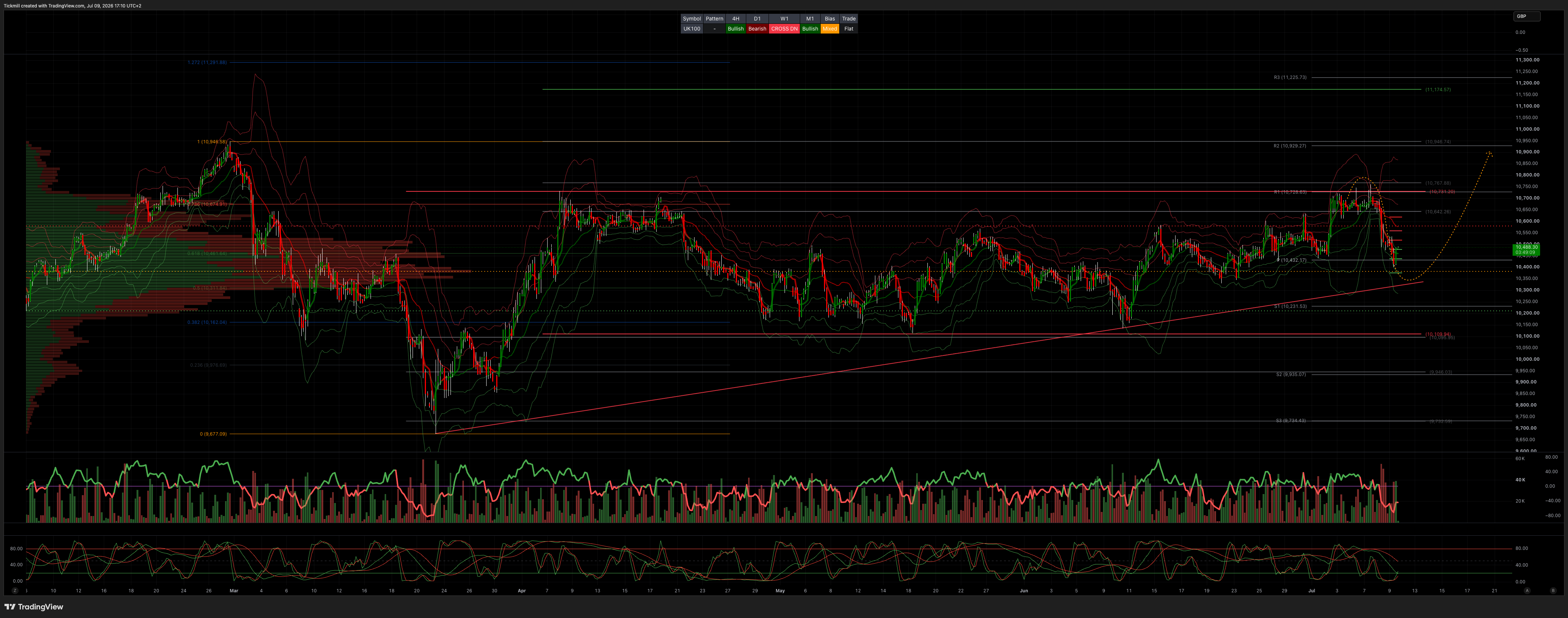
TECHNICAL & TRADE VIEW – FTSE100
Daily VWAP Bearish
Weekly VWAP Bullish>Bearish
Above 10300 Target 11000
Below 10100 Target 9469

Comments
Log in or sign up to join the conversation.